Top Tech Trends of 2026: AI, Cloud Sovereignty, and the New Enterprise Architecture
This article explains the five technology trends shaping 2026 and the deeper

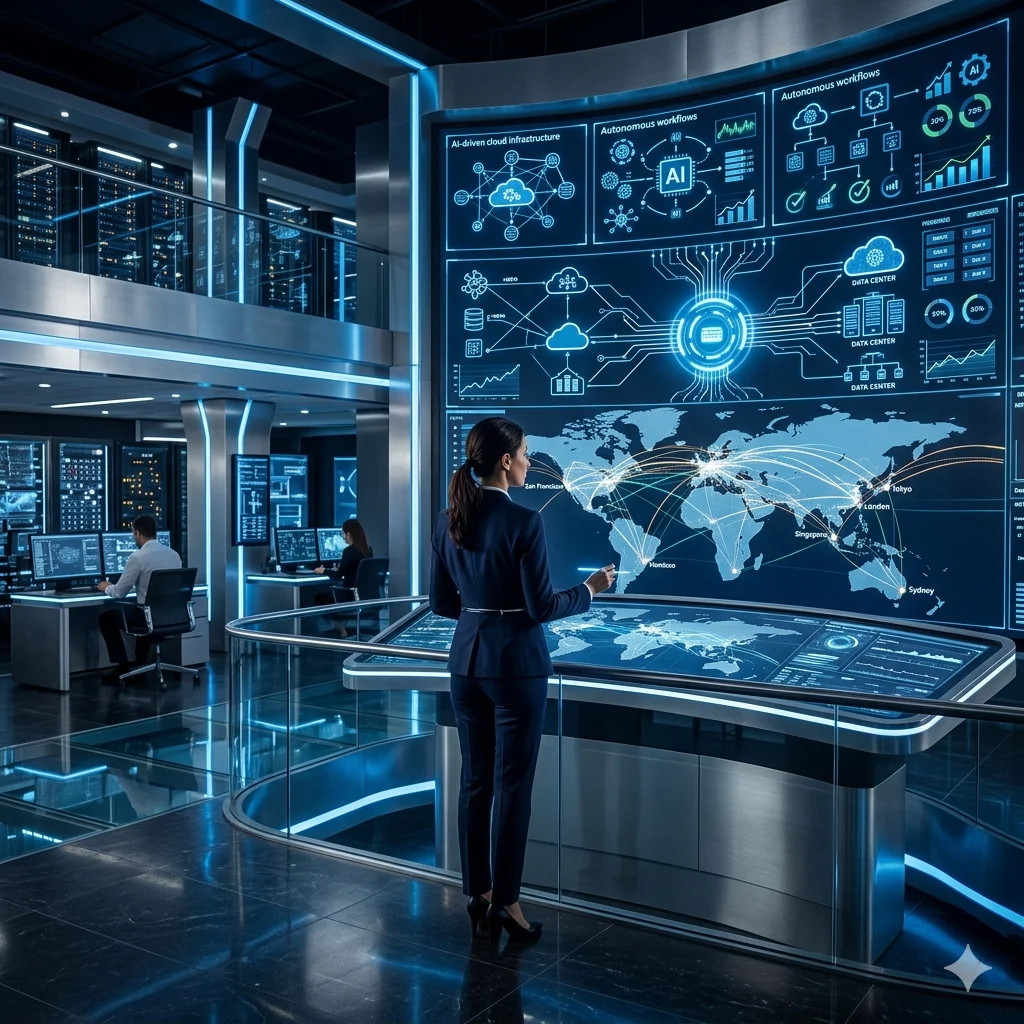
Top Tech Trends of 2026: AI, Cloud Sovereignty, and the New Enterprise Architecture
Executive Take: 2026 as the Year Enterprise Tech Reorganizes Around AI
The Capgemini report on technology innovation trends for 2026 is best read as a strategic indicator rather than a simple trend roundup. Its value lies in what it suggests about how enterprises are reorganizing digital operations around AI, cloud, software delivery, and sovereignty. In that sense, 2026 looks less like the next step in incremental digitization and more like a year in which enterprise architecture is being redefined.
The common thread across the report’s themes is that technology is moving from being a set of tools to becoming the operating system for business execution. AI is no longer confined to pilots or isolated copilots. Cloud is no longer a single vendor decision. Software development is no longer only about writing code faster. And sovereignty is no longer just a legal question; it is increasingly part of enterprise design.
[IMAGE: A CEO-style strategic overview of interconnected AI, cloud, and operations nodes.]
Why This Is a Slow-Analysis Story, Not a Fast-News Story
This kind of report is useful precisely because it is not breaking news. It is a synthesis of structural changes that have been building for several years. Capgemini’s intended audience is clearly enterprise leadership—CEOs, CIOs, CTOs, and operations executives—which means the implications extend beyond IT departments and into business model decisions, vendor strategy, risk management, and workforce design.
That also means the right way to read the report is to verify its themes against wider industry evidence. The analysis below first follows the report’s framing, then cross-checks it against broader enterprise patterns seen across cloud, AI, and software engineering. The goal is not to treat any one report as final truth, but to use it as a lens for understanding where enterprise technology is heading.
[IMAGE: A research desk with reports, charts, and a laptop showing enterprise trend analysis.]
The Hidden Economic Logic: From Digitization to Resilient Interdependence
The most important economic idea in the report is not simply innovation. It is dependency redesign. Modern enterprises depend on clouds, model providers, API ecosystems, data suppliers, and regional infrastructure. What changes in 2026 is that those dependencies are becoming more visible, more regulated, and more strategically important.
Capgemini’s language around resilient interdependence is useful here. The phrase suggests that the goal is not isolation. Instead, enterprises are trying to build controlled dependence: enough openness to access scale and innovation, but enough diversification and governance to reduce concentration risk. That matters for cloud sovereignty, AI model choice, and software supply chains.
In practice, this shifts the business question from “Which platform is cheapest?” to “Which platform mix gives us continuity, compliance, and bargaining power?” For banks, manufacturers, healthcare providers, and public-sector suppliers, that is a material change. It affects where workloads run, where data is stored, how model outputs are validated, and how quickly a company can switch providers if terms, regulations, or performance change.
[IMAGE: A network map connecting regions, clouds, and enterprise nodes with secure links.]
Trend One: AI Becomes the Backbone of Enterprise Architecture
The report’s first major signal is that AI is moving from experimentation into enterprise infrastructure. That distinction matters. A pilot project can be useful even if it remains isolated. Infrastructure, by contrast, has to be governed, monitored, integrated, and maintained at scale.
For enterprises, this means AI is increasingly embedded in core functions such as customer support, document processing, forecasting, fraud detection, developer productivity, and operational decision support. The trend is not just about more AI features. It is about AI becoming part of architecture: identity, permissions, auditability, data pipelines, and model oversight all become design questions.
This is where the risk profile changes. A chatbot demo can fail without much consequence. But if AI is used to route claims, approve invoices, recommend inventory actions, or generate production code, then model accuracy, traceability, and escalation logic become business-critical. Gartner, McKinsey, and other industry analysts have repeatedly pointed out that adoption alone is not enough; governance and operating discipline determine whether AI creates durable value.
A practical example is customer service. Early deployments often reduce handling time, but enterprises quickly discover tradeoffs: hallucinated responses, inconsistent tone, weak handoffs to humans, and compliance concerns. The result is not a simple replacement of agents, but a redesign of workflows. That is why AI enterprise architecture is now a board-level topic rather than an innovation lab topic.
Trend Two: Software Development Shifts from Writing Code to Expressing Intent
The report also reflects a broader shift in software delivery: developers increasingly specify what they want, while AI systems generate code, tests, documentation, and workflow suggestions. In other words, software development is moving from manual construction toward intent-based orchestration.
This does not eliminate engineering work. It changes where the effort goes. More time is spent on requirements clarity, prompt design, code review, validation, and policy enforcement. The bottleneck shifts from typing code to defining outcomes and checking whether generated output is correct, secure, and maintainable.
The enterprise implication is significant. As AI-assisted delivery becomes normal, software supply chains will depend more heavily on model quality, prompt governance, and approval layers. That introduces new failure modes: insecure generated code, hidden dependencies, inconsistent test coverage, or overreliance on a single model vendor. For regulated industries, that means the software pipeline itself becomes part of compliance and risk management.
At the same time, the productivity upside is real. Teams can move faster on boilerplate work, legacy modernization, and internal tooling. But the companies that gain the most are likely to be those that pair AI assistance with strong architectural standards, not those that simply maximize output volume.
[IMAGE: A developer workspace showing code generation, review, testing, and AI-assisted workflow steps.]
Trend Three: Cloud Sovereignty Becomes an Operating Model
Cloud sovereignty is often discussed as a compliance issue, but the report’s implications are broader than data residency alone. By 2026, sovereign cloud decisions are increasingly about operating model design: where data lives, who can access it, how workloads move, and what kind of dependency a company is willing to accept.
This is especially relevant in industries that handle sensitive data or cross-border operations. Financial services, healthcare, government contractors, and critical infrastructure operators face growing pressure to control data location, encryption, support access, and jurisdictional exposure. But even companies outside those sectors are rethinking cloud concentration because of resilience, cost predictability, and vendor lock-in.
The practical response is often hybrid rather than absolutist. Enterprises are mixing public cloud, private cloud, regional providers, and on-premises systems depending on workload sensitivity. That creates management complexity, but it also improves optionality. In that sense, cloud sovereignty is not the opposite of cloud adoption. It is a more mature way of using cloud.
The tradeoff is clear: sovereignty can increase cost and slow deployment if implemented poorly. It may also reduce access to the newest managed services. Still, for many organizations, the ability to control exposure outweighs the convenience of a fully centralized platform.
Trend Four: Intelligent Operations Move From Automation to Autonomy
The next step after digital process automation is not just more automation. It is intelligent operations: systems that monitor, learn, recommend, and in some cases act with limited human intervention.
This is already visible in IT operations, supply chain planning, fraud monitoring, and infrastructure management. AIOps tools detect anomalies, predict incidents, and suggest remediation. In advanced settings, they can trigger automated responses under approved policy rules. Over time, the aim is to reduce manual firefighting and create continuously learning operations.
But autonomy is not free. The more an enterprise allows systems to act on their own, the more important it becomes to define boundaries, audit trails, and override mechanisms. If an AI-driven workflow reroutes resources incorrectly, the cost can spread quickly across finance, operations, and customer experience.
That is why mature enterprises are adopting a “human-on-the-loop” approach rather than full handoff. The best results usually come from systems that handle detection and recommendation well, while people retain control over exceptions, escalation, and high-stakes decisions.
[IMAGE: An autonomous operations dashboard showing alerts, predictions, and controlled response workflows.]
Trend Five: Governance, Security, and Trust Become Product Features
A final implication across the report is that governance is no longer a back-office concern. In AI, cloud, and software delivery alike, trust is becoming part of product design.
Enterprises now need to know not only what a system does, but how it was trained, where the data came from, which controls are in place, and how decisions can be reviewed. This is especially relevant when AI outputs affect customers, employees, or regulated transactions. Security, privacy, explainability, and auditability are now competitive requirements, not just technical safeguards.
For vendors, that changes the sales conversation. Buyers increasingly ask for model documentation, data lineage, residency options, fallback plans, and incident response commitments. For enterprise leaders, it changes talent requirements as well. Architecture teams now need people who understand data governance, policy automation, and cloud economics, not just infrastructure and coding.
What Enterprise Leaders Should Watch in 2026
The report’s themes point to several practical questions:
- Which AI use cases are mature enough to become part of core operations?
- Where does intent-based software delivery improve speed without weakening security?
- Which workloads require sovereign or hybrid cloud treatment?
- How much concentration risk is acceptable across models, clouds, and service providers?
- What governance layer is needed to make intelligent operations safe and auditable?
These are not abstract questions. They shape cost structure, resilience, vendor leverage, and regulatory readiness. They also determine whether an enterprise can adapt as technology ecosystems become more distributed and interdependent.
Conclusion: The New Enterprise Architecture Is Built on Managed Dependence
The clearest takeaway from the 2026 technology innovation trends is that enterprise technology is being reorganized around managed dependence rather than simple scale. AI is becoming an infrastructure layer. Software delivery is shifting toward intent and validation. Cloud is moving into hybrid and sovereign operating models. Intelligent operations are reducing manual control while increasing the need for governance.
The companies that perform best will not necessarily be the ones that adopt every new tool first. They will be the ones that design for resilience, flexibility, and oversight across their technology stack. In that sense, the emerging advantage is not independence. It is the ability to manage interdependence well.
That is the architecture challenge of 2026.
(All rights reserved by Global Beacon Chronicle. Unauthorized reproduction is prohibited.)
Li Ming / Li Ming
Tech columnist and visiting scholar at MIT.