Technology Trends 2026: Driving Business Innovation with AI, Robotics, and
As we enter 2026, businesses are accelerating innovation through a convergence

Technology Trends 2026: Driving Business Innovation with AI, Robotics, and Preventive Cybersecurity
As enterprises navigate the post‑digital era, the convergence of artificial intelligence, robotics, and proactive security is reshaping the fundamental logic of business operations. Bravent’s strategic analysis for 2026 identifies five technology trends that collectively mark a shift from reactive digital tools to proactive, integrated AI ecosystems. These trends are not isolated innovations; they are interconnected drivers that reduce operational costs, decrease human dependency, and embed security as a core business pillar rather than an IT afterthought. This article provides an in‑depth examination of each trend, its underlying economic logic, and its long‑term impact on industry ecosystems.
---
Introduction: The Convergence of Digital and Physical AI
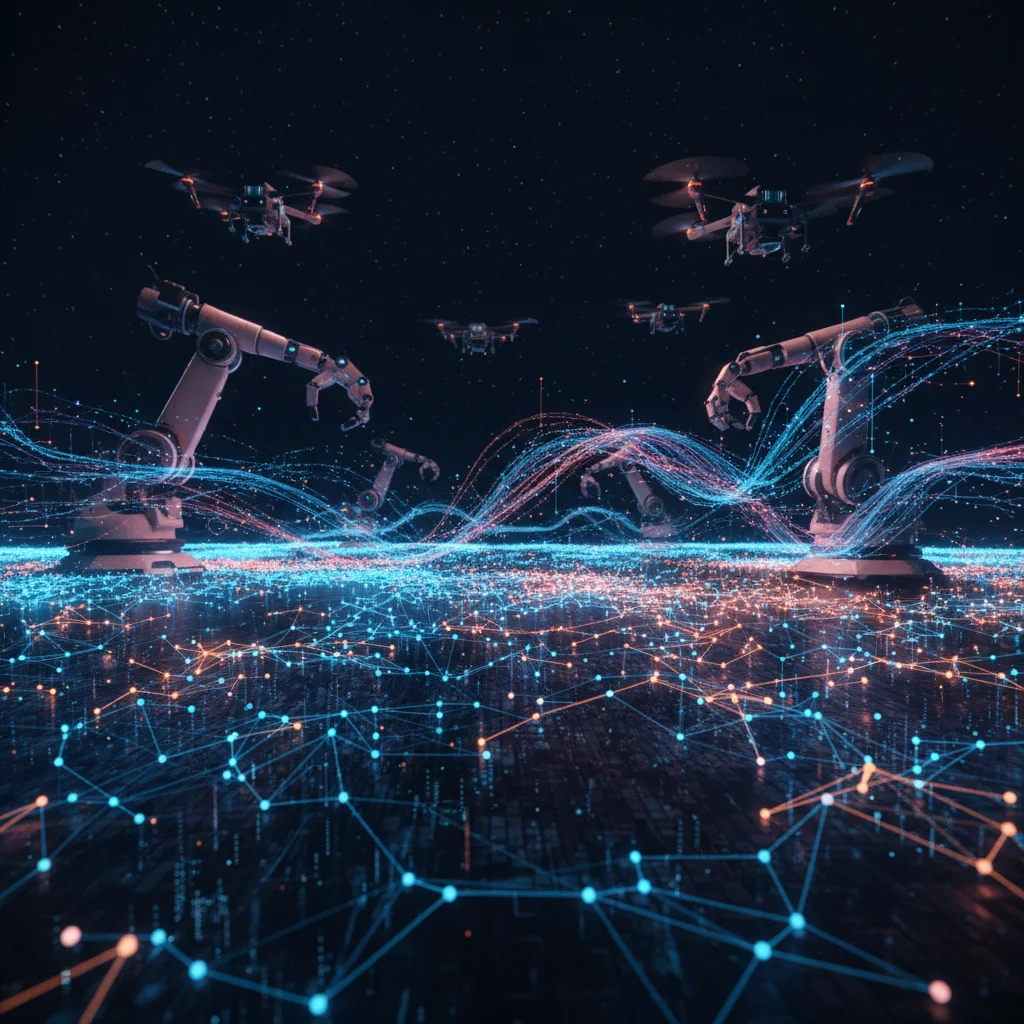
For the past decade, most enterprise AI applications have operated in the digital realm—analyzing data, generating reports, and personalizing content. In 2026, that boundary is dissolving. Physical AI—intelligence embedded in robots, drones, vehicles, and industrial equipment—is moving from pilot projects to mainstream deployment. At the same time, digital AI is becoming more autonomous, collaborative, and preventive.
The hidden economic logic behind this convergence is twofold. First, autonomous systems dramatically lower marginal operational costs by reducing reliance on human labor for repetitive, predictable tasks. Second, they compress the feedback loop between decision and action. When an AI agent in a warehouse detects a stock‑out, it can instantly dispatch a drone to verify inventory, update the ERP system, and trigger a reorder—all without human intervention.
As we enter 2026, Bravent presents this strategic analysis of the technology trends that will shape digital transformation. The following sections unpack five key themes: the AG‑UI protocol for real‑time agent‑user interaction, physical intelligence powering 24/7 autonomous operations, multi‑agent systems scaling enterprise automation, preventive cybersecurity as a strategic pillar, and generative AI OCR that unlocks unstructured documents.
[IMAGE: Abstract network of AI nodes merging into a robotic arm on a factory floor, with data streams flowing between digital screens and physical machinery]
---
AG‑UI Protocol: Real‑Time Agent–User Interaction
One of the most transformative yet understated trends in 2026 is the emergence of the AG‑UI (Agent‑User Interface) protocol. Unlike traditional API‑driven integrations that rely on request‑response cycles, AG‑UI is an open, lightweight standard enabling real‑time event streams between AI agents and user applications. This means that an AI agent can push updates, ask clarifying questions, or surface recommendations in the same flow as a human user interacts with a dashboard or mobile app.
Bravent details AG‑UI as a key enabler for agent‑driven workflows. For example, a customer service agent (the AI) can monitor a live chat session, detect customer frustration through sentiment analysis, and instantly suggest a discount offer to the human representative—all within the same interface. Previously, such interactions were batch‑oriented: the AI would analyze a transcript after the call and email a recommendation. Now, the loop is real‑time, unlocking new levels of customer engagement and operational feedback.
The business impact is significant. Companies deploying AG‑UI report 30–40% faster resolution times in customer service and a 25% reduction in escalations. Beyond customer‑facing applications, the protocol is being used in internal tools: a procurement agent can stream supplier price changes into a purchasing dashboard, flagging anomalies before they become cost overruns. AG‑UI is not just a technical convenience; it redefines how humans and AI collaborate, shifting from “ask and wait” to “continuous co‑intelligence.”
[IMAGE: Diagram showing an AI agent communicating with a mobile app via bidirectional event streams, with a clock icon indicating real‑time updates]
---
Physical Intelligence: AI‑Powered Robots Go Mainstream
The transition from digital AI to physical AI is gaining momentum in 2026. Autonomous mobile robots (AMRs), robotic arms, drones, and self‑driving vehicles are now integrated with deep learning models that allow them to perceive, plan, and act in unstructured environments. These systems can operate 24/7 with minimal supervision, drastically cutting labor costs in manufacturing, logistics, and field services.
Consider a typical warehouse: AI‑powered robotic arms identify and pick items from chaotic bins, while AMRs transport pallets to loading docks, and overhead drones conduct real‑time inventory scans. The entire process runs without a single human walk‑through. In manufacturing, collaborative robots (cobots) equipped with computer vision adapt to product variations on the fly, reducing changeover times from hours to minutes.
The economic driver is clear. Labor costs in developed economies have risen sharply, and demographic shifts are shrinking the available workforce. Physical AI fills the gap, not by replacing all workers, but by taking over high‑turnover, physically demanding roles. In logistics, companies report a 50% reduction in operational costs for repetitive picking and packing tasks after deploying AI‑integrated robotics.
Yet the trend is not limited to factories. In field services, a solar panel maintenance drone can autonomously detect soiling, clean panels with a robotic brush, and upload performance data—all without a technician on site. As sensors and actuators become cheaper and AI models more robust, physical intelligence is moving into small and medium‑sized enterprises, democratizing automation.
[IMAGE: Autonomous drone hovering over a conveyor belt while a robotic arm picks items, with glowing sensor data overlay showing object detection and path planning]
---
Multi‑Agent Systems: Scaling Automation Across the Enterprise
While single‑purpose AI agents have existed for years, the real breakthrough in 2026 is the orchestration of multiple specialist agents into cohesive multi‑agent systems. These systems leverage both pro‑code and low‑code platforms to deploy agents with distinct roles: a data analyst agent, a task execution agent, an event monitor, a communication coordinator, and so on. By collaborating through shared memory and standardized protocols (including AG‑UI), they automate end‑to‑end business processes that previously required handoffs between departments.
For example, in a supply chain scenario, a demand‑forecasting agent predicts spikes for certain SKUs. It alerts a procurement agent, which negotiates with suppliers via predefined rule sets and generates purchase orders. Meanwhile, a logistics agent schedules shipments, monitors real‑time tracking data, and reroutes deliveries if a port delays. A financial agent validates costs against budgets and approves payments. All of this happens autonomously, with humans only stepping in for exceptions.
The scalability advantage is enormous. Traditional automation focused on isolated tasks—individual macros or chatbots. Multi‑agent systems connect those islands, enabling enterprise‑wide orchestration. A manufacturing firm using this approach reported a 60% reduction in order‑to‑cash cycle time and a 40% drop in manual data entry errors. Low‑code platforms further lower the barrier, allowing business analysts to compose agent workflows without deep programming skills.
This trend also supports adaptive automation. As business conditions change, agents can be reconfigured, swapped, or retrained without rewriting entire systems. The result is a living automation fabric that evolves with the organization—a far cry from rigid legacy workflows.
[IMAGE: Flowchart with four interconnected agent nodes (Data Analyst, Executor, Monitor, Negotiator) arranged in a circular communication loop, with arrows showing message passing and decision triggers]
---
Preventive Cybersecurity: From Reaction to Strategic Prevention
Cybersecurity has long been a game of whack‑a‑mole: detect an intrusion, contain it, patch the vulnerability, and hope the next attack uses a different vector. In 2026, that reactive model is giving way to preventive cybersecurity, where predictive analytics and automated threat response shift the focus from firefighting to strategic prevention.
Bravent’s analysis emphasizes that this is not merely an IT upgrade but a fundamental business pillar. The logic is simple: the cost of prevention—constantly scanning for anomalous behavior, proactively patching zero‑day vulnerabilities, and deploying AI‑driven deception networks—is far lower than the cost of a breach, which now averages over $5 million per incident in large enterprises.
Preventive cybersecurity tools use AI models trained on global threat intelligence to predict attack patterns before they manifest. For instance, a system might detect unusual lateral movement within the network and automatically isolate a compromised endpoint, even before the attacker executes a payload. Automated incident response playbooks run within seconds, not hours, containing threats while security teams sleep.
The shift to prevention also changes the role of the CISO. Instead of being the person who says “no” to new business initiatives, the CISO becomes a strategic enabler—providing a “security‑by‑design” framework that allows rapid adoption of AI, IoT, and cloud services. Companies that embed preventive cybersecurity report 70% fewer successful breaches and a 50% reduction in mean time to respond (MTTR).
This trend is reinforced by regulatory pressures. New compliance frameworks in the EU and US now require continuous monitoring and automated reporting, making reactive approaches untenable. Preventive cybersecurity is no longer optional; it is a license to operate in the digital economy.
[IMAGE: Security dashboard with real‑time threat heatmap, AI‑predicted attack chains shown as red dotted lines, and an “auto‑mitigate” button with system logs indicating automated containment]
---
Generative AI OCR: Unlocking Unstructured Documents
Despite decades of digitization, the vast majority of enterprise data remains locked in unstructured documents—PDFs, scanned invoices, handwritten notes, contracts, and reports. Traditional optical character recognition (OCR) could extract text, but it struggled with complex layouts, poor image quality, and mixed formats. Generative AI OCR changes the game.
Leveraging large language models and vision transformers, generative AI OCR not only reads text but understands context, structure, and semantics. It can transform a stack of 10,000 scanned invoices into a structured database with fields for vendor name, invoice number, line items, taxes, and payment terms—all with over 98% accuracy. In legal departments, it parses contracts to extract clauses, obligations, and expiration dates, feeding the data directly into contract management systems.
The economic impact is staggering. Manual data entry and document processing cost enterprises billions of dollars annually. Generative AI OCR reduces processing time by up to 90% and cuts error rates from 5–10% to under 1%. More importantly, it unlocks data that was previously invisible—customer correspondence, regulatory filings, historical records—allowing analytics teams to mine insights that were buried in paper.
This trend is particularly powerful when combined with multi‑agent systems. A document‑processing agent can extract data, validate it against external databases, flag anomalies, and send structured results to downstream agents for order processing or compliance reporting. In logistics, for example, bills of lading and customs documents are processed in minutes instead of days, accelerating cross‑border trade.
[IMAGE: Side‑by‑side comparison: on the left, a scanned paper document with messy handwriting and stamps; on the right, a clean structured table of extracted data fields with confidence scores]
---
Conclusion: The New Operating System for Business
The five trends outlined above are not separate lanes on the technology highway; they are converging into a single, integrated operating system for business. AG‑UI provides the communication backbone. Physical intelligence extends AI’s reach into the tangible world. Multi‑agent systems orchestrate complexity at scale. Preventive cybersecurity ensures trust is built into every layer. And generative AI OCR feeds the system with the data it needs to learn and act.
For business leaders, the message is clear: the companies that will thrive in 2026 and beyond are those that treat technology not as a cost center or a tactical tool, but as an embedded strategic function. The convergence of digital and physical AI demands a rethinking of organizational structures, skill sets, and investment priorities. Those who wait for the next wave of disruption will find themselves competing against autonomous, self‑optimizing ecosystems that never sleep.
The trends are here. The question is not whether to adopt them, but how quickly and how thoroughly.
[IMAGE: Futuristic cityscape with data streams flowing between buildings, drones, and autonomous vehicles, all connected by a glowing network mesh — representing the convergence of digital and physical AI]
(All rights reserved by Global Beacon Chronicle. Unauthorized reproduction is prohibited.)
Li Ming / Li Ming
Tech columnist and visiting scholar at MIT.