From Chatbots to Autonomous Agents: How LLMs Are Reshaping Information Systems
The rapid evolution of large language models (LLMs) from simple chatbots

From Chatbots to Autonomous Agents: How LLMs Are Reshaping Information Systems Management
When ChatGPT burst onto the scene in late 2022, most enterprises treated it as a curiosity—a clever chatbot capable of generating poetry and answering trivia. Three years later, the landscape looks fundamentally different. By 2025, large language models have evolved into multimodal, reasoning-enabled engines that process text, images, audio, and video simultaneously. GPT-5, Gemini 3, and Claude 4.5 now handle complex enterprise workflows, while open-weight alternatives like Meta’s Llama give organizations unprecedented control over data privacy. This transformation is not merely an incremental upgrade to existing tools; it represents a structural shift in how information systems are designed, managed, and governed.
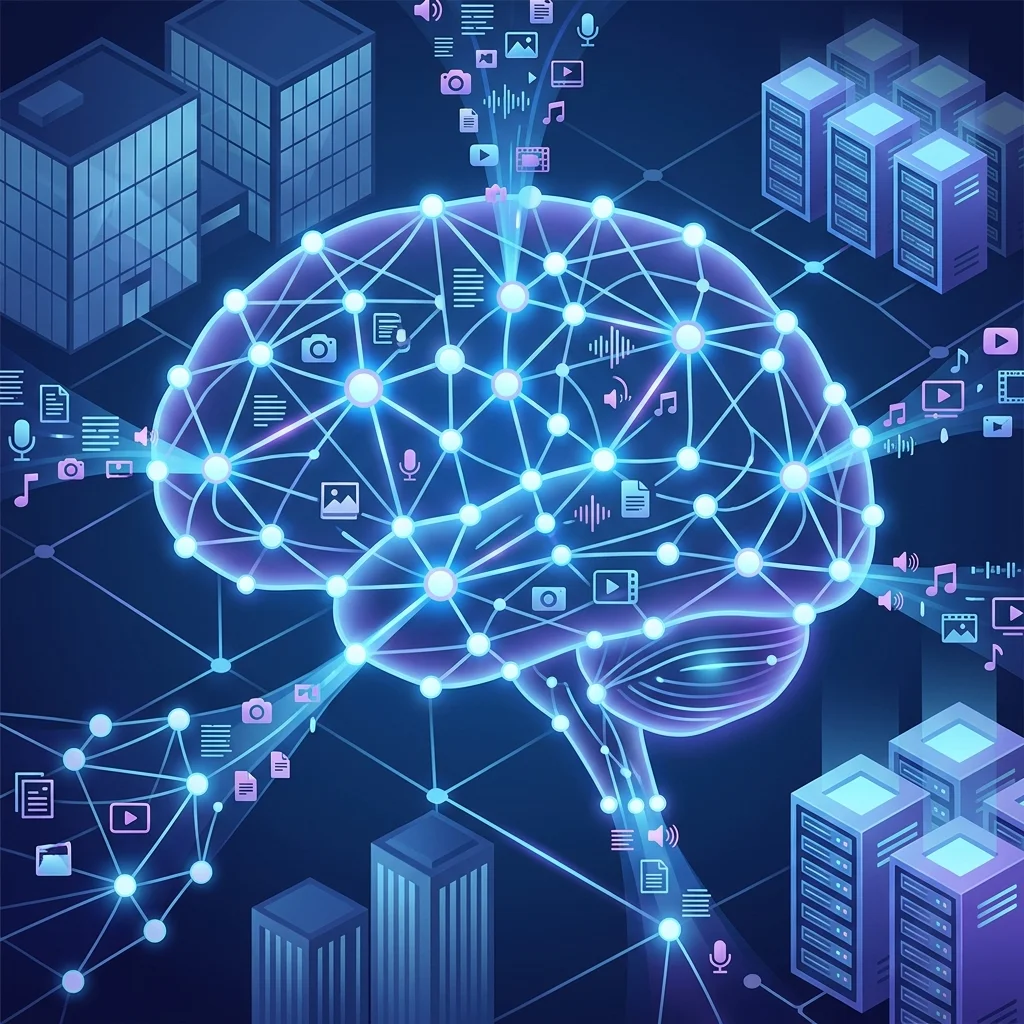
[IMAGE: A futuristic digital illustration of a network of interconnected glowing nodes forming the shape of a human brain, with streams of data (text, images, audio, video symbols) flowing into and out of the nodes. Subtle corporate silhouettes and server racks in the background. Blue and purple tones with bright accents.]
The New Infrastructure Layer: LLMs as Cognitive Engines
The most significant development in the 2022–2025 period is the maturation of LLMs from experimental novelties into a foundational layer of enterprise information architecture. Just as databases and cloud computing became indispensable infrastructure in earlier decades, LLMs are now positioned as cognitive engines that power everything from internal knowledge retrieval to customer-facing applications.
Multimodality and Reasoning
The leap from text-only models to natively multimodal systems has been transformative. GPT-5 can analyze a chart in a PDF, listen to a customer call recording, and read a product image—all within a single reasoning session. Google’s Gemini 3 processes video streams in real time, enabling applications such as automated quality inspection in manufacturing. Claude 4.5, with its emphasis on safety and long-context understanding, has become a favorite in legal and compliance departments.
Equally critical is the emergence of reasoning models. OpenAI’s o-series and DeepSeek-R1 employ chain-of-thought processing, breaking complex queries into step-by-step logical sequences. For enterprise decision-making, this means fewer hallucinations and more consistent outputs—a prerequisite for tasks like financial forecasting, contract analysis, and code auditing.
Long Context Windows: A Game Changer for Knowledge Management
The expansion of context windows to up to 2 million tokens (for models like Gemini 1.5 Pro) allows organizations to feed entire company documentation—thousands of pages of policy manuals, technical specifications, and historical project logs—into a single prompt. This capability effectively turns the LLM into an omniscient digital librarian. Employees no longer need to search multiple databases; they can ask natural-language questions and receive synthesized answers grounded in proprietary knowledge.
Companies such as Thomson Reuters have already deployed long-context LLMs to assist legal researchers, processing entire case law libraries in seconds. The implications for knowledge management are profound: traditional document retrieval systems are being supplemented—or replaced—by AI-powered semantic search and summarization.
[IMAGE: An infographic timeline showing key LLM milestones from 2022 to 2025, with icons for multimodality (text/image/audio), reasoning (chain-of-thought), and context length (2M tokens). Timeline includes ChatGPT, GPT-4, Gemini, Claude 3, Llama 3, o-series, DeepSeek-R1.]
Business Applications: Hyper-Personalization, Autonomous Agents, and Code Generation
The theoretical capabilities of LLMs translate into concrete business value across three major domains: personalization at scale, autonomous task execution, and accelerated software development.
Hyper-Personalization Beyond Recommendation Engines
Amazon and Netflix have long used machine learning for recommendation systems. But LLMs enable a step change in personalization by generating real-time content tailored to individual user context. For example, Amazon can now dynamically rewrite product descriptions based on a customer’s browsing history, purchase patterns, and even sentiment from customer service interactions. Netflix’s generative AI creates personalized trailers and synopses that adapt to the viewer’s taste profile.
This goes beyond simple collaborative filtering. LLMs understand nuance—a user who previously watched French New Wave films might receive a recommendation for a lesser-known Italian neorealist classic, along with a short paragraph explaining why it aligns with their interests. The result is higher engagement and conversion rates, as evidenced by early adopters in e-commerce and media.
Autonomous AI Agents: The 24/7 Digital Workforce
The rise of autonomous agents marks a pivotal shift. Unlike chatbots that respond to queries, agents can initiate actions: researching a market, drafting a proposal, scheduling meetings, or updating CRM records. Companies like Salesforce and ServiceNow have embedded agent frameworks into their platforms, allowing users to define goals and let the LLM execute multi-step plans.
For instance, a sales agent could be tasked with “find all leads that expressed interest in our cybersecurity product in the last 30 days, summarize their key pain points from call transcripts, and draft a personalized follow-up email.” The agent breaks this into sub-tasks, queries the database, processes audio recordings via speech-to-text, and generates the email—all without human intervention.
This capability is particularly valuable in knowledge-intensive roles. McKinsey estimates that AI agents could automate up to 30% of current work hours in professional services by 2027. In practice, firms like PwC are already using agents to prepare audit documentation, reducing manual review time by 40%.
Code Generation: Lowering Barriers, Accelerating Cycles
GitHub Copilot and Cursor have become indispensable tools for developers. Powered by models like OpenAI’s Codex and Claude, these assistants now write the majority of boilerplate code—e.g., API wrappers, database queries, and unit tests—allowing engineers to focus on architecture and business logic.
More striking is the emergence of “low-code” programming through natural language. Non-programmers can describe a data analysis task in plain English and receive a working Python script. BloombergGPT, a model fine-tuned on financial data, generates regulatory compliance code for banks. Specialized medical LLMs, trained on clinical data, draft discharge summaries in formats compliant with hospital standards.
[IMAGE: A diagram of an AI agent workflow: input from emails/documents → LLM reasoning (chain-of-thought) → output actions (draft reply, summarize, schedule). Logos of Amazon, Netflix, GitHub in the background. Arrows show data flow.]
The Strategic Race: Proprietary vs. Open-Weight Models and Data Privacy
The competitive landscape of LLMs is defined by a fundamental tension: proprietary models offer cutting-edge performance and managed infrastructure, while open-weight models provide data sovereignty and customization. For enterprise information systems managers, this decision is strategic.
Proprietary Leaders: Scale and Convenience
OpenAI’s GPT-5, Google’s Gemini 3, and Anthropic’s Claude 4.5 compete on benchmark scores, multimodal capabilities, and ecosystem integration. These models are accessed via API, offering instant scale and regular updates without in-house AI infrastructure costs. For organizations that handle non-sensitive data and prioritize time-to-market, cloud-based proprietary models remain the default choice.
Open-Weights: Privacy and Customization
Meta’s Llama series (now at Llama 3.1 with 405 billion parameters) has democratized access to state-of-the-art performance. Open-weight models can be downloaded and hosted on private servers—critical for regulated industries such as healthcare, finance, and defense. European banks, for example, are fine-tuning Llama on their own transaction data to build anti-fraud systems without ever sending customer information to external APIs.
The open-weight movement also enables fine-tuning for domain-specific tasks. A medical institution can train Llama on years of anonymized patient records to create a diagnostic support tool that outperforms generic models. This creates competitive moats: the more proprietary data a company feeds into its fine-tuned model, the harder it is for competitors to replicate.
The Hybrid Middle Ground
Many enterprises are adopting a hybrid strategy: using proprietary models for commodity tasks (e.g., general Q&A, email drafting) and open-weight models for sensitive or specialized workloads. Amazon Web Services’ Bedrock and Google Cloud’s Vertex AI now offer both options, allowing customers to switch between model families depending on the task’s privacy requirements.
[IMAGE: A comparison table showing proprietary (OpenAI, Google, Anthropic) vs. open-weight (Llama, Mistral, DeepSeek) models. Columns: performance, cost, data privacy, customization, ecosystem. Highlighting enterprise use cases like finance (BloombergGPT) and healthcare.]
Implications for Governance, Talent, and Information Architecture
As LLMs become embedded in information systems management, organizations must confront three critical challenges: governance of AI decisions, talent strategy for an agent-augmented workforce, and redesign of information architecture.
Governance and Ethical Oversight
When AI agents autonomously draft contracts, approve transactions, or triage customer complaints, who is liable for errors? Regulators are moving quickly. The EU AI Act, effective in 2025, classifies high-risk AI systems and mandates human oversight for automated decision-making that affects individuals’ rights. Enterprises must implement audit trails for agent actions, maintain “human-in-the-loop” checkpoints for critical processes, and ensure models are tested for bias and reliability.
A practical step is to deploy agent orchestration frameworks (e.g., LangGraph, Autogen) that log every reasoning step and allow managers to review decisions retroactively. Companies like JPMorgan Chase have established internal AI ethics boards to approve model deployments.
Talent Strategy: From Coders to Prompt Engineers
The skill set required to manage information systems is evolving. Routine cognitive tasks—data entry, report generation, basic coding—are increasingly handled by AI agents. This frees human workers to focus on higher-order activities: problem framing, creative strategy, stakeholder management, and ethical oversight.
Demand is surging for “prompt engineers” and “AI operations” specialists who can design effective agent workflows, evaluate model outputs, and fine-tune open-weight models. A recent LinkedIn analysis shows a 650% increase in job postings requiring LLM expertise since 2023. Traditional IT roles are absorbing new responsibilities; database administrators now need to understand vector databases, and security analysts must assess prompt injection risks.
Information Architecture for the LLM Era
Legacy information systems were built for human consumption: structured databases, folder hierarchies, and keyword search. LLMs require a different foundation. Vector embeddings, which convert text into numerical representations, allow semantic search across unstructured data. Knowledge graphs, augmented by LLM extraction, connect disparate data sources into a unified reasoning space.
Companies like Notion and Confluence have integrated LLM-powered search that retrieves context from wikis, meeting notes, and attachments. Behind the scenes, these systems rely on chunking strategies, metadata tagging, and retrieval-augmented generation (RAG) pipelines. IT teams now spend as much effort on data preparation as on model selection.
[IMAGE: A diagram of an enterprise RAG pipeline: raw documents → chunking → vector embedding → vector database → user query → LLM retrieval and generation → answer. Labels for security, governance, and monitoring layers.]
Conclusion: Planning for a Cognitive Infrastructure
The trajectory from chatbots to autonomous agents is not a trend—it is a structural transformation. By 2025, LLMs have become the cognitive infrastructure of the modern enterprise, as foundational as the database was in the 1970s and the cloud in the 2010s. Managers who ignore this shift risk falling behind competitors who have already integrated multimodal agents into their workflows.
The strategic decisions are clear: choose between proprietary and open-weight models based on data sensitivity; invest in RAG architectures and vector databases; upskill teams to work alongside AI agents; and establish governance frameworks that ensure accountability. The organizations that navigate these decisions thoughtfully will not only automate routine tasks but unlock entirely new forms of value—from hyper-personalized customer experiences to autonomous business processes that operate 24/7.
The era of “AI as a tool” is giving way to “AI as a platform.” The question is no longer whether to adopt LLMs, but how to manage the cognitive infrastructure they provide.
---
This article is based on publicly available information and industry analysis as of early 2025. Product names and capabilities reflect the author’s understanding at the time of writing.
(All rights reserved by Global Beacon Chronicle. Unauthorized reproduction is prohibited.)
Li Ming / Li Ming
Tech columnist and visiting scholar at MIT.