Beyond 2026: The Hidden Infrastructure Race Driving Exponential Tech Trends
While headlines focus on AI agents, autonomous vehicles, and humanoid robots,

Beyond 2026: The Hidden Infrastructure Race Driving Exponential Tech Trends
The convergence of space-based computing, next-generation energy storage, and hyperloop transport systems suggests that 2026 will mark a fundamental shift in how technology integrates into human society—not because of breakthrough products, but because of the infrastructure being built to support them.
The Exponential Adoption Paradox
Technology adoption follows a predictable pattern: initial slow uptake, followed by a sudden vertical climb. The emergence of ChatGPT in late 2022 demonstrated this curve, reaching 100 million users in two months—a rate unprecedented in consumer software history. Yet by 2024, generative AI had not fundamentally restructured daily work patterns. The inflection point, according to Esade professor Esteve Almirall, arrives when infrastructure catches up to innovation.
"The reason lies not only in social adoption processes, which tend to be slow at first, but also in the need to build infrastructure. Yesterday it was internet telecommunications networks; today it is data centers and AI infrastructure," Almirall stated in recent analysis (Source: Esade/La Vanguardia). "We will see adoption become widespread and start to look exponential."
The period between 2022 and 2026 represents a five-year latency window—the time required to construct the physical and digital foundations necessary for exponential deployment. This timeline aligns with historical patterns: the internet's commercial breakthrough occurred approximately five years after the 1995 Netscape IPO, following massive fiber-optic infrastructure investment.
Race for Physical Infrastructure: Energy, Transport, and Connectivity
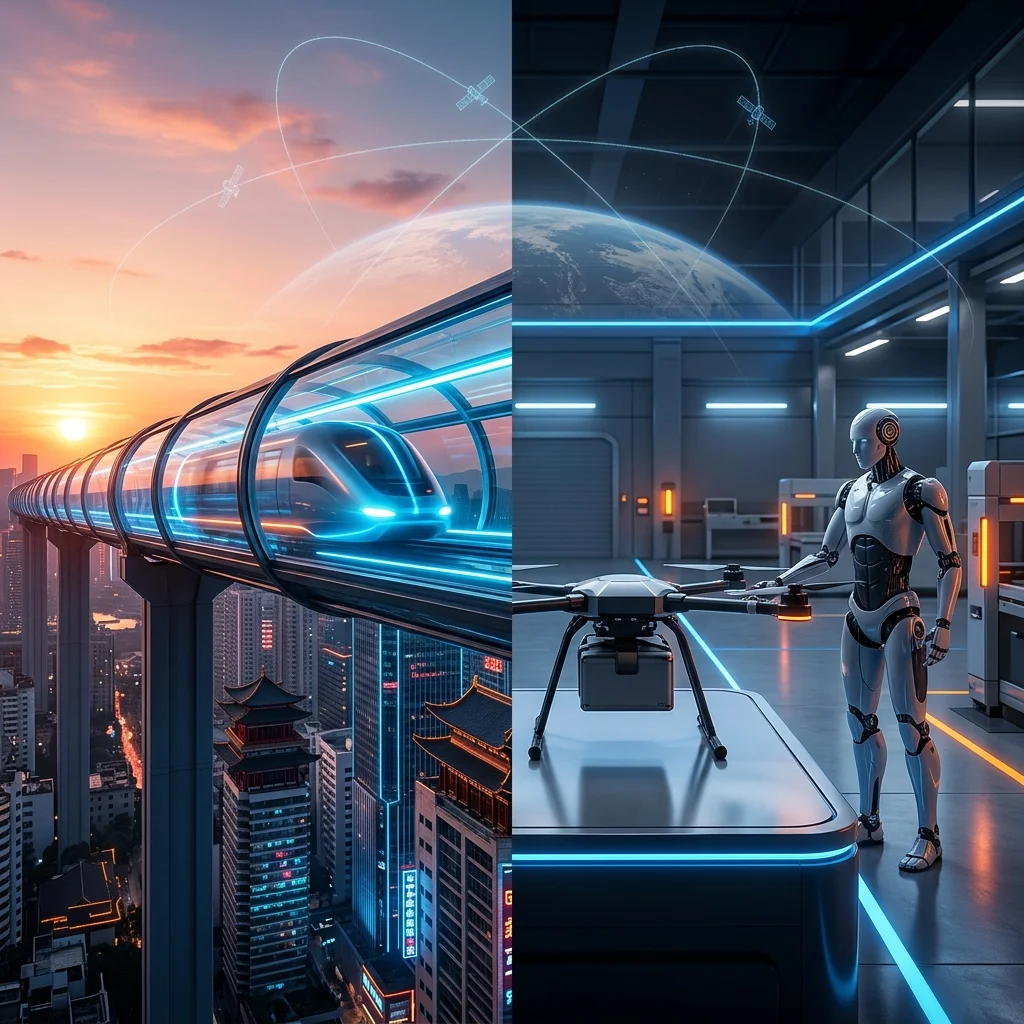
The infrastructure currently under construction spans three interconnected domains: energy storage, high-speed transport, and ultra-low-latency networking.
Sodium batteries represent a structural shift in logistics economics. Unlike lithium-ion cells, sodium-based batteries utilize abundant raw materials, reducing costs by approximately 30% while offering longer lifecycle performance. This chemistry enables round-the-clock autonomous fleet operations by significantly reducing per-kilometer energy costs. The commercial impact: logistics operators can deploy autonomous trucks for continuous 24-hour operations without refueling cost penalties (Source: Industry battery research data).
China's Hyperloop project targets speeds exceeding 1,000 km/h, requiring vacuum tube infrastructure spanning hundreds of kilometers. Simultaneously, autonomous truck operations have already achieved 24/7 deployment in multiple major US and Chinese cities. These systems demand standardized high-capacity charging networks capable of servicing dense vehicle clusters within short time windows. The energy infrastructure required for autonomous freight alone represents an investment magnitude comparable to national electrification programs.
10G networks currently under testing in China provide the control plane for humanoid robots and autonomous systems. At 10 gigabits per second symmetrical speeds with sub-millisecond latency, these networks enable real-time remote supervision and fallback control for robots operating in hospitals, factories, and logistics centers—environments where humanoid robots are predicted to begin replacing human-held positions by 2026.
The interconnection is non-trivial: sodium batteries power autonomous vehicles; Hyperloop provides intercity freight transport; 10G networks coordinate the entire system. None functions optimally without the others.
The Space Frontier: Data Centers in Orbit
The Nvidia-StarCloud collaboration that produced the first AI model trained entirely in orbit represents more than a technical demonstration. It signals a strategic calculation about where computational workloads should reside.
Orbital data centers offer two distinct advantages. First, latency reduction for remote operations: autonomous vehicles and drones operating in areas with limited terrestrial connectivity can access AI inference engines directly from orbit, bypassing ground infrastructure bottlenecks. Second, energy economics: space-based systems utilize passive radiative cooling at near-absolute zero temperatures, dramatically reducing the energy consumed by server cooling systems—currently 30-40% of terrestrial data center operating costs.
Starlink's direct-to-phone satellite connectivity creates the communication layer that makes orbital computing viable. Mobile phones connecting directly to satellites without ground relay stations establishes a seamless data path from user devices to orbital servers. The implication for 2026 is that "cloud" computing becomes physically literal: data processing occurs in low Earth orbit rather than in centralized ground facilities.
Following the Nvidia-StarCloud proof of concept, multiple space data center projects are expected to emerge by 2026, focusing on distributed AI workloads for autonomous vehicle fleets operating across international borders and maritime routes (Source: Space industry project pipeline data).
The Post-Smartphone Device: Not One, But Many
The recruitment of Jony Ive—principal designer of the iPhone and iPod—by OpenAI has generated speculation about a single "smartphone killer" device. This interpretation misunderstands both the infrastructure trajectory and the nature of ambient computing.
The smartphone's successor will not be a single gadget. Real-time simultaneous translation systems already deployed by Apple and Google function through wireless earbuds, with the smartphone serving as a passive relay rather than an active interface. The device itself becomes background infrastructure—undistinguished, distributed, and ambient.
What emerges by 2026 is a device mesh: autonomous vehicles function as mobile computing platforms; humanoid robots serve as physical interfaces in workspaces; satellite-connected earbuds provide continuous translation and information overlay; Hyperloop capsules offer high-bandwidth connectivity during transit. Each node performs computational functions that the smartphone previously monopolized.
China's leadership in autonomous logistics and humanoid robot production accelerates this fragmentation. Xiaomi, under CEO Lei Jun, has already demonstrated humanoid prototypes operating in manufacturing environments. The economic logic is clear: distributing computing across physical infrastructure reduces per-function costs compared to concentrating all capabilities in a single handheld device.
Economic Logic of the Integrated Mesh
The connections between China's Hyperloop, Jony Ive's OpenAI device project, and satellite-direct-to-phone connectivity form a coherent economic pattern. Each represents different layers of the same infrastructure stack:
- Energy layer (sodium batteries): Reduces operating costs for autonomous systems
- Transport layer (Hyperloop, autonomous trucks): Moves physical goods without human drivers
- Computing layer (orbital data centers): Provides AI inference without terrestrial constraints
- Interface layer (distributed devices): Eliminates the need for a single primary computing device
The integration reduces system-level costs below what any single component could achieve independently. Autonomous logistics become viable when energy costs drop (sodium batteries), transport speeds increase (Hyperloop), and real-time control becomes reliable (10G networks, orbital computing). The smartphone's successor emerges when its functions are distributed across these layers, with the smartphone itself reduced to a thin client for ambient infrastructure.
Market Predictions for 2026
Based on current project timelines and infrastructure investment cycles, four observable trends will materialize:
- Autonomous fleet operations will achieve cost parity with human-driven logistics in at least two major markets (China, select US regions), driven by sodium battery deployment and standardized charging infrastructure.
- At least three orbital data center projects will begin construction, focused on maritime and remote-terrestrial autonomous vehicle support.
- Humanoid robots will achieve limited commercial deployment in structured environments (hospital logistics, warehouse operations), with 10G networks providing remote supervision.
- The first major smartphone manufacturer will reposition its device as a peripheral to larger ambient computing infrastructure, rather than as the central computing hub.
The successor to the smartphone will not be unveiled at a product launch event. It will be recognized retrospectively, when users realize they have stopped reaching for their phones because the infrastructure around them already performs those functions.
(All rights reserved by Global Beacon Chronicle. Unauthorized reproduction is prohibited.)
Li Ming / Li Ming
Tech columnist and visiting scholar at MIT.