The $1.6 Trillion AI Power Crunch: Why Energy, Not Chips, Is The Next Bottleneck
The AI revolution is forecast to require a staggering $1.6 trillion in infrastructure

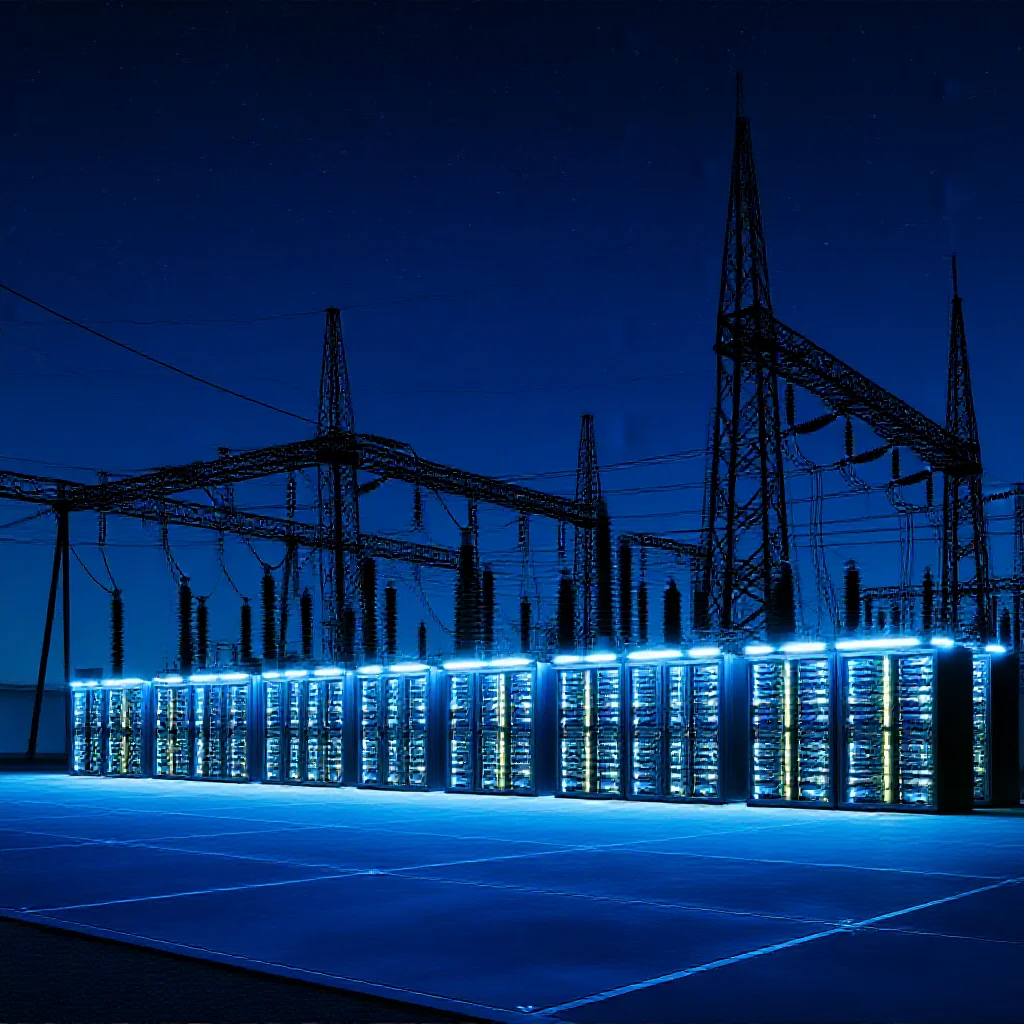
The $1.6 Trillion AI Power Crunch: Why Energy, Not Chips, Is The Next Bottleneck
Beyond the Trillion-Dollar Headline: Decoding the Real Cost of AI
The artificial intelligence revolution is forecast to necessitate a staggering $1.6 trillion in infrastructure investment by 2030. (Source 1: [Primary Data]) This headline figure, however, obscures a more consequential structural shift. The capital allocation is not solely for semiconductors but for the entire physical stack: data center construction, advanced cooling systems, and high-bandwidth networking. The core constraint for scaling AI has fundamentally shifted from computational density, historically governed by Moore's Law, to energy density and availability. Analyses, including those from real estate consultancy Knight Frank, serve as a starting point for a deeper audit of the industry's trajectory. The emerging bottleneck is not the availability of processing power but the electrical power required to sustain it.
!Infographic showing a breakdown of the $1.6 trillion AI infrastructure investment forecast.
The Silent Bottleneck: Why Power Grids Are the New Foundries
The assertion that power supply is the critical bottleneck is validated by comparing industrial lead times and scalability. Constructing a state-of-the-art semiconductor fabrication plant is a monumental, multi-year undertaking. Upgrading regional power transmission grids and generation capacity to support gigawatt-scale AI clusters is an even more complex, capital-intensive, and politically fraught process, often spanning a decade or more.
This creates a hidden economic logic that redefines the AI infrastructure model. Traditional data center economics were dominated by capital expenditure—the cost of servers, real estate, and construction. For AI workloads, particularly training and inference for large language models, the operational expenditure for electricity becomes the dominant, recurring cost factor. The insatiable energy demand of AI clusters flips this model, making continuous power cost and availability the primary determinant of total cost of ownership and operational viability.
Evidence of this constraint is materializing across major technology corridors. Utility companies and grid operators in key markets like Virginia's "Data Center Alley," Ireland, and parts of Germany have issued public warnings about reaching capacity limits, with moratoriums on new data center connections becoming more frequent. The lead time for securing power for a new facility has extended from months to several years, directly impeding the pace of AI deployment.
The Geopolitics of Watts: How Energy Access Will Reshape AI Hubs
Power constraints are initiating a geographic redistribution of AI infrastructure investment. The location calculus for new hyperscale data centers is evolving beyond proximity to talent pools and fiber optic networks. Investment is increasingly flowing toward regions characterized by stable, abundant, and cost-competitive power.
This trend suggests the emergence of new "power-rich" technology zones. Regions with robust renewable energy portfolios, such as the Nordic countries with hydropower and wind, or areas with access to reliable baseload generation, including specific U.S. states and parts of the Middle East, are gaining strategic advantage. Conversely, traditional tech hubs with strained electrical grids face potential relative decline in new AI infrastructure investment, with downstream effects on local real estate markets, tax bases, and economic development strategies. The long-term impact on the global AI supply chain will be determined by where electrons are most plentiful and affordable, not just where engineers are concentrated.
Innovation at the Plug: The Race for Efficient and Sustainable AI
The energy bottleneck is catalyzing parallel innovation tracks focused on efficiency and supply. The market pattern is clear: massive research and development is being directed at every layer of the power consumption stack. This includes chip architects designing for higher performance per watt, as seen in product roadmaps from firms like Nvidia and AMD, as well as advances in liquid immersion cooling, novel power delivery systems, and data center design software.
The pursuit of sustainability is becoming inextricably linked to scalability. While procurement of renewable energy credits is widespread, the intermittent nature of solar and wind power presents challenges for 24/7 AI operations. This reality is prompting serious, albeit controversial, investment in and discussion around next-generation nuclear power, particularly small modular reactors (SMRs), as a potential baseload solution for dense AI compute clusters.
Verification of this trend is evident in venture capital flow. Investment in "power tech"—encompassing nuclear fission and fusion, advanced geothermal, long-duration energy storage, and grid management software—has surged. The industry's trajectory indicates that breakthroughs in joules per computation will be as economically valuable as breakthroughs in transistors per chip. The race for AI supremacy is concurrently becoming a race for energy innovation.
Conclusion: The Infrastructure Imperative
The $1.6 trillion infrastructure forecast underscores a foundational truth: AI is not a purely digital phenomenon but a physical one, with profound material demands. The primary limitation to its growth has shifted from the silicon in chips to the capacity of global power grids and generation assets. This redefines competitive advantages, redirects capital flows, and forces a convergence between the technology and energy sectors.
Neutral market analysis predicts continued upward pressure on electricity demand and prices in tech-concentrated regions, accelerating the geographic diversification of AI infrastructure. The development of more energy-efficient hardware and algorithms will be commercially prioritized. Ultimately, the scalability of artificial intelligence will be governed not by the laws of computing alone, but by the laws of thermodynamics and the practical realities of electrical engineering. The next decade will be defined by the industry's ability to innovate at the plug as much as at the processor.
(All rights reserved by Global Beacon Chronicle. Unauthorized reproduction is prohibited.)
Li Ming / Li Ming
Tech columnist and visiting scholar at MIT.