Beyond Automation: How Agentic AI and Real-Time Data Are Redefining Mining
The convergence of agentic AI and real-time data is not merely automating

Beyond Automation: How Agentic AI and Real-Time Data Are Redefining Mining Economics
Summary: The convergence of agentic AI and real-time data is not merely automating mining tasks but fundamentally restructuring the industry's economic model. By enabling autonomous decision-making based on live sensor and drone feeds, this technology stack shifts operations from scheduled maintenance and static plans to dynamic, predictive optimization. This analysis examines the deeper implications for mining's future competitiveness and sustainability.
Introduction: The Paradigm Shift from Automation to Autonomy
Traditional industrial automation involves pre-programmed machines executing repetitive tasks. The emerging paradigm integrates agentic artificial intelligence, defined as systems capable of perceiving environmental data, making decisions, and executing actions within defined parameters without constant human oversight (Source 1: [Primary Data]). This capability, when fused with a continuous stream of real-time data from sensors, drones, and control systems, forms a central nervous system for mining operations. The transition is not an incremental improvement in efficiency but a foundational shift in the economic and risk management calculus of the industry. It moves the operational model from reactive and schedule-based to predictive and dynamically optimized.
Deconstructing the Technology Stack: AI Agency Meets Data Velocity
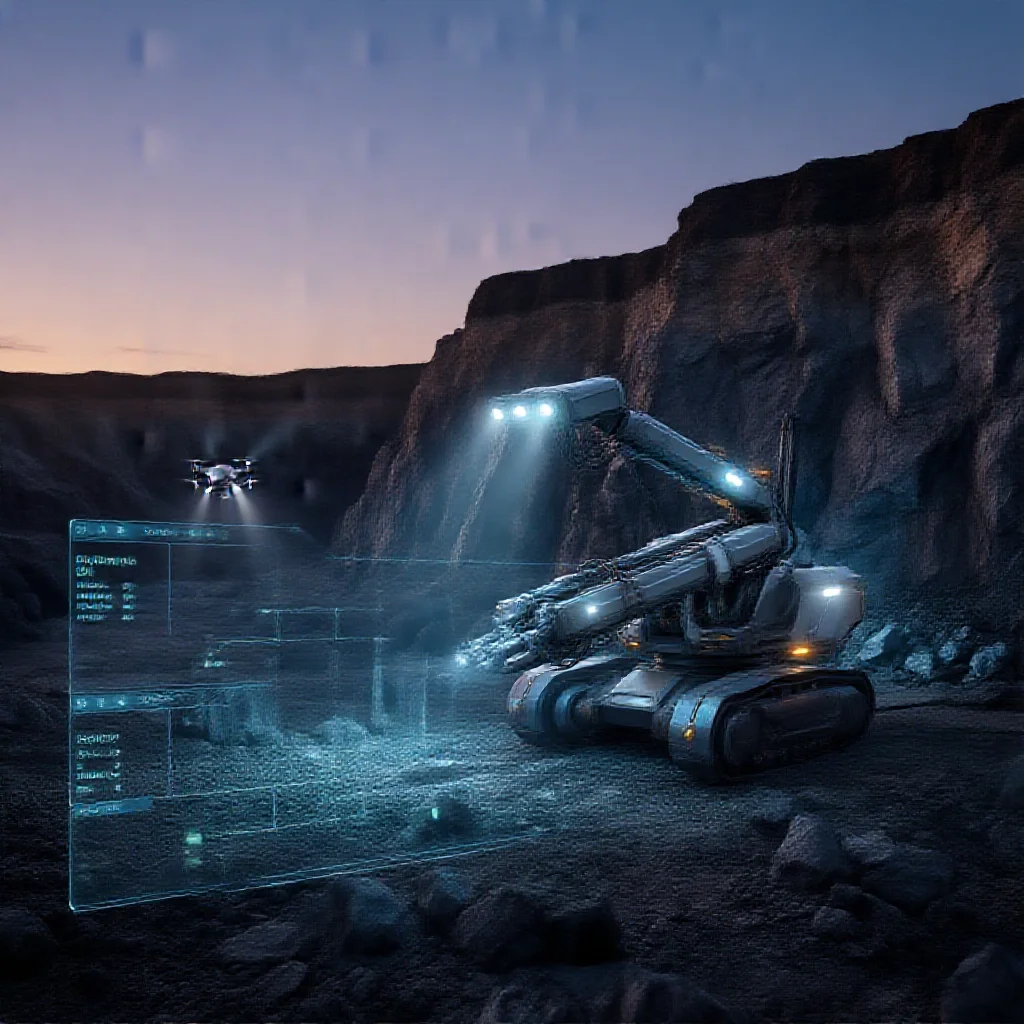
The technological foundation rests on two interdependent pillars. The first is agentic AI, which in an industrial mining context refers to software agents that can interpret complex data, evaluate multiple operational objectives—such as throughput, energy consumption, and wear rates—and initiate commands to physical machinery. The second is the high-velocity data ecosystem, comprising vibration and pressure sensors on drills and crushers, geospatial scanners, and aerial drones conducting volumetric and geotechnical analysis. The fusion creates a closed-loop system where data informs AI decisions, and those decisions alter the physical environment, which is then immediately re-sensed. This loop operates at a speed and consistency beyond human reaction times, enabling continuous micro-adjustments to operational parameters.
The Hidden Economic Logic: From Cost Center to Predictive Asset
The most significant economic impact lies in the transformation of heavy mining equipment from a depreciating cost center into a predictable, optimized asset. Predictive maintenance, driven by the real-time analysis of equipment health data, prevents catastrophic failures and unplanned downtime. This shift has a direct effect on financial planning. Capital expenditure cycles become more predictable as asset lifespans are extended and replacement schedules are optimized based on actual usage and condition rather than conservative time-based estimates. Operational expenditure becomes less volatile, reducing the budgetary impact of emergency repairs and lost production. The trend toward autonomous oversight, as noted in industry analysis (Source 1: [Primary Data]), is a primary driver for this financial model shift, moving cost structures from variable and reactive to fixed and predictable.
Safety and Efficiency: Surface Benefits with Deep Structural Impacts
The immediate benefits of removing personnel from hazardous environments, such as active pit faces or underground tunnels, are clear. However, agentic AI introduces a proactive safety culture through predictive hazard identification. Systems can analyze rock face stability data, gas concentrations, and equipment trajectories to predict and avoid incidents before they occur. Efficiency is similarly redefined. It is no longer solely about faster drilling or hauling cycles, but about system-wide optimization. An AI agent can simultaneously balance the energy consumption of a processing plant with the ore feed rate from autonomous haul trucks and the maintenance schedule of a conveyor system, maximizing overall resource utilization. Consequently, the human workforce's role evolves from direct machine operation to higher-order functions like system supervision, exception management, and data science.
The Ripple Effect: Implications for Supply Chains and Competitiveness
The implications of this shift extend beyond individual mine sites. Reliable, predictable production output stabilizes supply chains for critical minerals, reducing the volatility that plagues downstream manufacturing industries. Companies that successfully implement this technology stack will achieve a structural cost advantage, potentially reshaping global competitive landscapes. Furthermore, the precision enabled by real-time data and autonomous control can lead to reduced waste and lower energy intensity per ton of material processed, directly linking operational advancement to sustainability metrics. The capital-intensive nature of this transition, however, may create a divergence between large, well-resourced mining firms and smaller operators.
Conclusion: Neutral Market and Industry Predictions
The integration of agentic AI and real-time data represents the next phase of operational technology in mining. Market adoption will be gradual, prioritized in high-value, complex operations where the return on investment in predictability and safety is clearest. The technology providers that succeed will be those offering robust, interoperable platforms capable of functioning in extreme environments. A secondary market for retrofitting legacy equipment with sensing and connectivity packages will likely emerge. Workforce composition will continue to shift, with increased demand for remote operations specialists, AI maintenance technicians, and cybersecurity experts. The ultimate trajectory points toward fully integrated, self-optimizing mines where human decision-making is focused on strategic direction rather than tactical execution.
(All rights reserved by Global Beacon Chronicle. Unauthorized reproduction is prohibited.)
Li Ming / Li Ming
Tech columnist and visiting scholar at MIT.