S&P 500 C-Suite Snapshot 2025: The Strategic Divide in Leadership Pipelines
The 2025 S&P 500 C-Suite snapshot reveals a sharp strategic dichotomy in

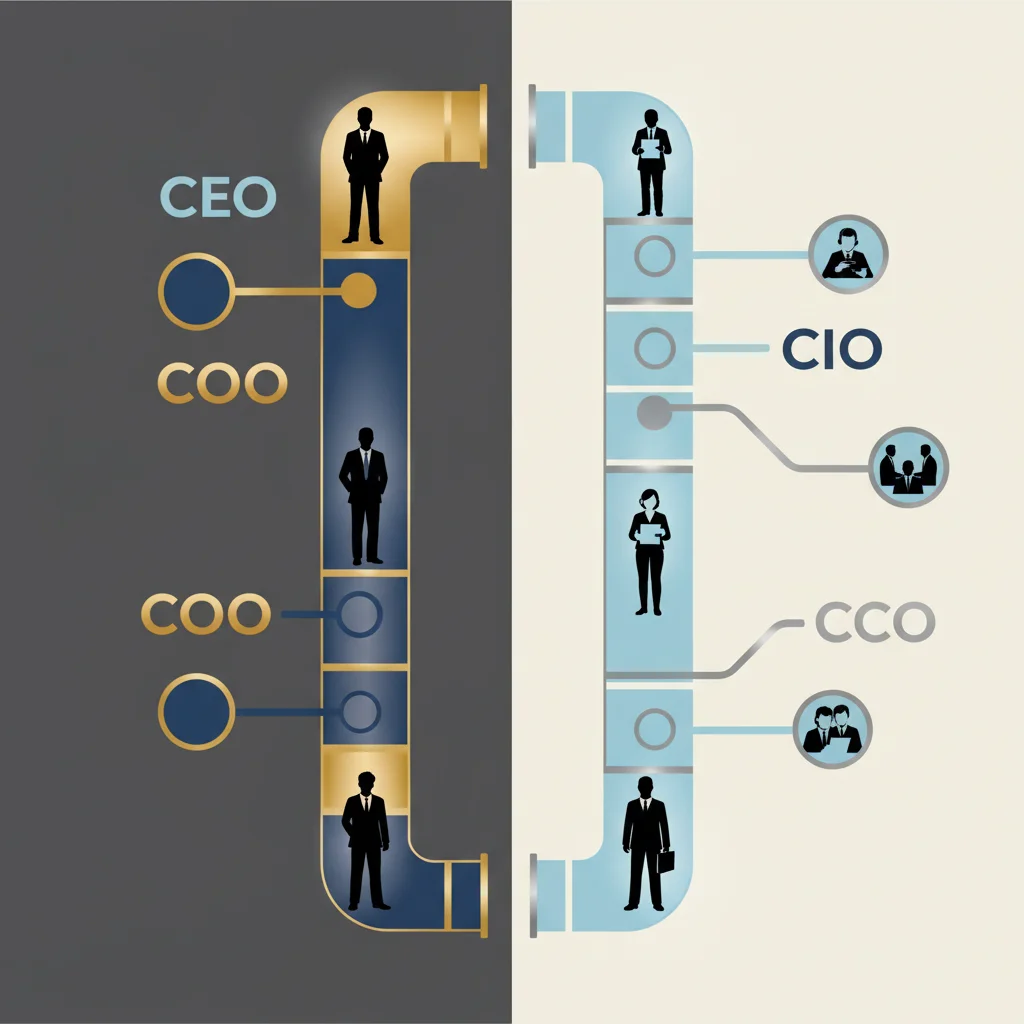
S&P 500 C-Suite Snapshot 2025: The Strategic Divide in Leadership Pipelines
Introduction: The Hidden Logic of the C-Suite
In 2025, the average tenure of a C-suite functional leader in the S&P 500 stands at 5.2 years. Of 503 identified CEOs and their senior executive teams, 59% were promoted from within their company, while the remaining 41% entered from outside. A further 43% of these leaders are women or from historically underrepresented groups. [Source: Spencer Stuart S&P 500 C-Suite Snapshot 2025]
These aggregate figures, however, obscure a deliberate strategic calculus. The internal-versus-external hiring split varies enormously by role, revealing a pattern where companies prioritize organizational continuity for positions tied to firm-specific knowledge, and inject fresh expertise into roles that demand specialized, often cross-industry, capabilities. This article deconstructs the data across role types, industries, and prior-experience profiles to surface the hidden logic behind the pipeline decisions shaping corporate resilience.
The Continuity Core: CEO and COO as Institutional Anchors
The highest internal promotion rates belong to the two roles most responsible for operational coherence and stakeholder alignment: 80% of chief operating officers and 76% of chief executive officers were promoted from within their current company. [Source: Raw Data – Internal hire percentages]
These numbers are not accidental. Both roles require deep, tacit knowledge of corporate culture, supply chains, legacy relationships, and unwritten decision-making norms—knowledge that external hires rarely possess. The data reinforce this: among externally hired CEOs and COOs, only 17% and 14% respectively came from a different industry. By comparison, the average across all C-suite roles for external hires arriving from a different industry is considerably higher. [Source: Raw Data – External hires from different industry]
Furthermore, prior role experience is lowest for these two positions. Only 16% of CEOs and 12% of COOs had held the same title at a previous company. [Source: Raw Data – Prior role experience percentages] This indicates that the CEO and COO roles are typically promotions from adjacent functions (e.g., CFO to CEO, division head to COO) rather than lateral moves of someone who has already performed the same job elsewhere. Companies are effectively betting that institutional memory and cultural fit outweigh the benefits of importing a pre-trained executive.
The Innovation Inflow: Roles Where External Expertise Wins
At the opposite end of the spectrum, three roles show external hiring rates above 50%: chief communications officer (57% external), chief information officer (54% external), and chief legal officer (53% external). [Source: Raw Data – External hire percentages]
The rationale is role-specific. CCOs and CIOs operate in domains where external best practices, regulatory landscapes, and digital transformation strategies evolve faster than a single firm’s internal learning curve. Cross-industry mobility is particularly pronounced: 53% of externally hired CCOs and 52% of externally hired CIOs came from a different industry. [Source: Raw Data – External hires from different industry] A CCO hired from a consumer goods firm into a financial services company, for instance, brings brand-reputation frameworks that the incumbent sector may lack. A CIO from a tech-native company can accelerate the digital agenda in a legacy industrial firm.
Chief legal officers also show high external hiring (53%), with 49% of those external hires coming from a different industry. [Source: Raw Data – External hires from different industry] This suggests that legal leaders are often recruited for specialized regulatory expertise (e.g., antitrust, data privacy) that may not exist in-house, particularly as compliance complexity increases across sectors.
Chief financial officers and chief marketing officers occupy a middle ground. CFOs are internally promoted 64% of the time, reflecting the importance of firm-specific financial structures, while CMOs are internally promoted 62% of the time, perhaps indicating a balance between creative talent and brand continuity. [Source: Raw Data – Internal hire percentages]
Prior-role experience data further validates this specialization divide. The highest prior-role experience percentages belong to CHROs (45%), CIOs (44%), and chief legal officers (42%)—roles where the technical or regulatory core of the job transfers directly across companies. The lowest belong to CEOs (16%) and COOs (12%)—roles where the context matters more than the title. [Source: Raw Data – Prior role experience percentages]
Sector Signals: How Industry Context Shapes the Pipeline
The internal-hire rate also varies significantly by sector, reflecting each industry’s structural characteristics. Industrial and consumer sectors have the highest internal appointment rates at 61% and 62%, respectively. [Source: Raw Data – Sector internal appointment rates] These are industries with legacy systems, established supply chains, and brand-specific knowledge that take years to master. An external CEO or COO entering a manufacturing firm, for example, would face a steep learning curve in factory floor culture and supplier relationships.
Healthcare and technology sectors record the lowest internal appointment rates at 56% each. [Source: Raw Data – Sector internal appointment rates] Technology companies, by nature, operate in fast-changing markets where fresh product or engineering perspectives can be decisive. Healthcare—encompassing pharmaceuticals, biotech, and medical devices—faces rapid regulatory and scientific shifts that often require leaders with external, specialized R&D or clinical expertise.
Consumer companies are particularly open to cross-industry external hires: 44% of all external appointments in the sector come from outside the industry, compared to a 42% average across all sectors. [Source: Raw Data – Consumer sector external cross-industry rate] This likely reflects the fact that consumer brands compete on customer experience and marketing innovation, skills that are portable across verticals.
The Pipeline Calculus: Stability and Renewal in the 5.2-Year Window
The aggregate data point to an intentional corporate strategy: companies are using the C-suite as a portfolio of risk-adjusted bets. They anchor the firm in internal continuity for the roles that steer day-to-day operations and long-term strategy (CEO, COO). They inject external talent into functional roles where the institutional advantage of deep knowledge is outweighed by the need for fresh, often cross-industry, expertise (CCO, CIO, CLO). The result is a leadership ecosystem with an average tenure of 5.2 years—short enough to allow renewal, long enough to embed strategic initiatives.
Looking ahead, several trends are likely to intensify. The high external hiring rates for CIOs (54%) and CCOs (57%) suggest that companies will continue to prioritize digital transformation and reputation management as distinct functional pipelines. The low prior-experience rates for CEOs and COOs (16% and 12%) imply that these roles will remain apprenticeship-based, with future incumbents likely drawn from the CFO, CHRO, or general management track rather than from outside.
Sector convergence may also blur the current divides. As technology permeates industrial and consumer sectors, the internal-hire gap between industries may narrow—especially if industrial firms find it necessary to hire CIOs from outside at rates closer to the tech sector. Conversely, as healthcare and technology companies mature, they may develop deeper internal benches for COO and CFO roles, pushing those internal rates upward.
The 43% diversity representation figure—while notable—remains a composite. Future pipeline analyses should examine whether the internal vs. external split differs by demographic group, and whether the tenure clock (5.2 years) is consistent across functions. For now, the strategic divide is clear: companies are not choosing between internal and external hiring wholesale. They are choosing one or the other based on the specific stability-versus-innovation trade-off embedded in each C-suite seat.
(All rights reserved by Global Beacon Chronicle. Unauthorized reproduction is prohibited.)
Chen Hao / Chen Hao
Biographical writer who has interviewed over 100 entrepreneurs.