Moving Beyond Experimentation: AI's Shift from Pilots to Production Impact
Analyzing the strategic shift in Artificial Intelligence adoption from pilot programs to tangible business impact, focusing on infrastructure, operational redesign, and the velocity required for real-world value in the Digital Economy.

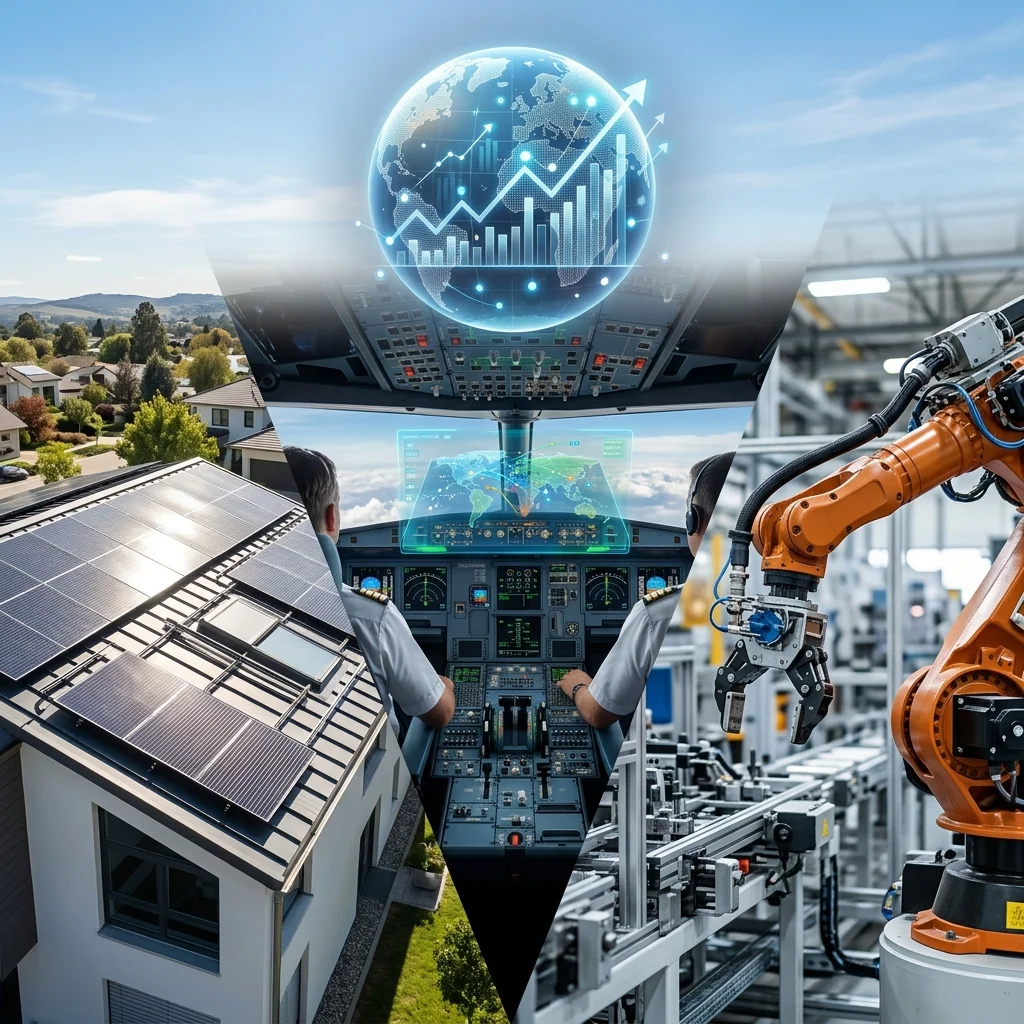
The rapid advancement of Artificial Intelligence is moving the focus from theoretical capability to demonstrable impact. The central strategic challenge facing global organizations is no longer simply 'What can AI do?' but rather 'How do we move from experimentation to production impact?' This pivot reflects a broader trend across the global economy: the compression of innovation S-curves, where the distance between emerging and mainstream technologies shrinks, demanding a vastly accelerated pace of organizational adaptation.
This acceleration is evidenced by the exponential growth rates observed in AI adoption, where leading generative AI tools have reached hundreds of millions of weekly users in a matter of months, signaling a shift from niche application to pervasive digital integration. However, the mere availability of powerful models does not guarantee commercial success. The critical differentiator in the current landscape is the ability of organizations to integrate these technologies effectively into existing operational frameworks.
Strategic analysis indicates that the traditional playbook—relying on sequential improvement through endless proofs of concept—is becoming obsolete. Organizations that succeed are those prioritizing velocity over perfection, focusing intensely on solving specific, high-value business problems rather than pursuing broad, unconstrained technological exploration. This requires a fundamental redesign of processes, moving from an 'automation' mindset to a 'redesign' mindset. This distinction is paramount, as automating flawed or poorly defined processes merely scales inefficiency.
This operational imperative has direct implications for infrastructure and digital transformation. The architecture built for legacy systems or cloud-first strategies is often inadequate for the computational demands of production-scale AI. The trend points toward a strategic hybrid infrastructure model: leveraging cloud elasticity for scale, maintaining on-premises consistency where necessary, and utilizing edge computing for immediacy. Simultaneously, the economic reality of AI deployment is being reshaped by the interplay of token costs and usage explosion, forcing enterprises to develop sophisticated compute strategies that balance cost management with the need for high-throughput inference.
Furthermore, the integration of AI is forcing a complete overhaul of corporate governance and organizational structure. The traditional IT operating model designed for human worker productivity is failing to support agentic workflows. The future of work is being redefined not by incremental task enhancement, but by the orchestration of human-agent teams. This demands that CIOs evolve into strategic orchestrators, driving modular architectures and embedding governance directly into the technology lifecycle. This transformation is not incremental; it is a structural rebuild of the technology organization itself.
Compounding these internal shifts is the imperative of security. As AI becomes more autonomous and deeply embedded in physical and digital systems, the threat landscape evolves from perimeter defense to securing AI models, data pipelines, and applications at machine speed. Organizations must proactively deploy AI-powered defenses to counter threats operating at this new velocity. This interconnected web of technological, operational, and security shifts underscores the necessity of building resilient, adaptive systems capable of continuous learning and rapid iteration.
Ultimately, the trajectory suggests that competitive advantage will accrue not solely to those with the most advanced algorithms, but to those possessing the organizational agility to connect specific business needs with the right technological solutions, underpinned by robust, future-proof infrastructure. The market signal is clear: the time for incremental pilots has passed; the era of decisive, outcome-driven redesign is underway.
(All rights reserved by Global Beacon Chronicle. Unauthorized reproduction is prohibited.)
Chen Hao / Chen Hao
Biographical writer who has interviewed over 100 entrepreneurs.