What YouTube's Footer Reveals About Platform Governance and Future-Proofing
YouTube's website footer is more than a navigation menu—it's a strategic

What YouTube's Footer Reveals About Platform Governance and Future-Proofing
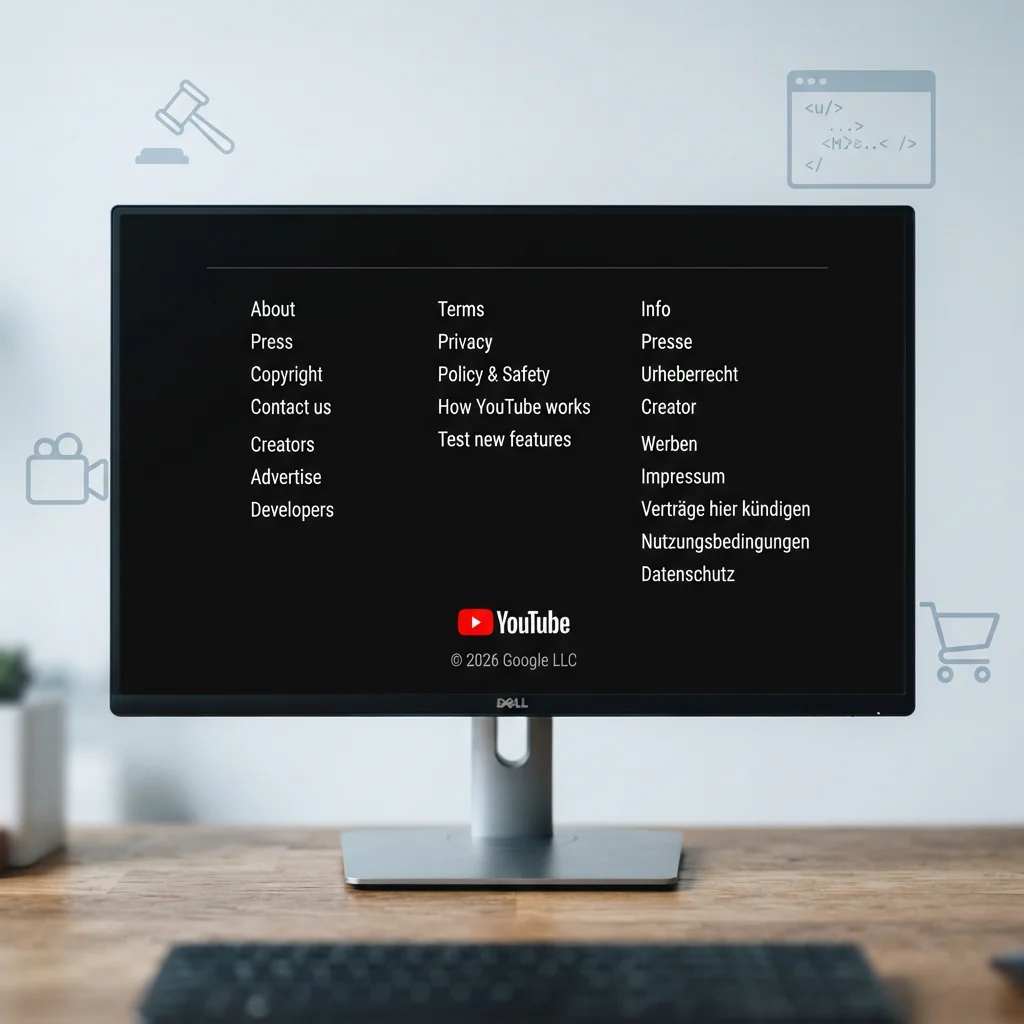
The bottom of a webpage rarely commands attention. Yet YouTube's footer—a dense strip of links, legal disclaimers, and a curious copyright notice dated 2026—offers a surprisingly revealing window into how the world’s largest video platform manages trust, compliance, and its economic ecosystem. This seemingly mundane navigation zone is, in fact, a strategic blueprint for digital governance, balancing the interests of creators, advertisers, developers, and regulators while signaling long-term operational confidence.
The 2026 Copyright Anomaly: Glitch or Strategy?
As of 2024, anyone scrolling to the bottom of YouTube’s homepage will see the line: © 2026 Google LLC. A copyright date two years into the future is not an error—at least not in the traditional sense. While a casual observer might dismiss it as a placeholder or a coding oversight, the practice is far more deliberate.
Why pre-date a copyright notice? Large platforms like Google often employ automated renewal systems that batch-update copyright years across multiple products. The 2026 stamp could be the result of a forward-looking script that sets the date to "current year + 2" as a buffer against renewal lapses. This strategy is common among companies that manage thousands of digital assets: by proactively claiming a future year, they avoid the legal gray area of an expired notice during the gap between updates. The risk of displaying an incorrect year is low in most jurisdictions, as copyright protection is automatic upon creation, but the notice serves as a public assertion of ownership.
From a digital governance perspective, this habit reveals how platforms prioritize operational continuity over absolute precision. Google's confidence in 2026—nearly three years out—signals that it expects the platform to remain active, legally compliant, and profitable. In an industry where startups fold overnight, such a forward-looking copyright is a subtle but powerful trust signal to users, advertisers, and investors.
[IMAGE: Screenshot of YouTube footer with 2026 copyright highlighted, alongside a digital calendar showing 2024, with a magnifying glass over the date.]
Yet the anomaly also raises questions about legal compliance. While most courts do not penalize an over-extended copyright year, the practice can be interpreted as a form of "copyright trolling" in some jurisdictions if used aggressively. For now, it remains a quirk of automated asset management—one that reinforces the idea that YouTube, as part of Google LLC, treats its legal notices as part of a scalable, machine-driven system rather than a handcrafted document.
The Footer as a Trust Hub: Transparency in Practice
Scrolling through the footer's link list reveals a curated suite of pages that serve as the platform's public-facing governance interface. Links like "Info," "Presse," "Urheberrecht" (Copyright), and "Kontakt" (Contact) are more than navigation aids—they are trust anchors.
The transparency imperative has grown sharply under the European Union’s Digital Services Act (DSA), which requires platforms to clearly display terms of service, content moderation policies, and contact points for authorities. YouTube’s footer responds directly by placing "Richtlinien & Sicherheit" (Policies & Safety) and "Nutzungsbedingungen" (Terms of Service) in prominent positions. For German users, the inclusion of "Impressum" —a mandatory legal disclosure for commercial websites—fulfills a specific regulatory requirement that carries fines for non-compliance.
One of the most striking entries is "Verträge hier kündigen" (Cancel contracts here). This direct link empowers users to terminate subscriptions or agreements without navigating a maze of settings. In an era of subscription fatigue and growing consumer rights advocacy—particularly under EU directives on unfair contract terms—this link functions as a user trust mechanism. It signals that YouTube is not trying to lock users into hidden auto-renewals, but instead offers a straightforward exit path. The move is both a regulatory compliance measure and a strategic transparency play: by making cancellation easy, the platform reduces the risk of chargebacks, disputes, and negative press.
[IMAGE: A diagram of a website footer with icons representing trust signals: a shield for security, a document for terms, a handshake for user rights, and a padlock for privacy.]
The footer's design also reflects a shift from "information dumping" to platform transparency as a competitive differentiator. Users who feel informed about their rights and obligations are less likely to mistrust the platform or fall prey to misinformation about hidden fees or data misuse.
The Tripartite Ecosystem: Creators, Advertisers, Developers
Beneath the legal and trust-oriented links lies a triad of economic arteries: "Creator," "Werben" (Advertise), and "Entwickler" (Developers). These three links encapsulate YouTube's core revenue model and its strategic dependencies.
Creators — The Content Engine
The Creator link leads to YouTube Studio, where over 50 million active creators manage analytics, monetization tools, copyright claims, and audience insights. In the creator economy, retaining top talent is a constant battle against platforms like TikTok, Instagram, and Twitch. YouTube's footer elevates this link to prime real estate, signaling that creator support is not an afterthought but a core governance priority. The link functions as a gateway to monetization tools—AdSense, channel memberships, Super Chat, and shopping features—that directly determine creator livelihoods.Advertisers — The Revenue Lifeline
The Werben link serves advertisers seeking brand safety, audience targeting, and ad format options. In Germany, where advertising regulations are among the strictest in Europe, the placement of "Impressum" near this link is intentional: German law requires every commercial website to display a legal notice with contact details. By grouping advertising resources with a legal disclosure, YouTube reduces friction for ad buyers who must verify compliance before launching campaigns. The YouTube advertising ecosystem depends on advertisers trusting that the platform will not place their ads next to harmful content—a commitment reinforced by the footer's transparency links.Developers — The Ecosystem Extender
The Entwickler link opens the door to YouTube APIs, enabling third-party tools for video analytics, live streaming, content management, and even AI integration. For a platform that competes with closed ecosystems like Apple or Meta, fostering a developer community is a strategic lock-in strategy. Developers who build on YouTube’s APIs—whether for video editing, subtitle generation, or data visualization—become dependent on the platform’s continued existence and policies. The footer’s inclusion of this link underscores YouTube’s ambition to remain not just a content site but a platform infrastructure provider.[IMAGE: Three interconnected circles labeled 'Creator', 'Advertiser', 'Developer' with the YouTube logo in the center, arrows showing flows of content (from creator to platform), money (from advertiser to platform to creator), and code (from developer to platform and back).]
These three pillars—supply (creators), demand (advertisers), and extensibility (developers)—form a self-reinforcing loop. The footer acts as a permanent advertisement of this balance, reminding every visitor that YouTube is not a single-service product but a multi-sided marketplace.
Global Compliance and Localization: The German Imperative
The footer’s language and specific link choices are not accidental. They reflect a localization strategy that treats legal compliance as a regional, rather than global, affair. The version of the footer displayed to German users includes "Impressum" and "Verträge hier kündigen" —elements absent from, say, the US or Japanese version.
Why Germany? German internet law is among the most demanding in the world. The Telemediengesetz (TMG) requires all commercial websites to provide an Impressum with full name, address, registration details, and contact information. Failure to comply can lead to warnings from competitors and fines. Similarly, the right of withdrawal under the Bürgerliches Gesetzbuch (BGB) mandates that consumers must be able to cancel contracts easily. By featuring these links prominently, YouTube avoids legal battles and demonstrates respect for local sovereignty.
This localization extends beyond language translation. The footer serves as a digital governance document that adapts to regional regulatory pressures. For example, under the EU’s General Data Protection Regulation (GDPR), platforms must provide clear information about data processing. YouTube’s footer includes "Datenschutz" (Data Protection) links, which lead to privacy policies tailored to each country’s interpretation of the law.
[IMAGE: A world map with the YouTube footer overlaid on Germany, with a legal gavel icon and a checkmark, indicating compliance with local regulations.]
The presence of "Urheberrecht" (Copyright) as a standalone link also reflects Europe’s strong copyright protection culture, particularly after the implementation of the Copyright Directive (Article 17). YouTube must demonstrate that it has mechanisms to prevent copyright infringement, and this link directs users to copyright policies, content ID information, and takedown procedures. By making copyright information accessible in the footer, the platform signals to regulators that legal compliance is a front-and-center priority.
Conclusion: The Footer as a Governance Document
YouTube’s footer is far more than a navigation menu. It is a living document that encodes the platform’s strategy for balancing trust, monetization, innovation, and regulation. The pre-dated copyright 2026 reflects a forward-looking, automated approach to digital asset management. The curated set of links—from creators to Impressum—reveals a deliberate architecture designed to serve multiple stakeholders while staying ahead of legal requirements.
For users, the footer offers a sense of control and transparency. For creators, it is a gateway to their livelihood. For advertisers, it is a brand safety promise. For regulators, it is a checklist of compliance. And for competitors, it is a reminder that platform governance is not an afterthought—it is built into every pixel of the user interface.
As the digital landscape evolves, the footer will likely continue to adapt: adding links for AI content labeling, sustainability disclosures, or new subscription management tools. But its core function—to serve as a trust hub and strategic blueprint—will remain unchanged. The next time you scroll down on YouTube, take a moment to read the fine print. It tells a story far bigger than the video you came to watch.
(All rights reserved by Global Beacon Chronicle. Unauthorized reproduction is prohibited.)
Zhang Wei / Zhang Wei
Global business observer focusing on multinational enterprise strategy.