International Business Strategy and Global Growth: What PDF Metadata Reveals
This article should analyze how an academic PDF on international business

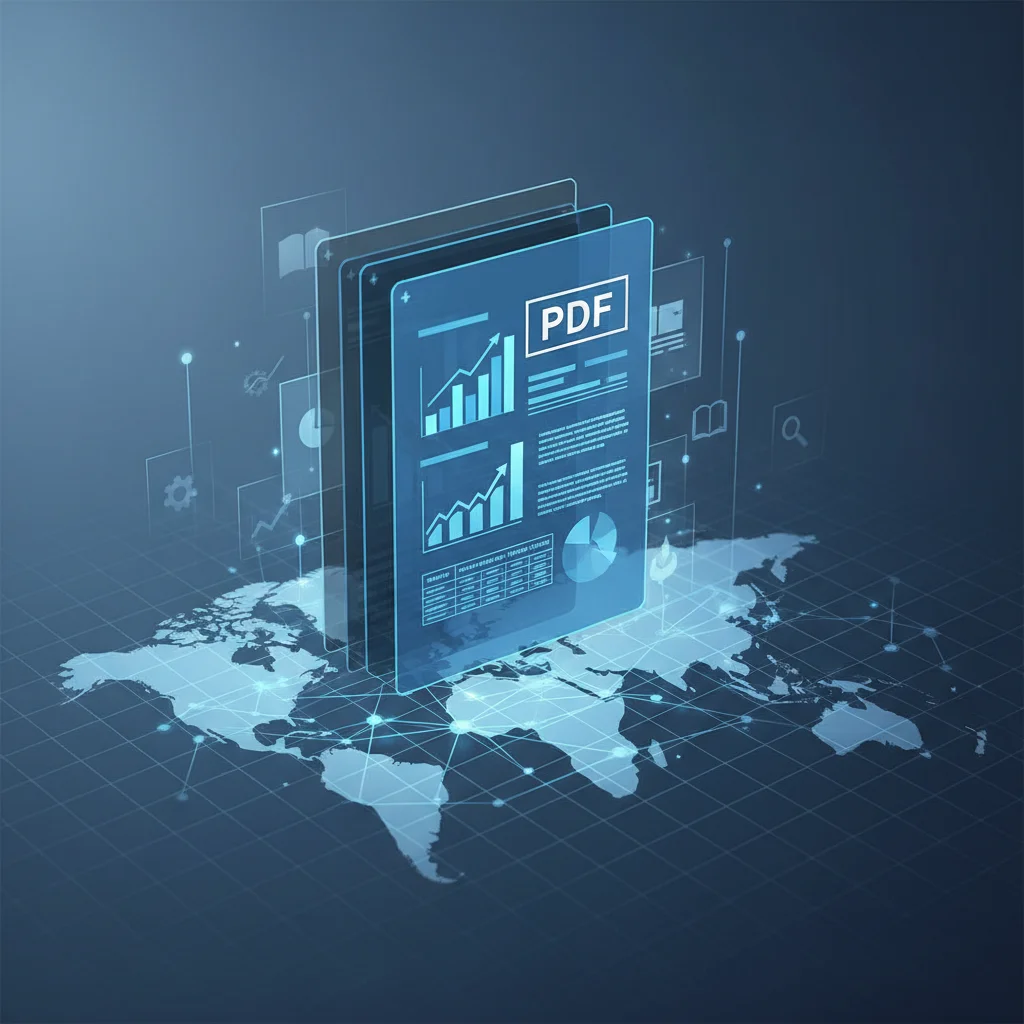
International Business Strategy PDF Metadata and What It Shows About Academic Framing
[IMAGE: A clean editorial-style illustration of a PDF document floating above a global network map, with subtle academic and business elements such as charts, world grid lines, and layered document interfaces.]
A PDF file can reveal more than its visible text. In this case, the readable article content is not available in the excerpt, so the most reliable evidence comes from the document container, its metadata, and its structure. That limits what can be said about the paper’s argument, but it does not make the file uninformative. On the contrary, the file itself shows how academic work in international business strategy, global growth, and related fields is packaged for distribution and verification.
This is therefore a document-level analysis rather than a content summary. The focus is on what can be confirmed: the source domain, file format, structural composition, and the difference between verified metadata and interpretation. That distinction matters because academic PDFs are often read not only as texts, but also as objects that circulate through databases, archives, and institutional systems.
1. Why the File Itself Matters
The hidden article text is not available here, so the document cannot be evaluated on its full claims, methods, or conclusions. What can be examined is the file as evidence. In academic settings, that matters for three reasons:
- Verification — A file can be checked against its source domain and format.
- Archiving — A PDF preserves a fixed version of a document for later retrieval.
- Indexing — Metadata and file structure affect how the document is stored and found.
[IMAGE: A magnified PDF icon with layered binary code and a subtle journal-style background.]
This approach is best understood as slow analysis. Instead of rushing to interpret the paper’s argument, it asks a narrower question: what does the file itself confirm, and what remains unknown?
That method is especially useful when only binary structure or metadata is visible. A careful reading avoids overstating what the document contains. It treats the file as a source object, not as proof of a particular thesis about global growth or strategic performance.
2. The Hidden Economics of Scholarly Distribution
Academic PDFs are part of a distribution system. Their movement depends on hosting platforms, library access, search indexing, and document stability. In that sense, a paper on global business strategy is not only a research artifact; it is also a digitally packaged item designed to travel across institutions and jurisdictions.
The available evidence suggests a standard scholarly distribution model rather than a proprietary or altered file. That matters because distribution format influences what can be checked and how. A PDF that is structurally intact can be cited, archived, and compared across copies. A damaged or incomplete file would create uncertainty about its version and provenance.
[IMAGE: A world map with connected nodes flowing from a central PDF document toward universities and business hubs.]
From a research-circulation perspective, this is where the file becomes informative even without visible text. It shows that academic knowledge about international business strategy is being delivered through a fixed digital container. That does not prove the document’s claims are correct, but it does show the form in which the knowledge is expected to circulate.
The broader lesson is modest: scholarly publishing relies on packaging as much as on prose. Discoverability, access, and archival stability are all shaped by the file format. The PDF is therefore part of the research infrastructure, not just a wrapper around it.
3. What the Source URL and File Structure Confirm
The source domain visible in the provided material is abacademies.org. That is the most direct verifiable origin available here. It indicates that the file is associated with an academic publishing platform rather than an unknown or anonymous host.
Several structural features also support a basic authenticity check:
- The file is identified as PDF 1.5
- The document contains object definitions
- It includes page structures
- It uses compressed streams
These are standard properties of a normal PDF publication. They do not prove the content of the paper, but they do indicate a conventional digital document format. In other words, the structure is consistent with a scholarly PDF that has been prepared for distribution and reading.
[IMAGE: A technical forensic view showing PDF layers, object tree structures, and a secure source link.]
This is where it is important to separate observation from inference.
Verified from the file-level evidence:
- The domain associated with the source is abacademies.org
- The file format is PDF 1.5
- The document includes standard structural elements such as objects, pages, and compressed streams
Not verified from the available excerpt:
- The paper’s thesis
- Its research design
- Its conclusions about international business strategy
- Any claim about the paper’s empirical results or competitiveness effects
That distinction keeps the analysis grounded. It allows source verification without pretending that file metadata can replace full-text reading.
4. Slow Analysis vs. Fast Analysis
This is a case where slow analysis is the better method.
Fast analysis works well when a readable abstract, introduction, or conclusion is present and can be checked quickly. Here, however, the article text is hidden. That means there is nothing in the excerpt that can be responsibly summarized or fact-checked at the argument level.
A fast reading would likely do one of two things:
- Overstate what can be inferred from metadata alone
- Fill the gap with assumptions about academic publishing in general
Neither approach is reliable.
Slow analysis, by contrast, asks more precise questions:
- What is directly visible?
- What is structurally confirmed?
- What is only suggested?
- What remains outside the evidence?
[IMAGE: A split visual showing a stopwatch on one side and a forensic document analysis workspace on the other.]
For a PDF tied to international business strategy and global growth, this matters because the file may be used in multiple contexts: teaching, citation, archiving, database indexing, or research review. In each case, the integrity of the document format matters before any interpretive claim does. A careful analyst should first verify the source and structure, then move to the article itself if the content becomes available.
5. Global Business Strategy as a Knowledge Infrastructure Problem
One useful way to read this file is as an example of how global business strategy research depends on knowledge infrastructure. The strategy field is often discussed in terms of markets, firms, entry modes, and cross-border competition. But the file suggests another layer: the research itself must be stored, distributed, and preserved in a standardized form before it can influence readers.
That observation does not mean the PDF has strategic importance in itself. It means the document participates in a system that determines whether a paper can be located, cited, and checked across academic environments.
The file format is part of that system. A PDF 1.5 document is likely to preserve layout and pagination in a stable way, which supports quoting and page-based reference. The presence of object structures and compressed streams indicates a compiled document rather than an informal draft. Those features are consistent with formal academic dissemination, but they do not by themselves establish the quality of the research.
[IMAGE: An academic knowledge network with document nodes, page layers, and quiet business-chart elements in the background.]
This is where source-grounded analysis should stay restrained. The visible evidence supports a conclusion about formatting and circulation, not about the paper’s findings on global expansion, internationalization, or competitive outcomes. Any stronger claim would exceed the available record.
6. What Can Be Said Without Overstating the File
A disciplined reading of the metadata supports a limited but useful conclusion:
- The file comes from a named academic domain.
- It is a standard PDF publication.
- Its internal structure is consistent with a formal scholarly document.
- The excerpt does not expose the text needed to assess the article’s argument.
That is enough to discuss the document as a verified object in the academic record. It is not enough to claim what the paper proves.
This matters because metadata analysis often gets misread as content analysis. They are different. Metadata can tell us how a document was packaged, identified, and delivered. It cannot tell us whether the paper’s reasoning is strong, whether its evidence is sufficient, or whether its conclusions about international business strategy and global growth are sound.
[IMAGE: A document verification screen showing confirmed fields, with the article text area intentionally obscured.]
The most defensible position, then, is simple: the file demonstrates standard scholarly formatting and a traceable source domain, but the substantive argument remains inaccessible in the excerpt.
7. Conclusion: Reading the File Before Reading the Claims
The value of this PDF lies not in unsupported inference, but in what it confirms at the document level. It shows how academic work travels through digital form, how source identity can be checked, and how much of scholarly interpretation depends on access to the actual text.
For readers of global business strategy and academic publishing, the lesson is methodological. Before drawing conclusions about a paper’s findings, it is necessary to distinguish between:
- verified metadata,
- structural evidence,
- and speculative interpretation.
That distinction is especially important in cross-border research fields, where documents circulate widely and are often encountered out of context. In this case, the file supports a careful, limited conclusion: it is a formal academic PDF from a known source domain, built in a standard format, and suitable for archiving and retrieval. Anything beyond that would require the full readable article.
[IMAGE: A closed PDF document resting on a global grid, with subtle archival and journal references, no text.]
(All rights reserved by Global Beacon Chronicle. Unauthorized reproduction is prohibited.)
Zhang Wei / Zhang Wei
Global business observer focusing on multinational enterprise strategy.