Global Business Strategy: A Comprehensive Framework for International Expansion
Expanding a business globally is fraught with hidden risks—from product-market

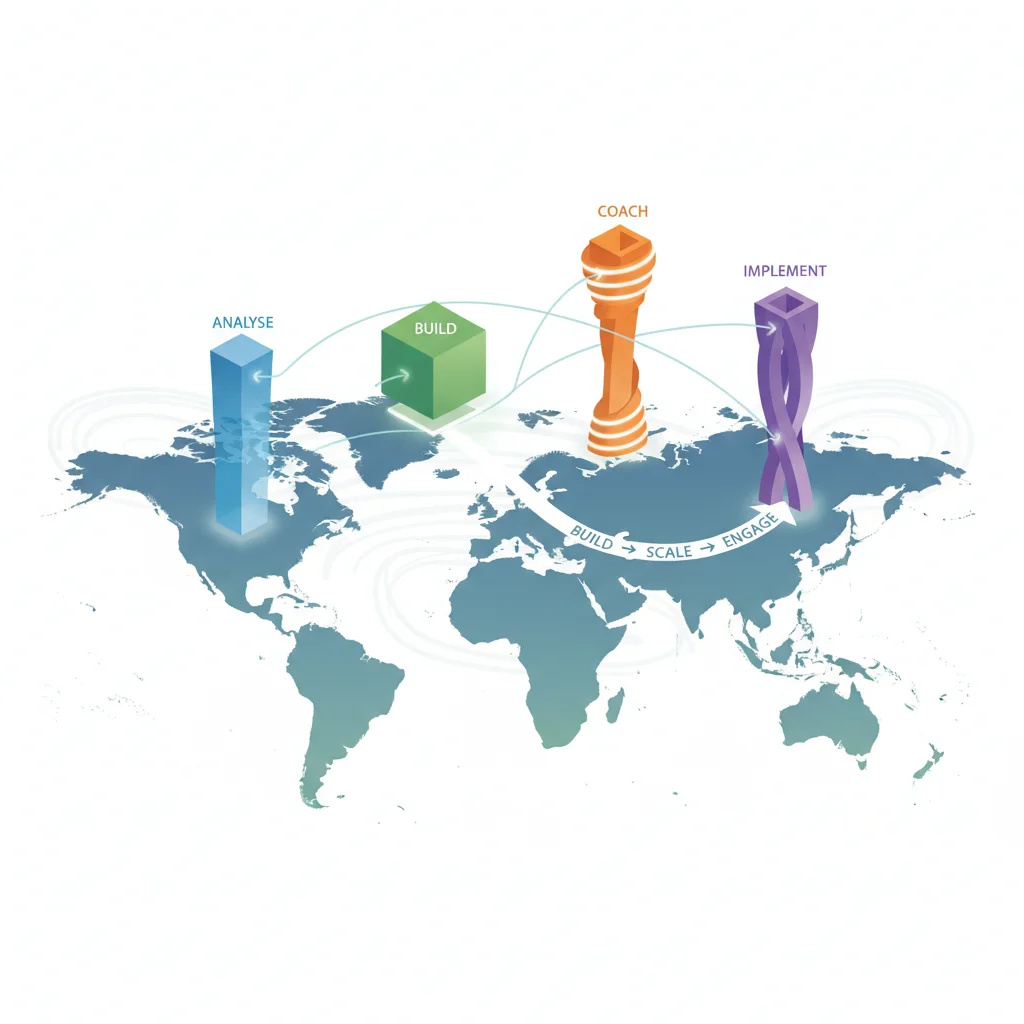
Global Business Strategy: A Framework for International Expansion
The Hidden Cost of Going Global: Why Most Expansions Fail
Every year, hundreds of companies announce ambitious plans to enter new international markets. Yet the numbers tell a sobering story: studies consistently show that 60% to 70% of cross-border expansions either underperform or fail outright within the first three years. The reasons are rarely a lack of ambition. Instead, they stem from a set of predictable but often overlooked pitfalls.
Product-market mismatch ranks highest on the list. A company may launch a well-loved domestic product in a foreign market, only to discover that local tastes, regulations, or distribution channels render it unappealing or even illegal. Insufficient readiness assessment is another common culprit—firms jump into new geographies without auditing their own organizational capacity, financial resilience, or leadership bandwidth. Weak partner selection compounds the problem: a distributor who lacks local market knowledge or a joint venture partner with misaligned incentives can derail even the best strategy. Legal and fiscal missteps, from tax structuring errors to non‑compliance with local labor laws, add further friction and cost.
Without a structured framework, companies often overspend on entry modes that look good on paper but fail to align with local realities. They pour millions into setting up a subsidiary in a market that requires a low‑risk partnership model, or they franchise into a region where local partners lack the operational maturity to maintain brand standards. The financial toll of these missteps is staggering: wasted capital, lost time, and damaged brand reputation that can take years to repair.
[IMAGE: A bar chart showing high failure rates of international expansions vs. those using a structured framework.]
This is where a methodical approach to global business strategy becomes essential. Rather than relying on intuition or a single market entry tactic, companies need a repeatable, data‑driven process that diagnoses risks before they materialize. One proven methodology—developed by Ipanovia, a firm with operational experience across 20 countries and deep expertise in tech, B2B, and B2C sectors—structures international expansion around four pillars and a three‑step execution cycle. These tools are designed not to guarantee success, but to systematically reduce the probability of failure.
Introducing the Four-Pillar Framework: Analyse, Build, Coach, Implement
At the heart of any sound business development framework lies a clear segmentation of work. The four‑pillar approach divides the complexity of global growth into manageable phases, each with specific deliverables and decision gates.
Analyse: Internal and External Diagnosis
The first pillar, Analyse, is where objectivity matters most. Internally, the organization must audit its own readiness: What is our current maturity level in terms of processes, talent, and technology? A SWOT analysis—strengths, weaknesses, opportunities, threats—provides a baseline, but it must be grounded in data, not optimism. An organizational audit also reveals whether the company has the leadership bandwidth to manage a new geography without neglecting its home market.
Externally, the analysis shifts to market potential, competitive landscape, and value proposition fit. Which markets offer the strongest demand signal? Who are the incumbents, and what barriers do they erect? How does the company’s value proposition need to be adapted—in terms of product features, pricing, or messaging—to resonate locally? This phase answers the foundational question: Should we enter this market at all, and if so, with what focus?
[IMAGE: A diagram with four stacked blocks labelled Analyse, Build, Coach, Implement, each with sub-items listed inside.]
Build: Strategy Creation and Partner Selection
Once analysis yields a clear “go” decision, the Build pillar translates insights into action. A tailored market entry strategy is crafted—detailing the optimal entry mode (franchising, joint venture, wholly owned subsidiary, distribution agreement, etc.), the go‑to‑market timeline, and the resources required. Partner selection becomes a rigorous process: potential distributors, joint venture partners, or franchisees are vetted for capability, cultural fit, and ethical alignment. The goal is to design a structure that balances control, cost, and local relevance.
Coach: Hands‑On Training and Guidance
Strategy documents are useless if they are not executed properly. The Coach pillar ensures that local teams—whether inside a new subsidiary or within a partner organization—receive the training and ongoing guidance needed to implement the plan. This goes beyond a one‑time workshop; it involves embedding experienced managers who understand both the corporate culture and the local context. Coaching covers sales techniques, customer support protocols, operational processes, and compliance obligations.
Implement: Full Operational Setup
The final pillar, Implement, is where theory becomes reality. Legal entities are formed, fiscal registrations completed, contracts signed, and supply chains activated. Multichannel marketing support—ensuring the brand reaches customers through the right online and offline touchpoints—is rolled out. Ipanovia’s experience in over 20 countries means that the implementation team brings knowledge of local bureaucratic nuances, from how to register a branch in Singapore to the specific tax incentives available in Ireland. By the end of this pillar, the new market operation should be capable of running independently, with clear KPIs and reporting lines.
From Build to Scale to Engage: The Three-Step Process
The four pillars provide a static framework. The three‑step process—Build, Scale, Engage—adds a dynamic, cyclical dimension that recognizes international expansion is never a one‑and‑done exercise.
Build: Optimize Product‑Market Fit and Readiness
The Build step (distinct from the Build pillar above, though overlapping) focuses on refining the core offering for the target market. It is about proving that the product or service solves a real problem for local customers at a price they are willing to pay. This phase often involves pilots, minimum viable product launches, or limited test‑and‑learn programs. An expansion readiness assessment ensures the company has the operational and financial capacity to scale beyond the pilot stage.
Scale: Execute Market Entry
Scale is the execution phase. The company chooses its growth path—organic (subsidiaries, branches, distribution networks) or external (M&A, joint ventures, franchising)—and moves forward with legal and fiscal support. Here, a structured business development framework reveals its value: standardized checklists for entity setup, tax registration, banking, and compliance reduce the risk of costly delays. The Scale step is not a sprint; it requires careful sequencing, especially when entering multiple markets simultaneously.
Engage: Sustain Momentum
Entry is only the beginning. The Engage step ensures that the market operation continues to capture local audiences through multichannel international expansion marketing. This includes digital marketing tailored to local search engines and social platforms, trade shows, partnerships, and direct sales. Engagement also involves continuous feedback loops: what are customers saying? Are competitors responding? Is the original market entry strategy still valid, or does the product need further adaptation? The answers feed back into the Build step, creating a virtuous cycle.
[IMAGE: A circular flow chart with three arrows: Build → Scale → Engage, looping back to Build.]
This cyclical process aligns with Ipanovia’s stated mission: “Set your International Business Strategy development from the Product Market Fit to the operations set up.” By treating international growth as an iterative loop rather than a linear project, companies can adapt to changing market conditions without starting from scratch.
Organic vs External Growth: Choosing the Right Path
One of the most critical decisions in any global business strategy is whether to pursue organic growth, external growth, or a hybrid. Each path carries distinct trade‑offs, and the choice depends on the company’s risk appetite, speed requirements, capital availability, and long‑term control preferences.
Organic Growth: Full Control, Gradual Pace
Organic growth modes include establishing wholly owned subsidiaries, setting up branch offices, or building direct distribution networks. The primary advantage is control: the parent company retains complete authority over brand standards, product quality, pricing, and customer relationships. Organic growth is ideal for companies with strong internal resources, a high need for IP protection, or a desire to build a long‑term competitive moat. However, it is slower and more capital‑intensive. Each new market requires building a local team from scratch, navigating regulatory requirements independently, and assuming full financial risk.
External Growth: Speed and Local Expertise
External growth modes—mergers and acquisitions (M&A), minority equity stakes, joint ventures, and franchising—offer faster scaling with shared risk and immediate access to local infrastructure and relationships. A well‑chosen joint venture partner can provide deep market knowledge, existing customer bases, and even regulatory goodwill. Franchising, meanwhile, allows a company to expand brand footprint without major capital outlay, as franchisees bear most of the investment. The downside is reduced control: partners may not execute the brand vision or quality standards as tightly, and conflicts over strategy are common. Legal structuring becomes paramount to protect both parties’ interests.
[IMAGE: A fork in the road with signs pointing 'Organic (Subsidiaries, Branches)' left and 'External (M&A, JV, Franchising)' right, with a dashed line indicating a hybrid path.]
Ipanovia’s methodology supports both paths, providing partner vetting, legal structuring, and fiscal compliance services that reduce friction regardless of the chosen route. For example, if a company opts for an acquisition, the framework ensures thorough due diligence, integration planning, and post‑merger cultural alignment. If it chooses franchising, the Build pillar includes developing a comprehensive franchise operations manual and selecting partners through a multi‑stage screening process.
Practical Steps for Implementing the Framework
While the four‑pillar and three‑step models provide a high‑level structure, successful execution requires attention to several practical details:
- Start with a readiness assessment. Before investing in any market research, the company must honestly evaluate its own capacity. Do we have the management talent to oversee a foreign operation? Is our supply chain resilient enough to support cross‑border logistics? Do we have the financial runway to sustain losses for the first 12–18 months?
- Use data, not intuition, for market selection. Rather than chasing “hot” markets or following competitors, the Analyse pillar should rank potential countries by objective criteria: market size, growth rate, regulatory ease, cultural distance, and competitive intensity. A weighted scoring system can help.
- Invest in partner due diligence. Whether selecting a distributor, a franchisee, or a joint venture partner, background checks, reference calls, and site visits are non‑negotiable. Look for partners whose values and operational capabilities mirror your own.
- Build legal and fiscal compliance into the timeline. Many companies underestimate how long it takes to register a company, obtain permits, or secure tax IDs. The Implement pillar should include a realistic schedule that accounts for government processing times and potential delays.
- Plan for the engagement loop. Even after a market is “launched,” the Engage step requires ongoing investment. Allocate budget for local marketing, customer support, and periodic product adaptation. Set up regular review cadences to assess performance and adjust the market entry strategy as needed.
Conclusion: A Roadmap for Sustainable Global Growth
Expanding a business across borders is one of the most complex strategic moves a company can undertake. The high failure rates of international expansions are not inevitable—they are largely the result of skipping foundational steps. A structured global business strategy framework, built on the four pillars of Analyse, Build, Coach, and Implement, and executed through the Build‑Scale‑Engage cycle, provides a reliable path forward.
By investing in proper diagnosis, rigorous partner selection, and continuous coaching, companies can avoid the common traps of product‑market mismatch, regulatory fines, and wasted capital. Whether the chosen route is organic—through subsidiaries and branches—or external—via M&A, joint ventures, or franchising—the framework ensures that every decision is supported by data and that every operational step is guided by experienced professionals.
The companies that succeed in international expansion are not necessarily the ones with the deepest pockets or the most innovative products. They are the ones that treat global growth as a disciplined process, not a gamble. With the right methodology, even small and mid‑sized firms can build a sustainable global presence—one market at a time.
(All rights reserved by Global Beacon Chronicle. Unauthorized reproduction is prohibited.)
Zhang Wei / Zhang Wei
Global business observer focusing on multinational enterprise strategy.