Global Business Strategy: Decoding the 5 Archetypes for Successful International
Nearly half of all corporate growth comes from foreign markets, yet 70%

Here is the article in English, following your specified outline, style, and formatting requirements.
---
Global Business Strategy: Decoding the 5 Archetypes for Successful International Expansion
Nearly half of all corporate growth now originates from foreign markets, a finding from a McKinsey study that underscores a fundamental shift in the global economic landscape. For multinational corporations, international expansion is no longer an option but a necessity. Yet, despite this immense opportunity, a significant gap in execution exists. The same research indicates that 70% of small and medium-sized businesses (SMBs) feel uncertain about navigating shifting consumer preferences and rapid technological changes. This uncertainty represents a critical knowledge barrier, often leading to failed market entries and wasted resources.
The central thesis of modern global business strategy is that choosing the right path for expansion is not merely a question of market entry tactics. It is about fundamentally aligning a company’s core capabilities, supply chain structure, and innovation model with the specific demands of different international markets. Understanding the underlying economic logic of a company's operations is the first step toward building a resilient and profitable global footprint.
[IMAGE: A bar chart showing corporate growth from domestic vs. foreign markets, with a highlight on the 50% statistic.]
The Four Classic Global Strategies and When to Use Them
For decades, the conversation around globalization was framed by four classic strategies, each defined by the tension between global integration and local responsiveness. These models remain the foundational vocabulary for any discussion on international expansion.
- Global Strategy: This approach prioritizes standardization to achieve massive economies of scale. Products are designed for a universal market with only minor, superficial localization. Companies like Microsoft (with its Windows operating system) and Apple (with core iPhone hardware) exemplify this. It works best for products with universal appeal where cost leadership is a primary competitive advantage.
- Transnational Strategy: This is a "think global, act local" hybrid. The goal is to achieve global efficiency while also being highly responsive to local markets. Spotify and Amazon use this model, maintaining a powerful, centralized platform while tweaking languages, payment systems, and content libraries for specific regions. It is the ideal model for digital platforms and services that must navigate cultural nuances.
- International Strategy: Often the starting point for early-stage exporters, this strategy involves leveraging core competencies developed in the home market and transferring them abroad with minimal adaptation. A US-based software company that simply translates its app into Spanish for the Latin American market is using an international strategy. It works when the home market advantage is strong and sustained.
- Multi-domestic Strategy: This is the deepest form of local customization. A company operating under this strategy treats each country as a distinct profit center with a high degree of autonomy. A powerful example is Apple’s modification of Face ID in Japan to work more effectively with face masks, responding to a specific cultural and epidemiological need. This strategy is essential when cultural, regulatory, or consumer preference differences are extreme.
The key insight is that these four strategies are not mutually exclusive. Most successful global companies evolve through them. A company might start with an international strategy, evolve into a transnational approach as it grows, and use multi-domestic tactics for specific product lines in specific countries.
[IMAGE: A 2x2 matrix with axes 'Global Integration' vs 'Local Responsiveness', plotting each strategy in its quadrant.]
McKinsey’s Five Archetypes: The Hidden Logic Behind Global Expansion
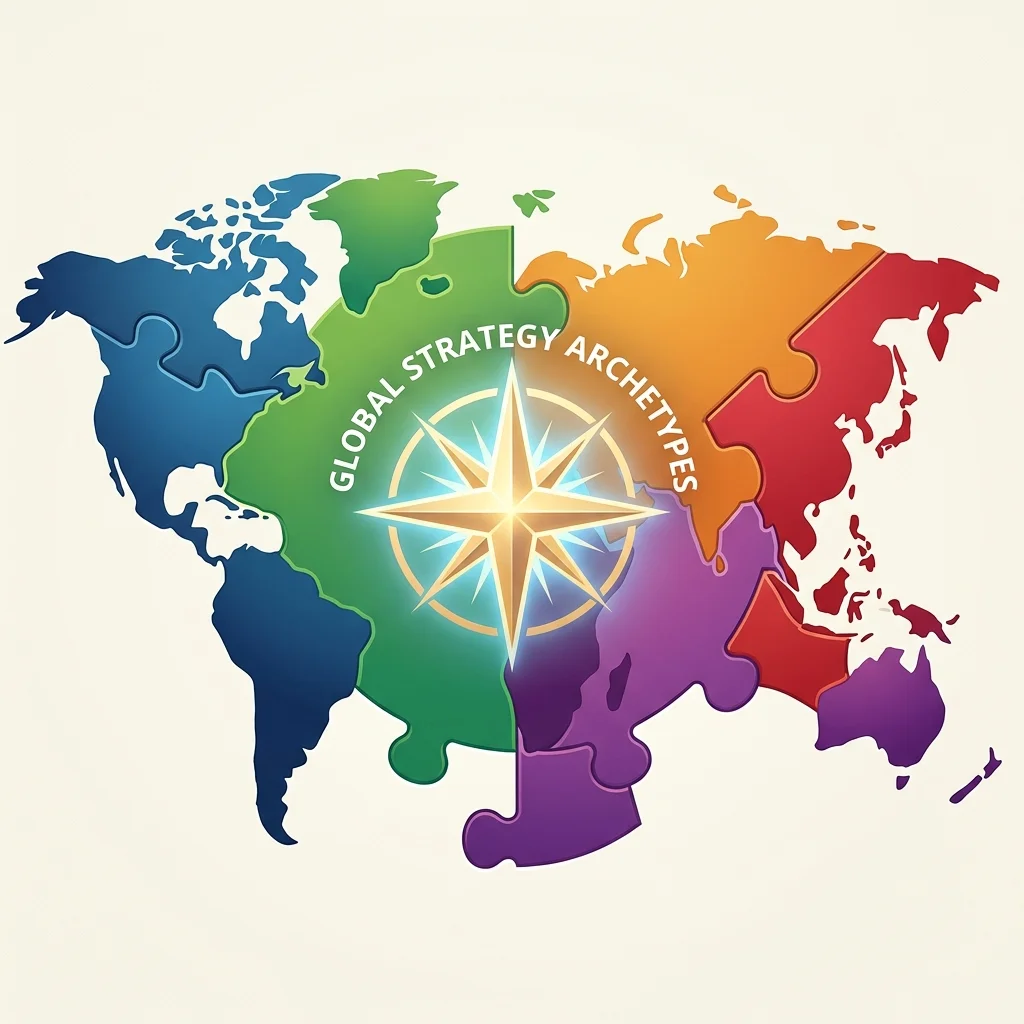
While the four strategies provide a useful taxonomy, they often fail to explain why a company chooses one over the other. To address this, McKinsey identified five distinct archetypes that decode the hidden economic logic—the specific value creation mechanism—that drives global expansion. These archetypes explain how companies seek competitive advantage not just through product sales, but through the very structure of their global footprint.
- Resource Seekers: This archetype is driven by the need to secure raw materials, energy, or low-cost labor. Their international expansion is vertical integration in reverse—going to where the inputs are. Rio Tinto, De Beers, and ExxonMobil are classic examples. Their supply chains are geographically dictated by nature, and their primary risk is geopolitical instability.
- Researchers: These companies globalize to access a global talent pool and innovation clusters. Their logic is "innovation arbitrage"—they place R&D centers in specific locations (e.g., biotech in Boston, AI in Bangalore) to capture the best ideas and speed up the innovation cycle. Pfizer (with its global drug discovery network) and Google (with its numerous AI research labs) are prime examples. Risk for Researchers centers on intellectual property protection and talent retention.
- Global Offerers: This archetype corresponds most closely to the "Global Strategy." These firms create value by offering a standardized, high-quality brand experience everywhere. The product is the brand. Louis Vuitton, Apple (in its brand strategy), and Coca-Cola are Global Offerers. Their economic logic is the premium they can command from a consistent, trusted brand name. Their risk is brand dilution through inconsistent quality or counterfeiting.
- Networkers: The Networker creates value by building and controlling a physical or digital infrastructure that connects people or things across borders. Their value increases with the scale of the network. FedEx, DHL, and Emirates Airlines are quintessential Networkers. Their global expansion is a direct function of adding more nodes to their network, which makes the entire system more valuable. Their biggest challenge is capital intensity and regulatory complexity.
- Customizers: Mirroring the "multi-domestic" strategy, Customizers create value through deep, local adaptation. Their competitive advantage is their ability to understand and serve hyper-local needs better than a standardized global competitor. Unilever (with 15 local variants of its Dove soap for different water hardness levels), Procter & Gamble, and Nestlé are masters of this archetype. Their risk lies in operational complexity and higher unit costs.
These five archetypes map elegantly onto the four classic strategies: Global Offerers align with the global strategy; Customizers align with the multi-domestic strategy; Networkers align with the transnational strategy; while Resource Seekers and Researchers are often best served by an international strategy, leveraging a specific home-market advantage (access to resources or talent) into foreign operations.
[IMAGE: A visual map showing the five archetypes (with their icons) connected to the four quadrants of the 2x2 matrix from the previous section, with a small graphic indicating the core economic logic for each (e.g., a factory for Resource Seekers, a globe for Networkers, a test tube for Researchers).]
Choosing the Right Archetype for Your Organization
The post-pandemic world has forced a re-evaluation of these models. Supply chain fragility has made the Resource Seeker model riskier, pushing companies like Apple to diversify beyond China. The rise of generative AI is forcing Researchers to reconsider where to place their bets. For any business, the first step is to conduct an "archetype audit."
Decision Framework:
- Ask: What is our primary source of competitive advantage? Is it our brand (Global Offerer), our innovation pipeline (Researcher), our operational efficiency (Networker), our local market insight (Customizer), or our access to unique inputs (Resource Seeker)?
- Align your supply chain and risk management. A Global Offerer needs a resilient supply chain focused on cost and quality. A Customizer needs flexible, regional production capabilities. Misalignment here is a common cause of failure.
- Consider your stage of maturity. A startup may begin as an International player. As it grows, it might evolve into a Networker or a Customizer. The goal is not to pick one archetype forever, but to recognize which logic currently drives your value creation.
| Strategy | Best For | Core Risk |
| :--- | :--- | :--- |
| Resource Seeker | Commodity, energy, raw material firms | Geopolitical risk, supply disruption |
| Researcher | Pharma, tech, high-innovation firms | IP theft, talent retention, high R&D costs |
| Global Offerer | Luxury goods, consumer electronics | Brand dilution, quality inconsistency |
| Networker | Logistics, airlines, telecom | Capital intensity, regulatory hurdles |
| Customizer | Consumer packaged goods, food & beverage | Operational complexity, high unit costs |
Action Plan for SMBs:
For an SMB feeling the uncertainty noted in the opening statistic, the path is clear. Instead of trying to be a Global Offerer immediately, leverage the logic of a Researcher or a Global Networker. Use digital platforms (Networkers like Shopify or Amazon) to test products. Focus on a niche where you can act as a Customizer for a specific, underserved customer segment in a foreign market. This reduces risk and builds a foundation for more complex expansion later.
The Future of Global Strategy Archetypes
The future of international expansion lies in fluidity. The rigid boundaries between these archetypes are blurring. A company like Spotify is a Networker (connecting listeners and podcasters) that also acts as a Customizer (local playlists and payment systems). A resource firm is now expected to act like a Researcher regarding environmental, social, and governance (ESG) compliance.
The companies that will thrive in the next decade are those that understand not just where to go, but why they are going. By decoding the five archetypes—the hidden logic of global business strategy—leaders can move from a reactive, uncertain approach to a proactive, resilient framework for sustainable global growth. The opportunity is immense, but it belongs to those who can align their core economic logic with the right global model.
(All rights reserved by Global Beacon Chronicle. Unauthorized reproduction is prohibited.)
Zhang Wei / Zhang Wei
Global business observer focusing on multinational enterprise strategy.