Beyond the Numbers: The ATM Infrastructure Crisis and Nigeria''s Deepening
Nigeria's ATM network, with 22,500 terminals, reveals a stark infrastructure

Beyond the Numbers: The ATM Infrastructure Crisis and Nigeria's Deepening Financial Exclusion Gap
A 2023 survey by the Enhancing Financial Innovation & Access (EFInA) organization found that 39% of Nigerian adults remain financially excluded (Source 1: [EFInA Survey 2023]). Concurrent data reveals a physical banking infrastructure in distress. As of December 2023, Nigeria operated 22,500 Automated Teller Machines (ATMs) (Source 2: [Central Bank of Nigeria/Payments System Data]). This figure, however, belies a systemic crisis characterized by severe under-provision, geographic disparity, and operational failure. This analysis examines the causal relationship between deteriorating ATM infrastructure and persistent financial exclusion, moving beyond descriptive statistics to model the reinforcing feedback loops within Nigeria's financial access ecosystem.
The Illusion of Coverage: Decoding Nigeria's ATM Density and Global Standing
The absolute count of 22,500 ATMs presents a superficial image of coverage. A more revealing metric is penetration density. Nigeria's ATM-to-100,000-adults ratio stands at 18.6 (Source 3: [Financial Infrastructure Analysis]). This ratio is less than half the global average of 41.96 (Source 4: [Global Benchmarking Report]). The mathematical implication is a higher transactional burden per terminal and increased travel distance for users. This deficit entrenches cash dependency, as alternative digital channels often require a foundational bank account linked to physical access points for cash-in/cash-out functions.
National averages further obscure a critical geographic fault line. The 22,500 terminals are not uniformly distributed. A disproportionate concentration exists in major commercial hubs like Lagos, Abuja, and Port Harcourt. Vast rural regions, home to a significant population segment, constitute an infrastructure desert. This uneven distribution sets the foundational condition for the exclusion documented in population surveys, rendering national density figures misleading for a majority of the territory.
A Network in Decline: The Alarming Rise of 'Ghost ATMs'
The infrastructure deficit is compounded by a severe reliability crisis. In 2023, 36.1% of Nigeria's ATMs were recorded as out of service (Source 5: [Banking System Operational Report]). This represents a near-doubling from the 18.6% out-of-service rate recorded in 2022 (Source 6: [Comparative Annual Data]). This trend indicates a systemic failure beyond isolated technical faults.
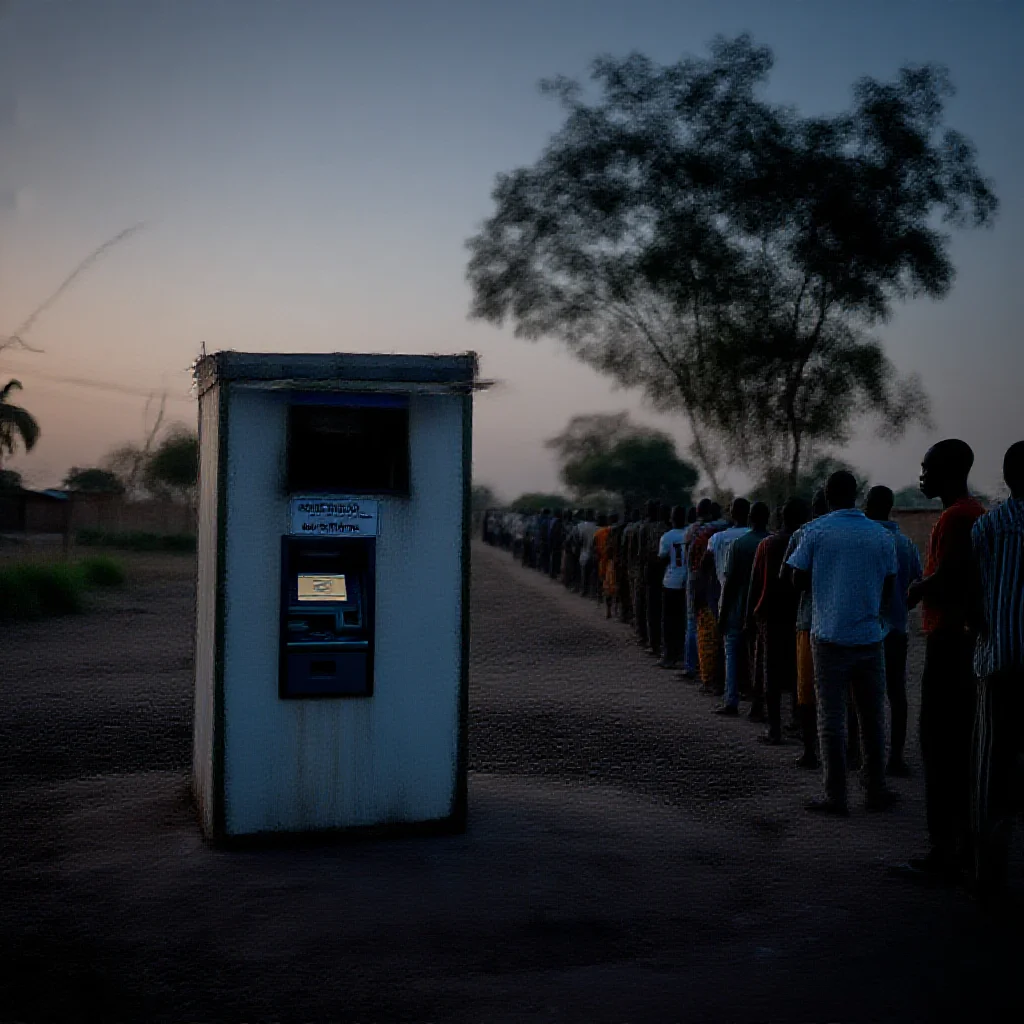
A rational analysis of root causes points to economic and operational pressures. Chronic power instability imposes high costs for generators and fuel. Vandalism and security concerns necessitate expensive safeguards. In areas with lower transaction volumes, particularly rural ones, the revenue from interchange fees may not justify these operational expenditures. The logical outcome for financial institutions is deferred maintenance or de facto abandonment of terminals in less profitable locations. This creates a category of "ghost ATMs"—physical structures that are non-functional, eroding public trust in the formal banking system.
The consequence is a vicious cycle. Non-functional ATMs diminish utility and reliability, discouraging adoption and use of formal accounts. This pushes individuals toward informal financial mechanisms, which lack security and regulatory protection. Reduced usage further depresses the profitability of maintaining the infrastructure, justifying further neglect. The cycle reinforces exclusion rather than mitigating it.
The Human Geography of Exclusion: Rural Realities and the Proximity Barrier
The EFInA survey data provides the human context for the hardware failure. With 64% of Nigerian adults residing in rural areas (Source 1: [EFInA Survey 2023]), the infrastructure disparity directly impacts the majority. For 35% of unbanked adults, proximity to a financial access point remains a primary barrier (Source 1: [EFInA Survey 2023]). "Proximity" in this context is not merely convenience; it defines economic participation.
The implication extends beyond cash withdrawal. It affects the ability to deposit savings securely, access formal credit, receive government social transfers, or perform basic merchant payments. A rural smallholder farmer may face a multi-hour journey to reach a bank branch or ATM, only to find it non-operational. This transaction cost—in time, travel expense, and opportunity loss—is prohibitive. It incentivizes the hoarding of physical cash, with attendant risks of theft, loss, and inflation erosion, and perpetuates reliance on local, often exploitative, informal lenders.
The urban-rural chasm becomes a financial services chasm. The urban customer experiences choice and redundancy among multiple functional ATMs, agency banking outlets, and digital apps. The rural dweller experiences a monopoly of absence, where the failure of a single local terminal can sever a community's link to the formal financial system.
Beyond ATMs: Rethinking Financial Access in an Infrastructure-Constrained Ecosystem
The concurrent trends of high exclusion and failing ATM networks necessitate a strategic pivot. The solution cannot be a linear expansion of a demonstrably fragile and economically challenging physical ATM network, particularly in rural areas. The logical progression is towards infrastructure-light, agent-based, and mobile-centric models.
Agent banking networks, where licensed retail outlets offer basic financial services, present a more scalable and cost-effective model for last-mile coverage. These agents operate with lower overhead and can be viable in lower-transaction environments. Their success, however, is contingent on robust digital rails and liquidity management.
The future trajectory will be determined by the integration of these channels. USSD and mobile money platforms must achieve seamless interoperability with agent networks and, crucially, provide reliable cash-in/cash-out functionality. The role of the ATM will likely evolve to become a high-volume, urban-centric liquidity hub supporting these digital channels, rather than the primary frontline access point.
Market predictions indicate that financial institutions prioritizing integrated, hybrid networks—combining targeted ATM placement for liquidity management with dense agent networks for access—will capture the excluded segment. Regulatory policy that incentivizes agent network expansion and ensures interoperability will be a more decisive factor in closing the financial exclusion gap than investments in a standalone, decaying ATM fleet. The infrastructure crisis, therefore, may catalyze a necessary leapfrog to a more resilient and inclusive financial ecosystem.
(All rights reserved by Global Beacon Chronicle. Unauthorized reproduction is prohibited.)
Zhang Wei / Zhang Wei
Global business observer focusing on multinational enterprise strategy.