Africa''s Refining Revolution: The 2026 Capacity Map and Its Geopolitical
A projection of Africa''s seven largest oil refineries by 2026 reveals more

Africa's Refining Revolution: The 2026 Capacity Map and Its Geopolitical Implications
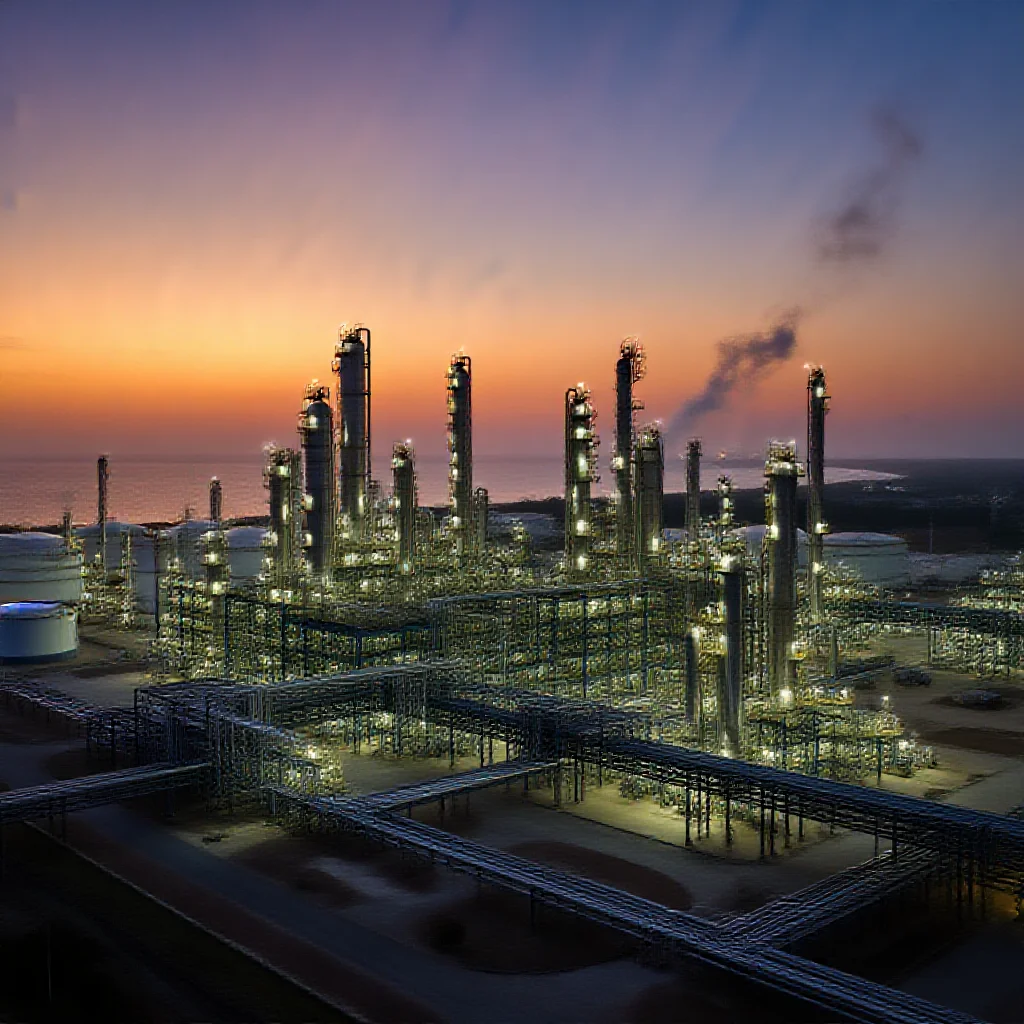
A dramatic, wide-angle aerial view of a massive, modern oil refinery complex at dusk, with intricate networks of pipes and towering distillation columns silhouetted against a vibrant orange and purple sky, located on an African coastline. No people, no text, no watermark.
Introduction: Beyond the Barrel Count – Decoding Africa's 2026 Refining Landscape
Projected data for 2026 ranks seven African oil refineries by their crude oil refining capacity, measured in barrels per day (bpd) (Source 1: [Primary Data]). The Dangote Refinery in Nigeria leads with 650,000 bpd, followed by Algeria's Skikda Refinery (365,000 bpd), Nigeria's Port Harcourt Refinery (210,000 bpd), Morocco's Mohammedia Refinery (200,000 bpd), Egypt's El Nasr Refinery (145,000 bpd), Egypt's Alexandria Refinery (117,000 bpd), and Algeria's M’sila Refinery (100,000 bpd) (Source 1: [Primary Data]). This list is not a static inventory but a snapshot of a strategic transformation. The ranking reveals a continent bifurcated between mega-projects for self-sufficiency and regional hubs for efficiency, with profound implications for trade, investment, and energy independence.
An infographic map of Africa highlighting the locations of the seven refineries with capacity bubbles.
The Two Tracks of African Refining: Mega-Project Gambit vs. Efficiency Cluster
The 2026 projection underscores two distinct strategic pathways. The first is the mega-project gambit, epitomized by Nigeria's Dangote Refinery. Its 650,000 bpd capacity represents a disruptive, import-substituting investment aimed at reversing a paradoxical condition: a major crude oil producer remaining a net importer of refined petroleum products. This project is a high-capacity bet on domestic value addition and energy security.
The second pathway is the efficiency cluster model, demonstrated in North Africa. Algeria's Skikda (365,000 bpd) and Egypt's combined cluster of El Nasr (145,000 bpd) and Alexandria (117,000 bpd) represent established, upgraded facilities (Source 1: [Primary Data]). These refineries function as efficient hubs serving relatively stable domestic markets and leveraging geographic positions for export to Mediterranean and European markets. Their capacities reflect incremental optimization rather than greenfield disruption.
A strategic middle tier exists between these models. Morocco's Mohammedia (200,000 bpd) and Nigeria's Port Harcourt refurbishment (210,000 bpd) function as critical national assets balancing regional supply obligations with core domestic needs (Source 1: [Primary Data]). Their operational success is pivotal for regional fuel stability.
A split-image comparison: one side showing the vast, new construction of Dangote, the other showing the complex, integrated layout of an older, upgraded refinery like Skikda.
The Hidden Supply Chain Calculus: From Crude Exporters to Fuel Traders?
The long-term impact of these capacity projections centers on the recalibration of continental and global supply chains. If the Dangote Refinery operates near its 650,000 bpd nameplate capacity, it could saturate the West African fuel market. This would alter established trade flows, potentially transforming Nigeria from a net importer to a net exporter of refined products. Such a shift would displace a significant volume of gasoline and diesel currently imported from Europe, the United States, and the Middle East.
This recalibration creates regional ripple effects. The economic viability of smaller, standalone refineries, such as Algeria's M’sila (100,000 bpd), and future planned projects may be challenged by the emergence of a regional product surplus (Source 1: [Primary Data]). Market dynamics could spur either consolidation or a push toward greater specialization in niche product streams. The strategic dependency also shifts. Nations move from reliance on product imports to a new vulnerability centered on the operational reliability of complex refineries, global crude feedstock pricing differentials, and the sustained availability of technical expertise for maintenance and optimization.
A flowchart diagram showing the shift from current crude export/product import flows to potential future refined product export flows from Africa.
Verification and Context: Projections, Challenges, and Credible Sources
The 2026 capacity list is inherently speculative, contingent on the successful completion of construction, commissioning, and financing. Historical data from industry monitors like the Oil & Gas Journal and the International Energy Agency (IEA) indicate a persistent gap between Africa's nameplate refining capacity and its actual utilization rate, often due to maintenance issues, feedstock supply problems, and operational inefficiencies. The projection for the Port Harcourt Refinery, for instance, is predicated on the successful conclusion of a long-delayed rehabilitation project.
The Dangote Refinery's projected dominance is based on its mechanical completion and phased commissioning as reported by the owning entity and construction contractors. The North African capacities are extrapolated from recent upgrade histories and stated capacity targets from national oil companies, such as Algeria's Sonatrach and Egypt's Egyptian General Petroleum Corporation (EGPC). The central verification challenge for 2026 will be the distinction between engineering capacity and sustainable throughput, a metric that will determine the real geopolitical and economic impact.
Conclusion: The Cautious March Toward Downstream Resilience
The 2026 capacity map signals a cautious but determined continental shift toward downstream resilience. The data projects a move away from pure crude extraction for export and toward capturing more value from hydrocarbon resources within African borders. The immediate effect will be a reconfiguration of intra-African and global fuel trade routes, with West Africa poised for the most dramatic change.
Market predictions remain contingent on operational execution. The success of the mega-project model in West Africa will pressure older, less efficient refineries globally and could create new African export corridors. Conversely, the efficiency cluster model in the north will likely continue to focus on serving proximate markets with competitive operational metrics. The ultimate outcome hinges not on installed capacity alone, but on the continent's ability to achieve sustained, efficient, and financially viable operations—a technical and managerial challenge that will define Africa's position in the next decade of global energy markets.
(All rights reserved by Global Beacon Chronicle. Unauthorized reproduction is prohibited.)
Zhang Wei / Zhang Wei
Global business observer focusing on multinational enterprise strategy.