Civilization
April 15, 2026 10 min read
Saturn''s Hexagon: How a 40-Year Storm Reveals the Hidden Physics of Planetary
For over four decades, a perfect geometric storm—a 20,000-mile-wide hexagon—has

Liu Yan
Liu Yan · Senior Columnist
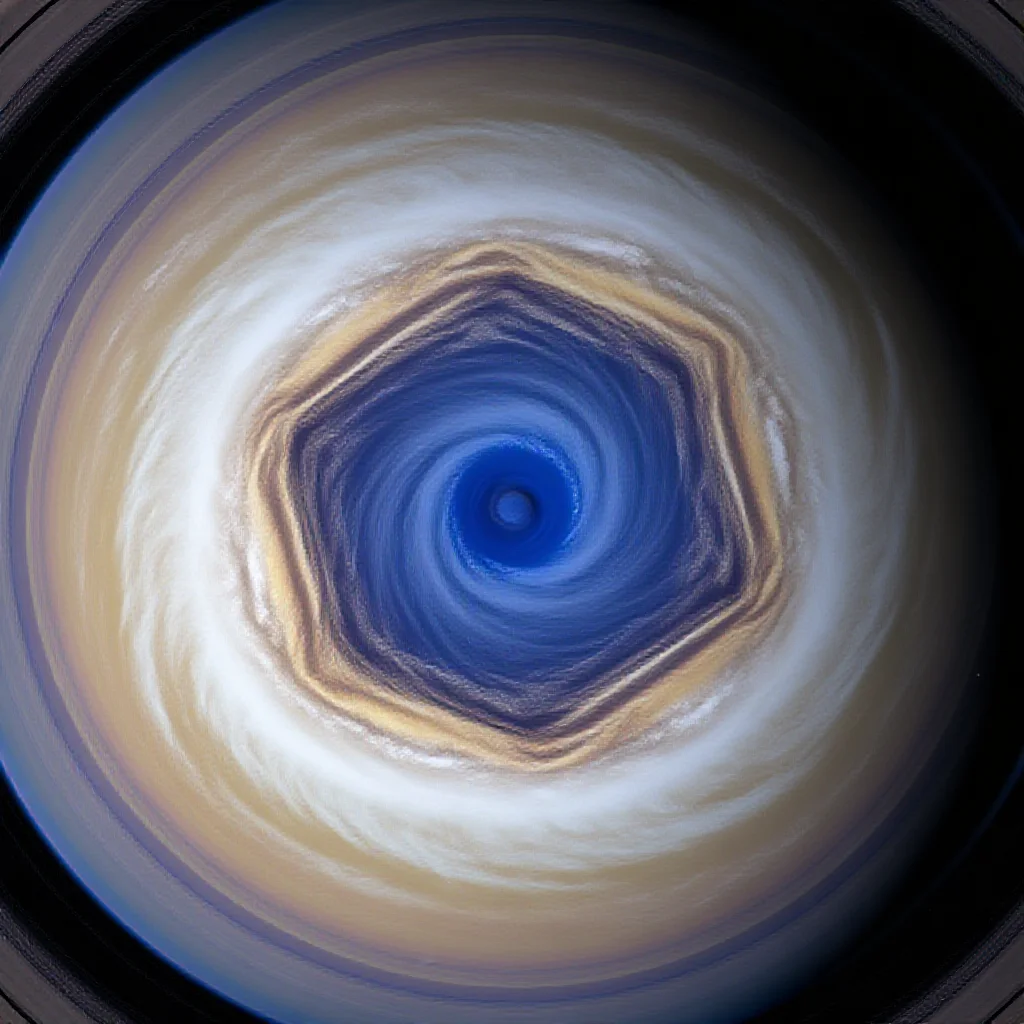
Saturn's Hexagon: How a 40-Year Storm Reveals the Hidden Physics of Planetary Atmospheres
Introduction: The Perfect Storm – A Geometric Anomaly in the Sky
A stable, hexagonal jet stream approximately 20,000 miles wide has persisted at Saturn's north pole for over four decades, a geometric atmospheric feature not observed on any other world (Source 1: [Primary Data]). First imaged by the Voyager 1 spacecraft in 1980, this structure was later studied in detail by the Cassini mission. The phenomenon represents more than a planetary curiosity; it functions as a long-term, natural physics experiment, providing empirical data on fluid dynamics under conditions impossible to replicate in terrestrial laboratories.The Observational Timeline: A 40-Year Data Harvest from Voyager to Cassini
The understanding of the hexagon is the product of sustained, multi-mission observation. Voyager 1's initial photographic evidence in 1980 provided the first data point (Source 1: [Primary Data]). The Cassini-Huygens mission, a joint venture of NASA, ESA, and ASI launched in 1997, arrived at Saturn in 2004 and operated until 2017 (Source 1: [Primary Data]). A key milestone was the Saturnian equinox in August 2009, which allowed sunlight to illuminate the northern hemisphere, bringing the north polar region into full view for Cassini's instruments by approximately 2012 (Source 1: [Primary Data]). This multi-decade dataset proved the hexagon's permanence. The feature, centered at 78° north latitude and approximately 100 km deep, showed negligible change in latitude, surviving multiple Saturnian seasons, each lasting more than seven Earth years due to Saturn's 30-year orbital period (Source 1: [Primary Data]).Core Axis: The Hexagon as a Rosetta Stone for Planetary Fluid Dynamics
The hexagon's stability provides critical boundary conditions for complex atmospheric models. It acts as a control experiment for theories of jet stream formation and stability on gas giants. Analysis indicates the shape is sustained by an eastward-moving jet stream traveling at roughly 360 km/hr, interacting with slower-moving airflow at lower latitudes (Source 1: [Primary Data]). The phenomenon's roots in fundamental physics, rather than Saturn-specific chemistry, were demonstrated through Earth-based laboratory experiments. Rotating fluid tanks have successfully replicated polygonal flow patterns, including hexagons, validating the underlying fluid dynamic principles (Source 1: [Primary Data]). Furthermore, Cassini observed a hurricane-like vortex with a well-defined eyewall at the hexagon's center, similar to a feature previously documented at Saturn's south pole in 2006 (Source 1: [Primary Data]). This nested structure offers a compound system for studying vortex dynamics.Deep Entry Point: Beyond Saturn – Implications for Exoplanet Characterization
The physics elucidated by Saturn's hexagon establishes a template for interpreting atmospheric data from exoplanets. The confirmed existence of stable, non-circular atmospheric patterns on a gas giant allows astrophysicists to model similar phenomena on distant "hot Jupiters." The knowledge derived from this decades-long observation directly influences the design of future space telescopes and the development of atmospheric retrieval algorithms. It provides a concrete framework for decoding spectral and photometric data, thereby shaping the foundational methodologies of comparative exoplanetology. The long-term atmospheric behavior observed—including changes in coloration, such as the north pole's blue hue attributed to methane (Source 1: [Primary Data])—informs models of seasonal and chemical cycles on tidally locked or highly inclined exoplanets.Conclusion: Neutral Analysis of Future Trajectories
The continued analysis of archival data from the Voyager and Cassini missions will refine existing fluid dynamics models. The primary industry impact will be seen in the development of more sophisticated computational simulations for planetary atmospheres, applicable to both solar system gas giants and exoplanetary models. Future missions to Uranus and Neptune may seek similar persistent atmospheric structures, testing the universality of the physics observed at Saturn. Investment in high-performance computing for climate modeling and exoplanet atmospheric characterization is predicted to increase, driven by the need to interpret complex, non-linear phenomena evidenced by features like the polar hexagon. The feature remains a benchmark for validating theories of planetary-scale fluid dynamics.(All rights reserved by Global Beacon Chronicle. Unauthorized reproduction is prohibited.)
Liu Yan / Liu Yan
Business historian researching the intersection of tech and society.
#Saturn hexagon
#Cassini mission
#Voyager 1
#planetary atmosphere
#fluid dynamics
#polar hurricane
#gas giant
#NASA ESA ASI