Beyond the Parade: The Roman Triumph as a Political and Economic Engine
The Roman triumph is often remembered as a spectacular victory parade. However,

Beyond the Parade: The Roman Triumph as a Political and Economic Engine
Introduction: The Spectacle and Its Hidden Ledger
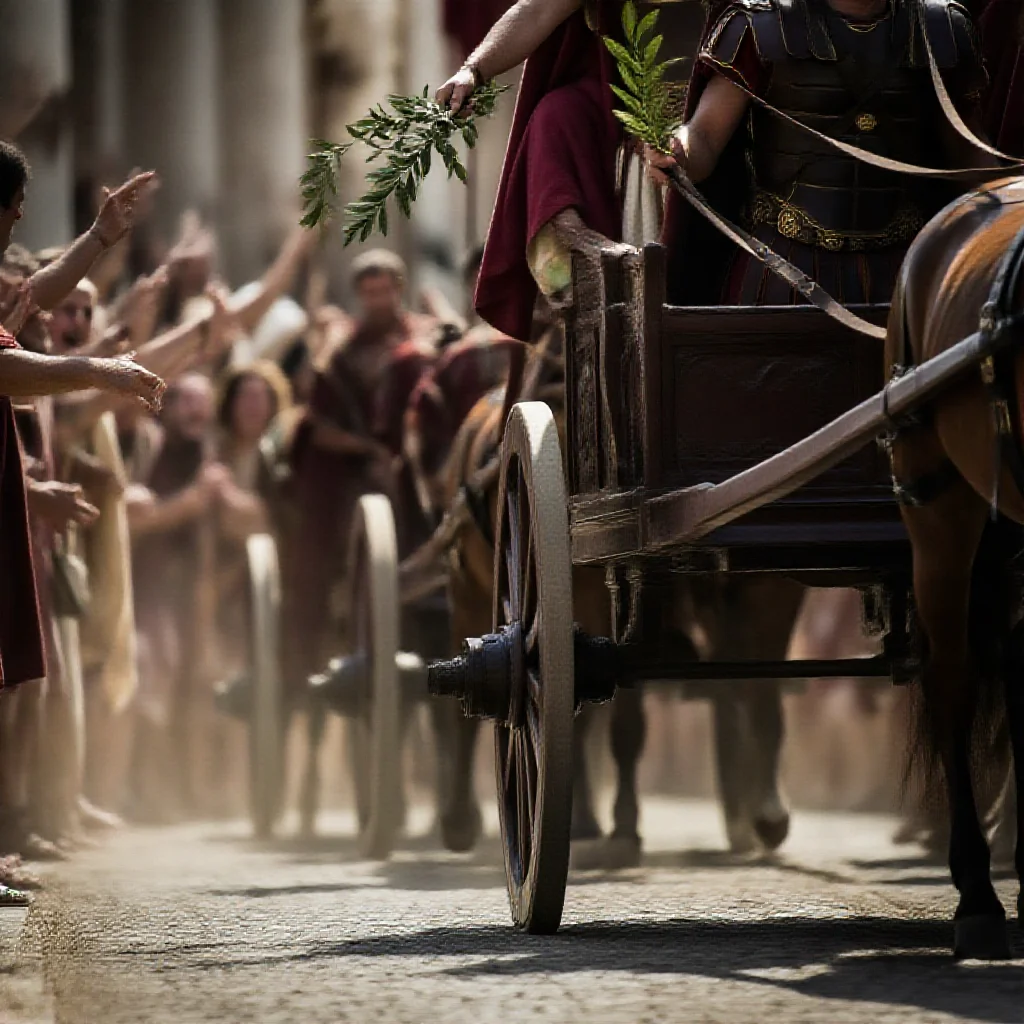
The Roman triumph is conventionally understood as a spectacular victory parade, a public celebration of military conquest. The image is iconic: a general in a gilded chariot, followed by troops, captives, and spoils, winding through the streets of Rome to the Temple of Jupiter Optimus Maximus. Historical records document approximately 300 such processions over centuries (Source 1: [Primary Data]). However, a functional analysis reveals a more complex mechanism. The triumph was not merely a celebration but a sophisticated state-controlled instrument. It functioned as a critical transaction, converting raw military power into legitimized political capital and redistributing economic wealth. This analysis aligns with scholarly deconstructions of Roman ritual, such as those by historian Mary Beard, which move beyond narrative to examine systemic function.
The Rules of the Game: Political Negotiation and Senatorial Gatekeeping
The Senate’s absolute authority to grant or deny a triumph was its foundational political feature. Victory in the field did not guarantee a procession; it required formal senatorial approval (Source 1: [Primary Data]). This gatekeeping role transformed the triumph from a military entitlement into a negotiable political prize. The subsequent debates over eligibility—concerning the scale of victory, the status of the defeated enemy, and the general’s conduct—were not bureaucratic formalities. They constituted a primary arena for internal power negotiation. This process served as a critical republican check on individual military commanders. By controlling the highest honor, the Senate could temper ambition, mediate factional rivalry, and prevent the autonomous rise of provincial warlords. The frequent political contention surrounding triumph grants (Source 1: [Primary Data]) underscores its role as a regulatory valve for military prestige.
!A depiction of Roman senators in debate within the Curia Julia (Senate House).
The Economy of Glory: Spoils, Redistribution, and Public Finance
The procession’s contents constituted a deliberate public audit of wealth extraction. The displayed captives represented future slaves, while the bullion, artifacts, and raw materials were tangible spoils of war (Source 1: [Primary Data]). The triumph, therefore, functioned as a highly publicized mechanism for injecting vast capital into the Roman state. This wealth was not merely displayed but systematically redistributed. A significant portion flowed into the state treasury (aerarium), funding public infrastructure such as temples, roads, and aqueducts. Another portion was distributed as bonuses (donativa) to soldiers, securing their loyalty. Further wealth funded the public games (ludi) that followed many triumphs. The ritual thus directly stimulated the economy, financed state projects, and purchased social stability through targeted disbursements, transforming plunder into public utility.
!A detailed still life of captured arms, armor, coins, and precious vessels displayed as spoils.
Symbolic Capital: Mimicking Jupiter and Manufacturing Consent
The general’s appearance was a carefully calibrated exercise in symbolic appropriation. Dressed in the regalia of Jupiter Optimus Maximus, his face painted with red minium, he temporarily embodied divine authority (Source 1: [Primary Data]). This was a dangerous and potent form of symbolic capital. The ritual’s strict format served to contain this power. The general was accompanied by a public slave who whispered reminders of mortality, and the procession followed a mandated route. The climax was not the general’s moment of personal glory but the public sacrifice of a white bull at Jupiter’s temple (Source 1: [Primary Data]). This act performed a crucial transfer: the wealth and victory, temporarily associated with the general, were formally returned to the gods and the Roman state. The ritual manufactured public consent for the commander’s authority while simultaneously subordinating that authority to senatorial and divine order.
The Triumph’s Evolution: From Republican Tool to Imperial Prop
The ritual’s function shifted decisively with the transition from Republic to Principate. Under the Republic, it was a tool for managing competition within a senatorial oligarchy. Under the emperors, this competitive aspect became obsolete. The right to celebrate a triumph was gradually restricted to the imperial family, culminating in the emperor’s monopolization of the honor. The triumph was transformed from a contested political prize into a monolithic propaganda display affirming the emperor’s preeminent and unchallengeable role as supreme military victor. Its economic redistribution function was absorbed into the regularized fiscal system of the imperial state. The spectacle remained, but its core purpose evolved from regulating ambition to demonstrating dynastic permanence and imperial power.
Conclusion: The Ritual as Systemic Stabilizer
The Roman triumph was a multi-faceted stabilization mechanism. Politically, it provided a formalized channel for recognizing and containing military success. Economically, it publicized and legitimized the redistribution of conquered wealth into the Roman state’s infrastructure and social fabric. Symbolically, it created a controlled space for the temporary elevation of a commander, only to definitively re-embed him within the civic and religious hierarchy. Its evolution from a republican negotiation to an imperial monopoly reflects the broader systemic transformation of Roman governance. The triumph’s enduring legacy lies not in its pageantry but in its demonstration of how a society can institutionalize and ritualize the conversion of violent conquest into durable political and economic capital.
(All rights reserved by Global Beacon Chronicle. Unauthorized reproduction is prohibited.)
Liu Yan / Liu Yan
Business historian researching the intersection of tech and society.