Rethinking the Cradle: The Hidden Economic Logic Behind the First Civilizations
What truly defines a civilization? Beyond writing, cities, and governments,

Rethinking the Cradle: The Hidden Economic Logic Behind the First Civilizations
Introduction: Beyond the Checklist Definition
The standard academic definition of civilization rests on five pillars: a writing system, formal government, surplus food production, division of labor, and urbanization. This framework, taught in introductory history courses for decades, presents these criteria as a unified checklist for determining whether a society qualifies as "civilized." Yet the historical record reveals significant inconsistencies. The Inca Empire, which dominated the Andes from the 13th to the 16th centuries, operated without a formal writing system (Source 1: [Primary Data]), relying instead on quipu—knotted cord records for accounting—yet it is universally classified as a civilization.
The problem is structural. The checklist approach conflates correlation with causation, treating symptoms as criteria. The central argument of this analysis is that the true core of civilization is not a bundle of attributes but an economic system: a mechanism that converts agricultural surplus into urban specialization and long-distance trade. This system is the underlying engine; the five standard traits are its byproducts.
The case of Göbekli Tepe provides a critical test. Constructed circa 10,000 BCE by pre-agricultural hunter-gatherers (Source 2: [Primary Data]), this site in southeastern Anatolia features monumental stone circles weighing up to 20 tons each—architectural ambition that rivals early Mesopotamian ziggurats. Yet its builders remained semi-nomadic; no permanent city emerged around the site. The explanation is economic. Göbekli Tepe’s inhabitants lacked a surplus storage and redistribution infrastructure. Their economy was immediate-consumption hunting and gathering, which could mobilize labor for seasonal construction projects but could not sustain year-round populations of non-food-producing specialists. The architecture existed; the civilization did not.
The Economic Engine: Surplus as the Hidden Axis
Surplus food production is not merely a trait on a list; it is the catalytic mechanism that enables all other civilizational features. When a society generates more calories than its population requires for immediate survival, it gains the capacity to support non-food producers: priests, administrators, artisans, soldiers, and merchants. This creates the division of labor, which in turn generates the need for accounting, record-keeping, and eventually, writing.
The Fertile Crescent, a term coined by Egyptologist James Henry Breasted in 1916 (Source 3: [Primary Data]), provided the ecological conditions for this transformation. Breasted described it as "approximately a semi-circle, with the open side toward the south, having the west end at the south-east corner of the Mediterranean, the centre directly north of Arabia, and the east end at the north end of the Persian Gulf" (Source 4: [Primary Quote]). This arc contained wild ancestors of barley and wheat, crops that could be domesticated and stored for extended periods. The combination of predictable rainfall, fertile alluvium, and the presence of domesticable species generated the first reliable agricultural surpluses in human history.
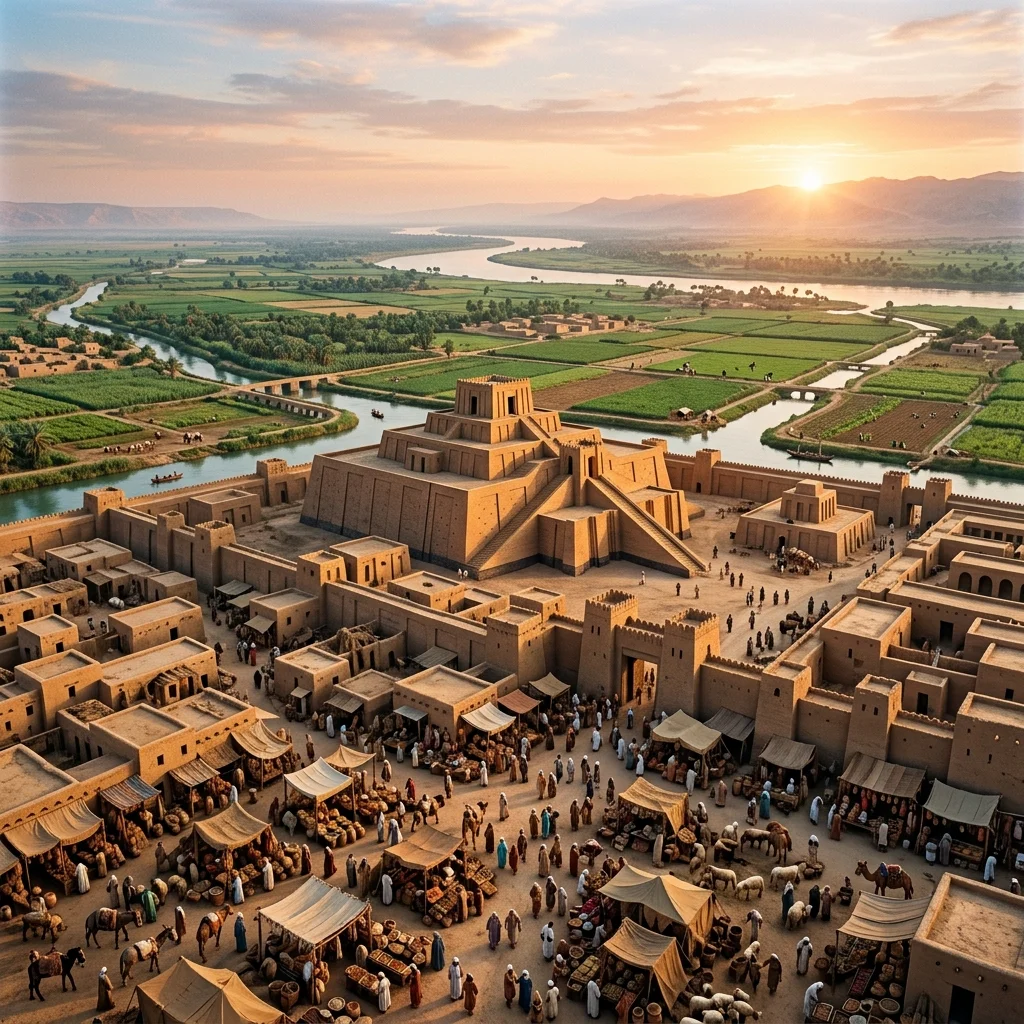
The mechanism of surplus management determined civilizational outcomes. In Mesopotamia, the alluvial plain of the Tigris and Euphrates required centralized irrigation works—canals, levees, and drainage systems—that demanded coordinated labor and administrative oversight (Source 5: [Cross-Reference Analysis]). This necessity drove the emergence of temple-based redistributive economies, where grain was collected, stored in granaries, and reallocated to workers. The temple became the first economic institution, controlling both production and distribution.
Contrast this with the Indus Valley Civilization, which emerged circa 7000 BCE and entered its Mature Harappan Period circa 2800-1900 BCE (Source 6: [Primary Data]). The Indus relied on monsoon-fed agriculture and different storage methods, including large-scale granaries at Mohenjo-daro and Harappa. However, the Indus Valley's economic logic appears trade-based rather than temple-based. Archaeological evidence of standardized weights, seals, and extensive trade networks with Mesopotamia suggests a commercial economy, not a redistributive one (Source 7: [Academic Consensus]). The absence of monumental palaces or temples in Indus cities supports this interpretation.
The implication is clear: civilizations that failed to develop effective surplus management systems—adequate storage infrastructure, redistribution networks, or trade mechanisms—either collapsed or remained semi-nomadic. Göbekli Tepe represents the latter: sufficient surplus for episodic construction, insufficient infrastructure for permanent settlement.
Urbanization as a Logistics Problem, Not Just a City
Urbanization is frequently emphasized as the central requirement of civilization, rooted in the term's etymology: civis (citizen) and civitas (city) in Latin. A civilization cannot be nomadic by definition. Yet urbanization is not merely about population density or defensive walls; it is fundamentally a logistics problem. Permanent settlement requires a reliable system for moving food from agricultural fields to non-farming urban populations on a daily basis.
The chronological record reveals significant disparities in urbanization timing. The Mesopotamian city of Eridu was founded circa 5400 BCE (Source 8: [Primary Data]), predating the oldest Egyptian cities by over a thousand years—Egypt's earliest urban centers date to circa 4000 BCE (Source 9: [Primary Data]). The explanation lies in ecological pressure. The Tigris-Euphrates alluvium, prone to unpredictable flooding and salinization, demanded centralized irrigation management. This created an early imperative for concentrated settlement around administrative and religious centers. Egypt, by contrast, relied on the Nile's predictable annual floods, which distributed water and fertile silt across the floodplain naturally. This allowed for dispersed agricultural communities long before urbanization occurred.
The Indus Valley presents a third model. Harappa and Mohenjo-daro, constructed during the Mature Harappan Period (circa 2800-1900 BCE), demonstrate sophisticated urban planning: grid layouts, advanced drainage systems, and standardized brick sizes (Source 10: [Primary Data]). The Great Bath of Mohenjo-daro, a water-tight brick structure, suggests public water management that rivaled Roman systems. This infrastructure points to a different economic logic—one based on trade networks connecting the Indus to Mesopotamia via the Persian Gulf, rather than temple-based redistribution. Indus cities were commercial hubs, not administrative centers.
The logistics of urbanization create feedback loops. Concentrated populations generate demand for specialized goods—pottery, metals, textiles—which drives craft specialization and long-distance trade. Trade, in turn, creates the need for accounting, standardization, and contract enforcement. These requirements push the development of writing and formal legal systems. Urbanization is not an endpoint; it is a process that, once initiated, generates the remaining features of civilization through economic necessity.
The Writing System as Economic Ledger (Not Just Literature)
The invention of writing is conventionally treated as a mark of intellectual achievement—the capacity to record language, literature, and history. Archaeological evidence, however, indicates that early writing systems emerged from accounting, not art. Cuneiform script in Sumer, appearing circa 3200 BCE (Source 11: [Primary Data]), began as a system of clay tokens and pictographs used to record grain, livestock, and tax obligations. The earliest cuneiform tablets are ledgers, not poetry.
This origin is consistent across civilizations. Egyptian hieroglyphs, emerging circa 3200 BCE, were used for administrative record-keeping before they were applied to monumental inscriptions. The Indus Valley script, which remains undeciphered, appears on seals and pottery primarily in trade contexts. The Chinese oracle bone script, dating to the Shang Dynasty (circa 1600-1046 BCE), was used for divination but also recorded royal hunts, harvests, and tributes.
The economic function of writing is direct. Surplus management at scale requires accountability: records of who contributed what, who received what, and what remained in storage. Without writing, these records are limited to human memory and oral tradition, which degrade over time and across generations. Writing enabled the accumulation of institutional knowledge, allowing economic systems to scale beyond the limits of individual recall.
The implications for civilization definition are significant. The Inca, lacking a writing system, developed quipu—knotted cords that encoded numerical data and possibly narrative information. This system served the same economic function as writing: recording tributes, census data, and agricultural production for the centralized Inca state (Source 12: [Cross-Reference Analysis]). The Inca case demonstrates that writing per se is not necessary for civilization—but the economic function of record-keeping is.
This reframes the question from "Did they have writing?" to "How did they manage surplus without writing?" The Inca answer was an elaborate system of knotted cords combined with trained memory specialists. It was less efficient than writing but functionally equivalent. The real civilizational threshold is not the technology of writing but the capacity for recorded economic administration.
Temporal and Definitional Paradoxes
The chronological data presents significant challenges to the standard definition. Göbekli Tepe (circa 10,000 BCE) predates Eridu (circa 5400 BCE) by nearly five millennia, yet Göbekli Tepe's builders were semi-nomadic hunter-gatherers, while Eridu is considered the first city and the cradle of Sumerian civilization. If monumental architecture is a marker of civilization, Göbekli Tepe qualifies before Mesopotamia. If permanent settlement is required, it does not.
Similar paradoxes emerge with the Indus Valley Civilization. Its earliest settlements date to circa 7000 BCE (Source 13: [Primary Data]), contemporaneous with early Mesopotamian development and predating Sumer's urbanization. Yet the Indus is not typically classified as the "first" civilization, partly because its script remains undeciphered and partly because its cities appeared later. The timing of civilization appears to depend on which criterion is prioritized.
The Egyptian civilization, spanning 6000-30 BCE (Source 14: [Primary Data]), overlaps with both Mesopotamia and the Indus Valley. Egypt developed urbanization later than Mesopotamia but achieved political unification earlier, around 3100 BCE. The Nile's predictable flows enabled early state formation without early cities—a reversal of the Mesopotamian pattern.
China's Xia Dynasty, traditionally dated circa 2070-1600 BCE (Source 15: [Primary Data]), appears late by comparison, though permanent settlements along the Yellow River existed by 5000 BCE. Chinese civilization developed in relative isolation, with its own trajectory of surplus management, urbanization, and writing. The time gap suggests that the economic logic of civilization is universal, but its expression is contingent on local ecology and resource distribution.
Reconstructing the Economic Definition
The evidence points toward a revised definition of civilization, centered not on a checklist of traits but on the presence of a self-sustaining economic system. A civilization can be defined as a human society that has developed the institutional infrastructure—storage, transport, record-keeping, and contract enforcement—to convert agricultural surplus into sustained urban specialization and interregional trade.
This definition resolves the paradoxes. Göbekli Tepe had monumental architecture but lacked the economic infrastructure for sustained urbanization; it is therefore a pre-civilizational society, not a civilization. The Inca had no writing but had a functional record-keeping system (quipu) and sophisticated surplus management; they qualify. The Indus Valley, despite its undeciphered script, clearly had trade networks, standardized weights, and urban planning; it qualifies.
The Fertile Crescent remains the "cradle" not because of any inherent superiority but because its ecology generated the earliest reliable agricultural surplus, which in turn created the first pressure for administrative innovation. The Tigris-Euphrates alluvium demanded cooperation and record-keeping. The Nile offered abundance with less administrative necessity, delaying urbanization. The Indus offered monsoon reliability and trade routes, producing a commercial civilization rather than a bureaucratic one.
Conclusion: Implications for Contemporary Understanding
The economic logic that drove early civilizations remains operative in modern economies. Surplus management, division of labor, urbanization, and record-keeping are not historical curiosities; they are the foundational structures of contemporary economic life. The difference is one of scale and technology, not of kind.
For the field of archaeology and history, this analysis suggests a reclassification of early societies. The checklist definition, inherited from nineteenth-century scholarship and enshrined in textbooks, obscures more than it reveals. A functional definition—based on economic infrastructure rather than cultural traits—provides greater analytical precision and cross-cultural applicability.
For future research, the key questions shift from "Did they have writing?" to "How did they manage surplus?" and from "Were they urban?" to "What economic function did their settlements serve?" The Indus Valley's trade-based economy, Egypt's riverine abundance, and Mesopotamia's irrigation imperative each generated distinct civilizational forms. Understanding these differences requires analyzing their economic logic, not measuring them against a universal checklist.
The conventional "cradle of civilization" narrative—linear, progressive, centered on Mesopotamia—requires revision. Multiple cradles existed, each responding to its ecological context with different institutional solutions. The true story of early civilization is not the triumph of one region over others but the parallel development of economic systems that converted agricultural surplus into human complexity.
(All rights reserved by Global Beacon Chronicle. Unauthorized reproduction is prohibited.)
Liu Yan / Liu Yan
Business historian researching the intersection of tech and society.