Rethinking Civilization: From Surplus Extraction to Social Classification
This article explores the hidden economic logic behind definitions of 'civilization,

Rethinking Civilization: From Surplus Extraction to Social Classification – An Anthropological Deep Dive
Introduction: The Elusive Definition of Civilization
The word “civilization” first appeared in 1756, buried in the pages of Victor de Riqueti, marquis de Mirabeau’s L’Ami des hommes. For Mirabeau, it was not a neutral descriptor but a banner of Enlightenment optimism: the belief that human societies could—and should—climb toward refinement, order, and moral improvement. Two and a half centuries later, the term remains as contested as it is ubiquitous.
Today, two competing definitions coexist uneasily. In popular usage, “civilization” evokes cathedrals, legal codes, scientific breakthroughs, and the bustling machinery of government—a shorthand for “high culture.” In technical anthropological and archaeological usage, however, the word denotes something far more specific: large, complex societies built on domesticated plants and animals, characterized by hierarchy, specialization, and centralized control. This article peels back those definitions to reveal the hidden economic logic—surplus extraction and its social consequences—that underpins nearly every technical classification of civilization. In doing so, it questions whether the term can ever be disentangled from its value-laden Enlightenment origins.
[IMAGE: A split image: left side showing a medieval city with cathedrals (popular image of civilization), right side showing a dig site with ancient pottery and tools (archaeological perspective).]
1. The Birth of ‘Civilization’ and the Enlightenment Mindset
Mirabeau’s 1756 coinage did not emerge in a vacuum. It reflected a broader Enlightenment conviction that history moved in a single, progressive direction: from savagery through barbarism to civilization. This teleological narrative—the idea that human societies naturally advance toward refinement—was embedded in the very DNA of the word. To be “civilized” was to be polished, rational, and orderly; to be “uncivilized” was to be crude, superstitious, and stagnant.
Later anthropologists tried to shed this value-laden baggage. But the stain remains. The California History-Social Science Framework, for example, still organizes world history around the “cradles of civilization”—Mesopotamia, Egypt, the Indus Valley, and China—implying that these regions were the launching pads of a universal human trajectory. National standards similarly teach students that civilization emerged when people stopped wandering and started building cities. The underlying message is clear: settled, hierarchical, state-organized societies are the apex of human achievement.
Yet this narrative ignores a crucial question: what exactly made those early cities and states possible? The answer, as we shall see, lies not in cultural genius but in economic extraction.
[IMAGE: Portrait of Victor de Riqueti, marquis de Mirabeau, with an open book showing the phrase L'Ami des hommes in the background.]
2. V. Gordon Childe and the Archaeological Checklist: The Economic Logic of Surplus
No single thinker shaped the technical definition of civilization more than V. Gordon Childe. An Australian-born archaeologist who spent most of his career teaching at the University of Edinburgh and later at University College London, Childe was a Marxist who saw history through the lens of material conditions. In his 1950 essay “The Urban Revolution,” he proposed a checklist of ten traits that distinguish a civilization from earlier societies:
- Large, permanent urban settlements
- Full-time specialists (craftspeople, scribes, priests, administrators)
- Primary producers (farmers, herders) who pay surpluses to support the elite
- Monumental public architecture (temples, palaces, fortifications)
- A ruling class that extracts and redistributes surplus
- Writing or recording systems
- Predictive sciences (calendars, mathematics)
- Monumental art styles
- Long-distance trade in luxury goods
- State organization based on residence rather than kinship
At the heart of Childe’s checklist lies an explicitly economic mechanism: the domestication of plants and animals created a reliable food surplus. That surplus could then be extracted by an emerging elite—priests, warriors, or kings—who used it to sustain specialists, build monuments, and maintain coercive power. Without surplus, there could be no specialization; without specialization, no hierarchy; without hierarchy, no state. Civilization, in Childe’s view, was not simply a cultural achievement; it was a system of extraction and control.
[IMAGE: A diagram illustrating Childe’s checklist with icons: a city wall (urban center), a potter (specialist), a grain silo (surplus), a ziggurat (monumental architecture), and a cuneiform tablet (writing).]
3. From Bands to Bureaucratic States: Classifying Societies Without Value Judgement?
Childe’s checklist provided archaeologists with concrete criteria, but it did not solve the problem of value judgments. In 1962, American anthropologist Elman Service proposed a four-tier classification of societies—band, tribe, chiefdom, state—that aimed to be neutral and evolutionary. Bands were small, egalitarian hunter-gatherer groups; tribes had part-time leaders and limited agriculture; chiefdoms had permanent hierarchies and redistribution; states had centralized government, social classes, and monopoly on force.
Service’s typology became widely used, especially in archaeology and political anthropology. It allowed researchers to compare societies across time and space without explicitly calling one “more civilized” than another. Yet the underlying assumption of directionality—that societies move from simple to complex—was hard to escape. A band might be “simpler” than a state, but does that make it less sophisticated? Many anthropologists since Service have argued that complexity is not synonymous with better, and that hunter-gatherer societies often enjoyed greater leisure time, better nutrition, and more egalitarian social relations than their agricultural neighbors.
In the 1970s and 1980s, critics pointed out that Service’s scheme still carried a teleological whiff: it implied that “progress” toward the state was inevitable and desirable. The term “civilization” itself became suspect, seen by some as a tool of colonial and imperial discourse. Yet the need to classify and compare remains central to archaeology and anthropology. The challenge is to classify without ranking—to describe differences in social complexity without assigning moral superiority.
4. Cynthia Stokes Brown: Redefining Civilization for the 21st Century
Cynthia Stokes Brown, a historian of big history, offered a more synthetic definition in her 2007 work Big History: From the Big Bang to the Present. She defined civilization as “a complex human society that has achieved a level of cultural and technological development sufficient to allow a large population to live in cities, with a system of social classes, a state structure, and a system of writing or record-keeping.” Her definition emphasizes three key elements: urbanism, hierarchy, and recorded knowledge.
What sets Brown apart is her insistence that civilization is not a single step but a spectrum. She explicitly states that many societies have exhibited “civilized” traits without possessing all of them—for example, the Inca had cities and a state but no writing (using quipus instead), while the Maya had writing and cities but a more fragmented political structure. Brown also highlights the costs of civilization: social inequality, warfare, environmental degradation, and the loss of autonomy for most individuals. She does not romanticize the Neolithic revolution; instead, she frames civilization as a trade-off—a package of benefits and burdens that emerged in multiple centers independently.
5. Jared Diamond: Agriculture as the “Worst Mistake in the History of the Human Race”
No critique of the traditional civilization narrative is more provocative than Jared Diamond’s 1987 article “The Worst Mistake in the History of the Human Race,” later expanded in his book Guns, Germs, and Steel (1997). Diamond argues that the adoption of agriculture—the very foundation of surplus that Childe celebrated—was actually a disaster for human health, equality, and well-being.
Drawing on skeletal evidence, Diamond shows that early farmers were shorter, more prone to disease, and suffered from more dental cavities and nutritional deficiencies than their hunter-gatherer predecessors. Agriculture concentrated populations, leading to epidemics; it allowed elites to hoard food, creating famine for the masses; it required backbreaking labor, reducing leisure time. Diamond’s evidence suggests that the “Neolithic Revolution” was not an improvement in living standards but a demographic trap—a shift that allowed more people to survive, but at a lower quality of life.
Diamond does not deny that agriculture eventually enabled the growth of complex societies. But he insists that we should not confuse directionality (change over time) with progress (value-laden improvement). The transition from foraging to farming was not a step forward but a Faustian bargain: population growth came at the cost of individual well-being. The surplus that Childe saw as the engine of civilization, Diamond sees as the fuel for inequality and exploitation.
[IMAGE: A comparison graphic: left side showing a hunter-gatherer camp with diverse food sources and leisure; right side showing an agricultural village with grain silos, a temple, and laborers, with overlaid health statistics (shorter stature, higher disease rates).]
Conclusion: Surplus, Classification, and the Unfinished Argument
The definitions of civilization proposed by Childe, Service, Brown, and Diamond all circle back to the same economic core: surplus extraction. Once a society produces more food than it needs for immediate survival, someone—elites, priests, warriors—can claim that surplus and use it to build monuments, support specialists, and enforce hierarchy. That, in essence, is what anthropologists mean when they talk about civilization.
But the term remains slippery. Diamond’s critique forces us to ask whether the extraction of surplus is a sign of “achievement” or a symptom of exploitation. Service’s classification tries to be neutral, yet the very act of classifying societies into bands, tribes, chiefdoms, and states implies a ladder of complexity that easily becomes a ladder of value. Brown’s spectrum approach acknowledges nuance, but still anchors civilization in urbanism and record-keeping, which are themselves products of surplus.
Perhaps the most honest conclusion is that “civilization” is an unavoidably political word. It was born in the Enlightenment as a rallying cry for progress, and despite a century of anthropological attempts to neutralize it, the term still carries a normative charge. When we call a society “civilized,” we are doing more than describing it—we are ranking it, implicitly or explicitly, on a scale of human development.
The challenge for the modern scholar, historian, or journalist is to use the term with care: to recognize its economic underpinnings, to acknowledge its costs as well as its benefits, and to resist the teleological temptation that has haunted it since Mirabeau first put pen to paper. Civilization, in the end, is not a destiny but a choice—a system of organization that emerged again and again across the globe, not because it was inevitable, but because it offered advantages to those who could control its central resource: surplus.
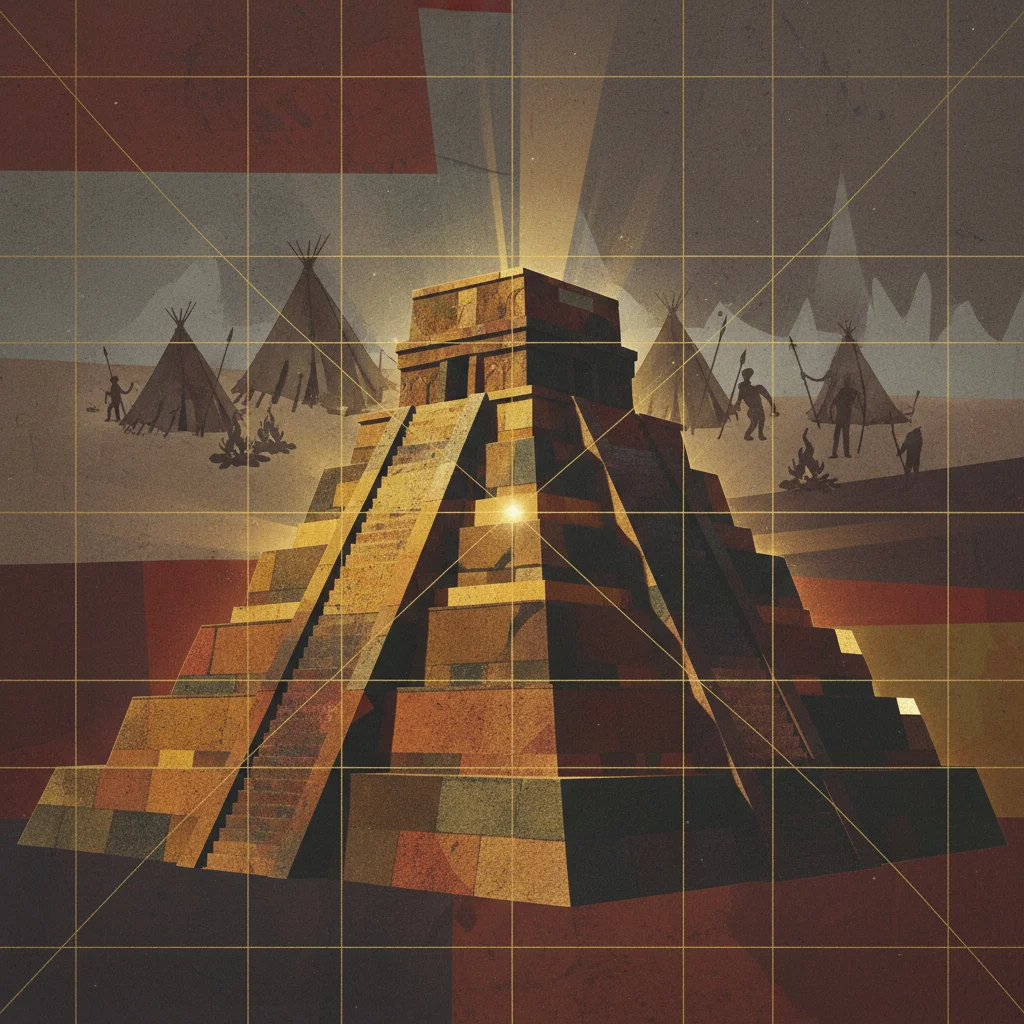
[IMAGE: An abstract collage blending a stylized ancient Mesopotamian ziggurat with a faint outline of a hunter-gatherer camp, overlaid with a subtle grid pattern representing classification. No text, no watermark. Moody earth tones with a touch of gold light. The image should convey the tension between complexity and primitive simplicity.]
(All rights reserved by Global Beacon Chronicle. Unauthorized reproduction is prohibited.)
Liu Yan / Liu Yan
Business historian researching the intersection of tech and society.