The Illusion of Now: How Your Brain''s Predictive Lag Creates the Present
Our experience of the 'present moment' is not a real-time feed but a carefully

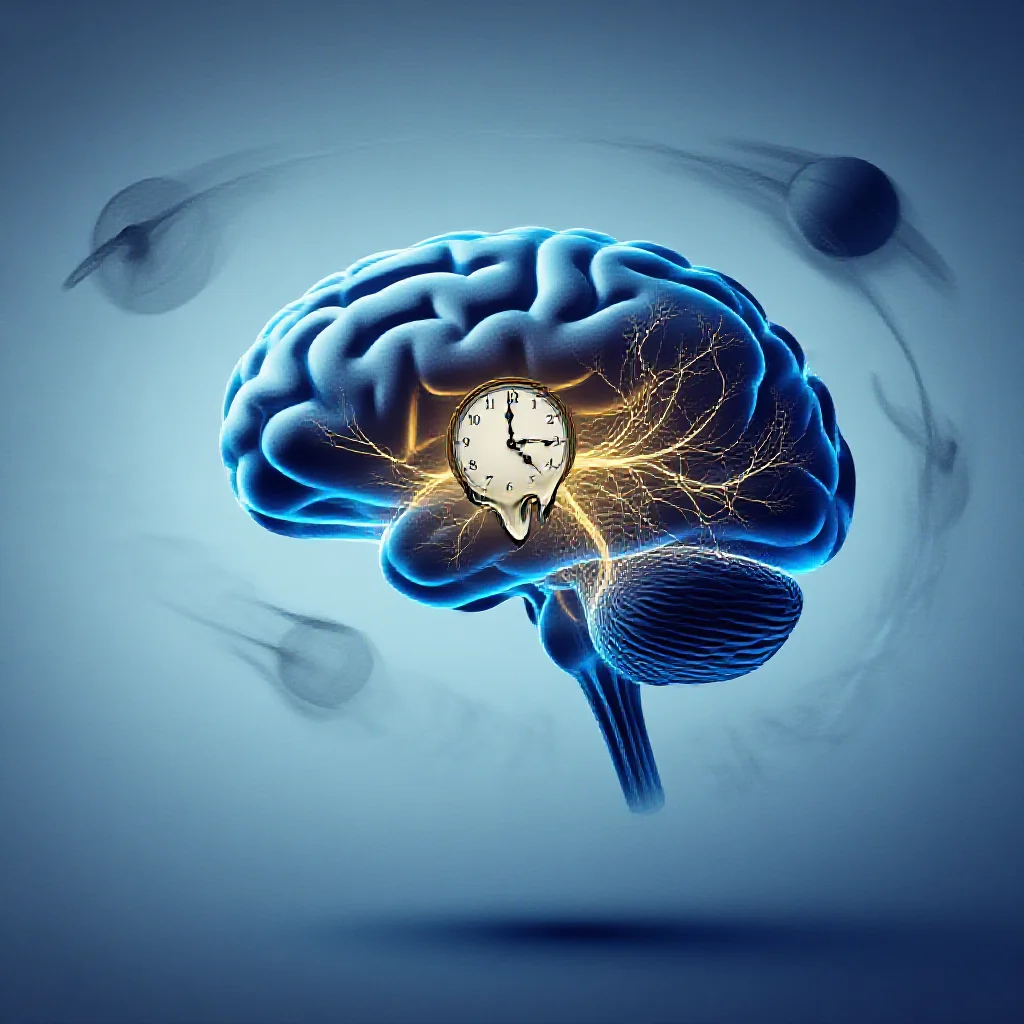
The Illusion of Now: How Your Brain's Predictive Lag Creates the Present Moment
Summary: The conscious experience of the "present moment" is not a real-time feed but a constructed narrative. Neuroscientific evidence indicates a consistent delay of approximately 80 milliseconds between an external event and conscious awareness. To create a coherent "now," the brain employs post-dictive and predictive mechanisms, integrating information from different times. This architecture has fundamental implications for understanding consciousness and for designing future technologies.
---
The Unavoidable Lag: Why We Live in the Past
The perception of experiencing reality in real time is a persistent cognitive illusion. The physics of perception imposes an inherent and unavoidable delay. Light and sound travel at finite speeds, and upon reaching sensory organs, the conversion into electrochemical signals and their transmission along neural pathways requires measurable time. The cumulative effect is a lag between an external event and its registration in the brain's cortical processing centers.
This lag can be quantified. Research integrating data from sensory physiology and timing perception experiments suggests the conscious present is delayed by roughly 80 milliseconds (Source 1: [Primary Data]). This interval represents the minimum processing time required for a stimulus to reach awareness. A further complication is the problem of temporal integration: sensory data from different modalities arrive at different speeds. The light from a distant firework reaches the eye almost instantaneously, while its sound arrives later. The brain must reconcile these asynchronous inputs to construct a unified event.
The initial neural challenge is not merely delay, but the management of staggered data streams to prevent a disjointed perceptual reality.
The Brain's Editing Suite: Prediction and Post-Diction
To overcome this inherent lag and create a seamless present, the brain functions as an advanced editing suite, utilizing both post-diction and prediction.
Post-diction refers to the brain's use of information from the immediate future to revise the perceived past. A seminal demonstration of this is the "flash-lag" illusion. In this experiment, a moving object is aligned with a flashing light. Observers consistently perceive the flash as lagging behind the moving object, even when they are physically coincident (Source 2: [Primary Data]). The brain incorporates the moving object's trajectory after the flash occurs, retroactively editing the perceived position of the flash to create a more accurate, coherent narrative of motion. This mechanism suggests that what is perceived as "now" is actually a narrative assembled from a brief window of past sensory information.
Concurrently, the brain engages in constant prediction. Based on prior experience and ongoing sensory input, it generates forecasts of the immediate future. This predictive processing compensates for the lag by pre-empting likely outcomes, allowing for faster reactions. As physicist and science communicator Jim Al-Khalili has noted, "We think we're experiencing the world in real time... but we're not." The perceived present is, in effect, a best-guess simulation that is continuously updated, a story "told after the fact."
Beyond Philosophy: The Hidden Economic and Technological Logic
The brain's predictive architecture operates on a logic that extends beyond biology into economics and engineering. Neural processing can be framed as a resource-constrained system engaging in a continuous cost-benefit analysis. High-fidelity, accurate processing is metabolically expensive and slow. Prediction offers an efficient shortcut, trading some accuracy for significant gains in speed and energy conservation. The brain operates a "prediction market," where prior probabilities shape current perception to optimize survival responses within a delayed reality.
This biological imperative has direct implications for artificial intelligence and robotics. The pursuit of "real-time" AI is, in a strict sense, a misnomer; all information processing systems incur latency. The insight from neuroscience is that effective intelligence does not require zero-latency perception, but rather robust predictive models that compensate for it. Next-generation machine learning architectures are increasingly adopting this principle, using predictive coding to anticipate sequences of data, thereby improving efficiency and response smoothness in applications from autonomous vehicles to conversational agents.
The technology industry already designs for this human perceptual lag. User experience (UX) paradigms are built around the 80-millisecond window. Predictive text algorithms anticipate words before they are fully typed. Video streaming services buffer content to prevent interruptions. Display technologies employ motion smoothing to interpolate frames, reducing perceived blur. These are not merely conveniences but necessary interventions to align machine output with the brain's constructed present, creating the commercially vital illusion of instantaneous interaction.
Analysis and Projections
The deconstruction of the present moment from a philosophical abstraction to a neuroscientific mechanism redefines several domains. In cognitive science, it shifts the focus from passive reception to active construction, where perception is an inferential process. This challenges intuitive notions of free will, as actions initiated subconsciously may be incorporated into the conscious narrative post-hoc.
From a technological and market perspective, the trend is toward deeper integration of predictive models that mirror biological efficiency. The next phase of human-computer interaction will likely involve systems that not only predict user intent but also adapt their latency compensation in real-time based on context and user cognitive load. Industries reliant on high-speed decision-making, such as financial trading or competitive gaming, will continue to invest in shaving milliseconds from system latency, not because humans can perceive the raw gain, but because it expands the window for more accurate biological and artificial prediction.
The fundamental analysis indicates that the experience of "now" is a highly functional illusion, a solution to a biological constraint. Its architecture reveals a system optimized not for truth in real-time, but for actionable coherence with minimal resource expenditure. This principle will remain a cornerstone for both understanding consciousness and engineering the next generation of intelligent systems.
(All rights reserved by Global Beacon Chronicle. Unauthorized reproduction is prohibited.)
Liu Yan / Liu Yan
Business historian researching the intersection of tech and society.