Beyond Ruins: The Invisible Infrastructure That Built Civilization
Civilization is often understood through its monuments and urban centers,

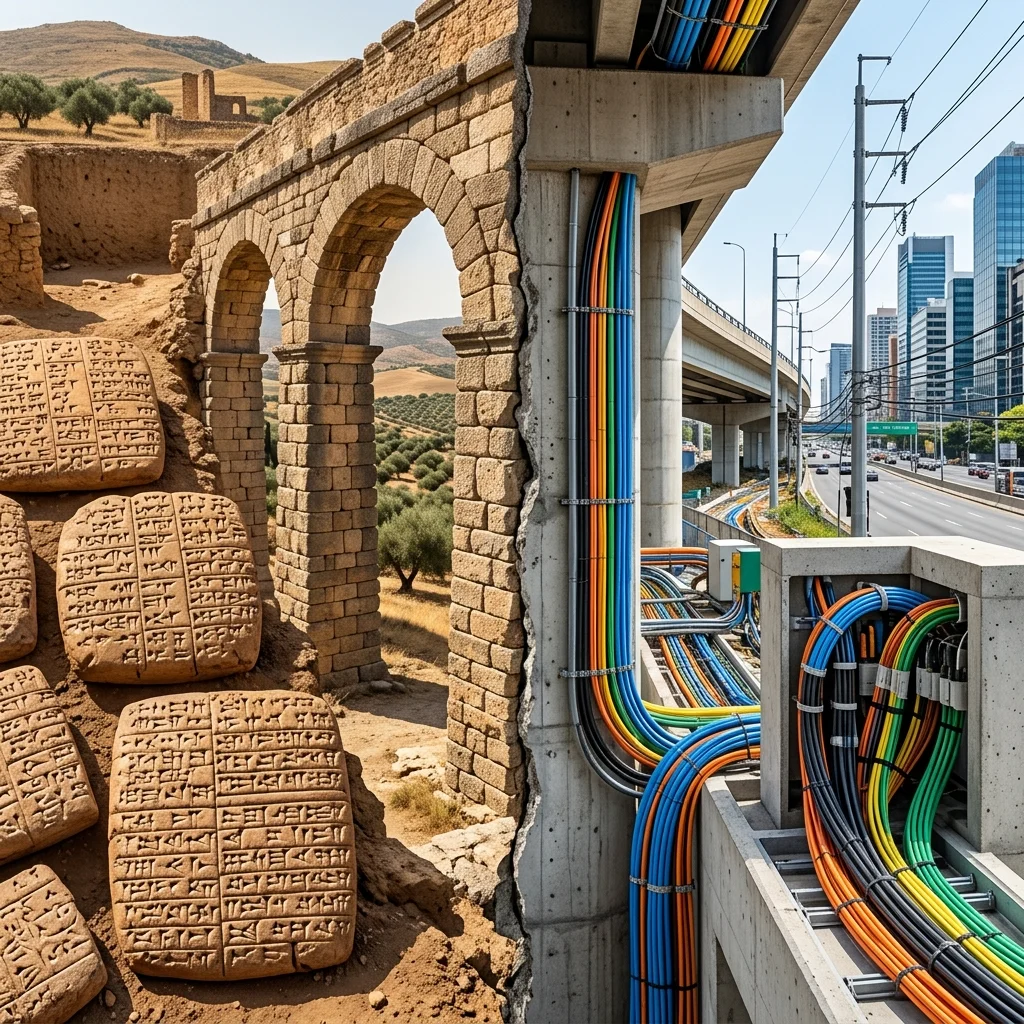
Beyond Ruins: The Invisible Infrastructure That Built Civilization
By a Senior Technical/Financial Audit Journalist
---
Introduction: The Hidden Engine of Civilization
The conventional narrative of human civilization fixates on visible monuments: the pyramids of Giza, the Colosseum of Rome, the ziggurats of Ur. These structures dominate archaeological tourism and popular imagination. Yet a forensic examination of the historical evidence reveals that the true scaffolding of civilization was never the stone and mortar of its monuments, but the invisible systems of communication, administration, and resource distribution that enabled human societies to scale beyond the tribal threshold.
The earliest civilizations emerged between 4000 and 3000 B.C.E. in Mesopotamia and Egypt, followed by the Indus Valley by approximately 2500 B.C.E., China by 1500 B.C.E., and Central America by 1200 B.C.E. (Source 1: Archaeological Consensus). Critically, every one of these societies developed shared communication systems and bureaucratic structures before their monumental architecture reached peak complexity. This temporal sequencing is not coincidental—it reveals the causal hierarchy of civilization's components.
Thesis: Administrative and communication infrastructure—not cities, not monuments—constitute the defining and most durable components of civilization. These systems outlast empires, survive conquests, and provide the operational foundation upon which all subsequent societal complexity is built.
---
The Primary Component: Urbanization as a Consequence, Not a Cause
Urbanization is universally cited as the primary characteristic of civilization (Source 2: Standard Civilizational Criteria). However, this classification mistakes effect for cause. Large population centers cannot exist without two prior innovations: surplus food production and administrative record-keeping.
The archaeological evidence from Teotihuacan, which housed an estimated 200,000 residents between 300 and 600 C.E. (Source 3: Demographic Analysis), demonstrates this dependency. The city's population density required centralized food distribution networks and water management systems that far exceeded what tribal organization could provide. Similarly, Great Zimbabwe, constructed between 1100 and 1450 and inhabited by more than 10,000 people at its peak (Source 4: Archaeological Survey), required administrative coordination for grain storage, cattle management, and trade route security.
The Roman aqueduct system provides the most quantifiable example of this principle. These engineering structures supplied freshwater to towns across the empire, enabling population densities that would otherwise have been limited by local water availability. The Aqua Appia (312 B.C.E.), Aqua Marcia (144 B.C.E.), and subsequent aqueducts represented not merely engineering achievements but administrative systems: they required centralized planning, ongoing maintenance budgets, legal frameworks for water rights, and bureaucratic oversight spanning hundreds of kilometers.
Key Finding: Urbanization is not a primary component of civilization but a dependent variable—it emerges only after administrative infrastructure is sufficiently developed to support concentrated populations.
---
Shared Communication: The Operating System of Society
If administrative infrastructure is the hardware of civilization, shared communication systems constitute its operating system. The evidence across civilizations demonstrates a consistent pattern: standardized communication systems precede large-scale societal coordination.
Sumerian cuneiform, developed in Mesopotamia around 3100 B.C.E., is recognized as the world's oldest known written language (Source 5: Linguistic Archaeology). Its earliest known uses were not literary or religious—they were administrative: tax records, trade agreements, and inventory ledgers. The cuneiform corpus reveals a society that required written records to manage its agricultural surplus, track labor obligations, and enforce legal contracts. Without this communication infrastructure, the city-states of Sumer could not have coordinated the labor pools necessary for their irrigation systems and temple construction.
The Indus Valley civilization (circa 2500 B.C.E.) developed standardized weights, measures, and seals for trade—a communication system that enabled economic exchange across a territory larger than contemporary Egypt or Mesopotamia. These seals, bearing animal motifs and Indus script characters, functioned as brand identifiers and certification marks, establishing trust in commercial transactions across long distances.
The Roman road network, spanning over 400,000 kilometers at its peak (including approximately 80,000 kilometers of paved roads), was constructed primarily for military and administrative communication rather than civilian commerce. The cursus publicus—the imperial postal and transportation system—enabled the Roman administration to transmit orders, collect taxes, and maintain political control across a territory spanning three continents.
The Islamic Golden Age (7th–13th centuries) advanced numeric systems that became the global standard for commerce and science. Arabic numerals, including the concept of zero, replaced the Roman numeral system because they enabled complex calculations essential for trade, astronomy, and engineering. This numeric infrastructure persists today as the universal language of global finance and technology.
---
Administrative Infrastructure and Bureaucracy: The Invisible Scaffold
Government administration and bureaucracy are the components that enabled civilizations to scale beyond the organizational capacity of tribes and chiefdoms. While often presented pejoratively in modern discourse, bureaucracy represents the most sophisticated technology for coordinating human behavior across time and distance.
The Roman Republic and later Empire developed the most documented administrative system of the ancient world. Provincial governors, tax collectors, census takers, and military logisticians constituted a professional bureaucracy that managed the empire's resources across Mediterranean and European territories. The census system, conducted every five years under the Republic, tracked population, property, and tax liability—providing the data necessary for fiscal planning and military conscription.
The Kingdom of Zimbabwe (circa 1100–1450) established its administrative center at Great Zimbabwe, controlling trade routes connecting the goldfields of the interior to the coastal Swahili city-states. The stone enclosures of Great Zimbabwe functioned not merely as royal residences but as administrative complexes where tribute was collected, trade goods were stored, and political authority was exercised over a territory of approximately 100,000 square kilometers.
The evidence of bureaucratic supply chains is physically preserved in the archaeological record. Roman roads connected grain storage facilities (horrea) across the empire, ensuring that Rome's population of approximately one million could be fed despite the city's distance from agricultural production zones. Roman aqueducts transported water through underground channels and above-ground arcades, with distribution points monitored by water commissioners who managed allocation rights and maintenance schedules. These were not ad hoc constructions but centrally planned and maintained systems requiring continuous administrative oversight.
Critical Observation: The bureaucratic systems of ancient civilizations are less visible than their monuments, but they are functionally more significant. A pyramid without administration is a pile of stone. An aqueduct without maintenance is a ruin. The administrative infrastructure is what transformed these physical structures into functioning systems.
---
Division of Labor: The Economic Architecture of Scale
The division of labor, closely tied to administrative infrastructure, represents the economic mechanism that enables civilization's productivity advantages. When individuals specialize in specific tasks, total output exceeds what generalist societies can achieve, generating the surplus that supports non-food-producing populations.
The earliest evidence of specialized labor appears in the archaeological record of Mesopotamia and Egypt between 4000 and 3000 B.C.E. (Source 6: Labor Archaeology). Scribes, priests, metalworkers, potters, and administrators emerged as distinct occupational categories, each requiring training and supported by the agricultural surplus generated by farmers. This specialization created economic interdependencies that required coordination—and thus administrative systems.
The Roman economy exhibited advanced division of labor across its provinces. Gaul produced grain, Spain supplied metals, Egypt provided papyrus and grain, and Italy manufactured luxury goods. This regional specialization required the communication and administrative infrastructure described above to function: roads for transport, ports for shipping, contracts for exchange, and courts for dispute resolution.
The Inca Empire (1438–1533) institutionalized labor division through the mit'a system, which required subjects to contribute labor to state projects in rotation. This system supported the construction of 40,000 kilometers of roads, agricultural terraces, and administrative centers—all without a written language, relying instead on the khipu (knotted cord) system for numeric record-keeping.
---
Material Evidence: What Survives and Why
The archaeological preservation of infrastructure is biased toward durable materials. Stone aqueducts, paved roads, and ceramic tablets survive; wooden administrative buildings, paper records, and organic storage facilities decay. This preservation bias creates the illusion that ancient civilizations were primarily builders of monuments, when the documentary evidence—from cuneiform tablets to Roman administrative records—reveals the primacy of systems over structures.
The cuneiform tablets of Mesopotamia, baked by the fires that destroyed the buildings containing them, preserve tax receipts, court judgments, and commercial contracts in quantities that far exceed the surviving monumental inscriptions. The Vindolanda tablets from Roman Britain, preserved in anaerobic conditions, record military supply orders, personal correspondence, and administrative reports that reveal the mundane but essential operations of empire. These documents provide more insight into how civilizations actually functioned than the monuments that dominate tourist itineraries.
---
Future Trends: The Continuing Evolution of Invisible Infrastructure
The components that enabled ancient civilizations continue to shape contemporary global society. Modern communication infrastructure—fiber-optic cables, satellite networks, internet protocols—represents the direct descendant of cuneiform tablets and Roman roads. Modern bureaucratic systems—tax codes, regulatory frameworks, corporate governance—extend the administrative innovations of Rome and the Islamic Golden Age.
Several trends are observable:
- Infrastructure concentration: As with ancient civilizations, modern infrastructure is concentrating in urban centers. Cities now house 55% of the global population, requiring ever more sophisticated administrative and communication systems.
- Systemic fragility: The complexity of modern infrastructure creates vulnerabilities. The Roman Empire's roads and aqueducts, once damaged, required centralized resources to repair. Modern digital infrastructure exhibits similar dependencies.
- Decentralization pressures: Blockchain and distributed ledger technologies represent attempts to create administrative systems without centralized bureaucracies—a departure from the historical pattern.
- Preservation challenges: Digital records, unlike clay tablets, degrade rapidly if not continuously migrated. The archiving of modern administrative systems may prove more difficult than the preservation of cuneiform.
---
Conclusion
The ruins of civilization—the Colosseum, the Pyramids, the Great Zimbabwe enclosures—are the visible residue of invisible systems. The shared communication systems, administrative bureaucracies, and division of labor that enabled these structures to be built are the actual technology of civilization. They remain less photographed but functionally more significant than any monument.
The evidence from Mesopotamia, Rome, the Indus Valley, and Great Zimbabwe demonstrates a consistent pattern: communication and administrative infrastructure precede and enable urbanization and monumental construction. These systems, not the cities they support, constitute civilization's defining technology.
For investors, policymakers, and historians, the lesson is clear: the infrastructure that matters most is the infrastructure that is hardest to see. The roads, records, and regulations that coordinate human behavior will continue to determine civilization's trajectory, just as they have for the past six millennia.
(All rights reserved by Global Beacon Chronicle. Unauthorized reproduction is prohibited.)
Liu Yan / Liu Yan
Business historian researching the intersection of tech and society.