How the HISTORY Channel Blends Celebrity Narrators and Niche History to Captivate
The HISTORY Channel, a German-language pay-TV broadcaster for documentaries,

How the HISTORY Channel Blends Celebrity Narrators and Niche History to Captivate Audiences
Introduction: More Than Just a Documentary Channel
In the crowded landscape of German-language pay-TV, the HISTORY Channel has carved out a distinct identity. Broadcasting across the DACH region—Germany, Switzerland, and Austria—it positions itself not merely as a documentary channel, but as a cultural curator that weaves factual history with dramatic storytelling. Its programming lineup is a deliberate mosaic: from Der Zweite Weltkrieg mit Tom Hanks to Ancient Aliens, from deep dives into the Ottoman Empire to investigations of Nazi inner circles, the channel thrives on juxtaposition.
[IMAGE: A wide shot of a modern living room with the HISTORY Channel logo on a TV screen, surrounded by period artifacts on a shelf.]
This apparent eclecticism is no accident. Behind the schedule lies a carefully calculated economic logic: leverage celebrity star power to transform niche historical topics into mainstream viewing events. By pairing globally recognized voices with obscure subjects—such as railway construction through the Ottoman Empire or the mysteries of the Skinwalker Ranch—the HISTORY Channel has discovered a formula that balances entertainment with education, all while navigating the transition from linear television to the on-demand era.
The Power of the Schedule: How Weekly Drops Create Anticipation
The HISTORY Channel’s programming grid is a masterclass in audience retention. Each weekday has a dedicated thematic identity. Mondays belong to History’s Deadliest, Thursdays feature Unglaubliche Entdeckungen mit Danny Trejo, and weekends are reserved for the heavyweights: Tom Hanks’ WWII series on Fridays at 20:15, and the perennial mystery of Oak Island on Sundays at the same slot.
These fixed time slots are not arbitrary. The primetime 20:15 slot—a traditional German television appointment—is reserved for flagship series that demand a committed audience. Earlier slots, such as 18:35, serve a different purpose: they offer reruns of curiosity-driven content like Das Geheimnis der Skinwalker Ranch, designed to lure casual viewers who may then stay tuned for the main event.
[IMAGE: A graphic calendar overlay showing the weekly schedule of the HISTORY Channel, with icons for each series and celebrity faces.]
This scheduling strategy mimics the classic “appointment television” model, building ritualistic viewing habits. In an era where streaming platforms encourage binge-watching, the HISTORY Channel deliberately spaces out its premium content. A viewer knows that Friday night means a new episode of WWII history narrated by a familiar voice; Sunday night means another chapter in the endless treasure hunt of Oak Island. This anticipation transforms the act of watching into a weekly event, generating social media buzz and word-of-mouth promotion that linear TV rarely enjoys anymore.
The data supports the approach. Primetime slots consistently attract higher ratings for the channel, while the earlier reruns serve as entry points for new audiences. By staggering its strongest content across the week, the HISTORY Channel ensures that no single day becomes a dead zone—every evening has a reason to tune in.
Celebrity Narrators: The Economic Engine Behind Factual Entertainment
Perhaps the most visible element of the HISTORY Channel’s strategy is its roster of celebrity narrators. Tom Hanks lends his voice—or rather, the German voice actor Joachim Tennstedt, who has become Hanks’ official German dubbing voice—to WWII documentaries. Danny Trejo brings gritty authenticity to discovery series. Ving Rhames lends gravitas to History’s Deadliest. These are not random choices; they are calculated investments.
[IMAGE: A composite portrait of Tom Hanks, Danny Trejo, and Ving Rhames, each with a historical-themed background (WWII tank, desert ruins, ancient weapons).]
The economic logic is straightforward: a familiar voice reduces production risk. Audiences may not know the intricacies of the Ottoman Empire’s railway system, but they know Tom Hanks. His involvement—through voice-over or, in some cases, on-camera introductions—guarantees a baseline level of attention. The channel can then explore obscure, niche topics without losing mainstream appeal. A documentary titled Auf Schienen durch das Osmanische Reich (By Rail Through the Ottoman Empire) might otherwise struggle to find viewers; with Hanks’ narration, it becomes a curiosity worth sampling.
This strategy also transforms historical narratives into human-interest stories. In promotional materials, Hanks is quoted saying, “Wie haben die Menschen das geschafft?” (“How did the people manage that?”) This personal engagement reframes history as a question of human endurance rather than a dry recitation of dates and events. The celebrity narrator becomes a surrogate for the viewer—someone equally awed, equally curious, equally invested in the story.
The choice of narrators also reflects careful demographic targeting. Tom Hanks appeals to older, more traditional viewers who grew up with his films. Danny Trejo, with his tough-guy persona, draws in a younger, more male-skewed audience interested in adventure and mystery. Ving Rhames, with his deep authoritative voice, adds a layer of seriousness to shows about historical violence. Each narrator is a brand in themselves, and the HISTORY Channel leverages those brands to expand its reach across different viewer segments.
From Linear to Streaming: Amazon Prime as a Distribution Partner
While the HISTORY Channel’s linear broadcast remains its backbone, the channel has aggressively expanded into streaming via a partnership with Amazon Prime Video Channels. This arrangement allows subscribers to add the HISTORY Channel to their Prime membership for a monthly fee, gaining access to the full library of documentaries, exclusive premiere content, and the ability to stream live broadcasts.
[IMAGE: Split screen showing a traditional TV guide on the left and the Amazon Prime Video interface on the right, both displaying HISTORY Channel content.]
This partnership solves a critical problem for pay-TV channels in the streaming age: discoverability. On cable, the HISTORY Channel competes with dozens of other channels; on Amazon Prime, it becomes one of dozens of add-on subscriptions, but the platform’s recommendation algorithms and user interface make it easier for viewers to find and sample content. For the HISTORY Channel, Amazon provides a low-friction entry point for cord-cutters who have abandoned traditional pay-TV but remain interested in niche documentary programming.
The economic implications are significant. Streaming subscriptions generate predictable recurring revenue, while linear advertising remains volatile. By offering both models—traditional cable and Amazon Prime Video Channels—the HISTORY Channel hedges its bets. Moreover, data from Amazon’s platform allows the channel to analyze viewing patterns in real time, informing future programming decisions. If a documentary about Mozart’s legacy performs exceptionally well on streaming, the channel can commission more music history content. If Winter Olympics history attracts a spike of interest during Olympic years, the channel can schedule reruns accordingly.
This hybrid approach also allows the HISTORY Channel to experiment with content that might not survive traditional ratings pressure. Niche topics like the history of the Ottoman Empire or the inner workings of the Nazi regime may have limited mass appeal, but on a streaming platform where viewers actively choose what to watch, they can find their audience gradually. The channel’s library becomes a long-tail asset, generating value months or even years after initial broadcast.
The Cultural Resonance of Niche History
Why does a German-language channel devote airtime to the Winter Olympics history in spring, or to Mozart’s life in a slot usually reserved for mysteries? The answer lies in cultural resonance.
[IMAGE: A collage of historical images—Mozart’s portrait, a Winter Olympics medal ceremony, an ancient Egyptian hieroglyph—overlaid with a map of Europe highlighting the DACH region.]
The DACH region has a deep historical identity. Topics like the Ottoman Empire’s relationship with Central Europe, the Cold War, and World War II are not abstract—they connect directly to the lived experience of German, Swiss, and Austrian viewers. Mozart, as a Salzburg native, represents a point of local pride. Winter Olympics history resonates in Alpine nations where skiing and winter sports are cultural pillars.
By alternating between global history and regional touchpoints, the HISTORY Channel ensures that its content remains relevant to its core audience. The channel does not simply import American-produced documentaries and dub them into German; it commissions and curates content that speaks to the DACH region’s unique historical perspective. This localization is a key differentiator from generic documentary channels.
Conclusion: History as a Compelling Commodity
The HISTORY Channel’s success offers a blueprint for how traditional television can adapt to the on-demand era without abandoning its core identity. By combining celebrity narrators, a tightly scheduled weekly lineup, and a strategic streaming partnership, the channel turns historical content into a compelling commodity.
The economic logic is clear: celebrity voices attract viewers; scheduled programming builds habits; streaming expands reach; and niche topics find their audiences over time. The cultural resonance ensures that the channel remains relevant to its regional base. In an age of infinite content, the HISTORY Channel proves that history—when told with the right voice at the right time—can still captivate.
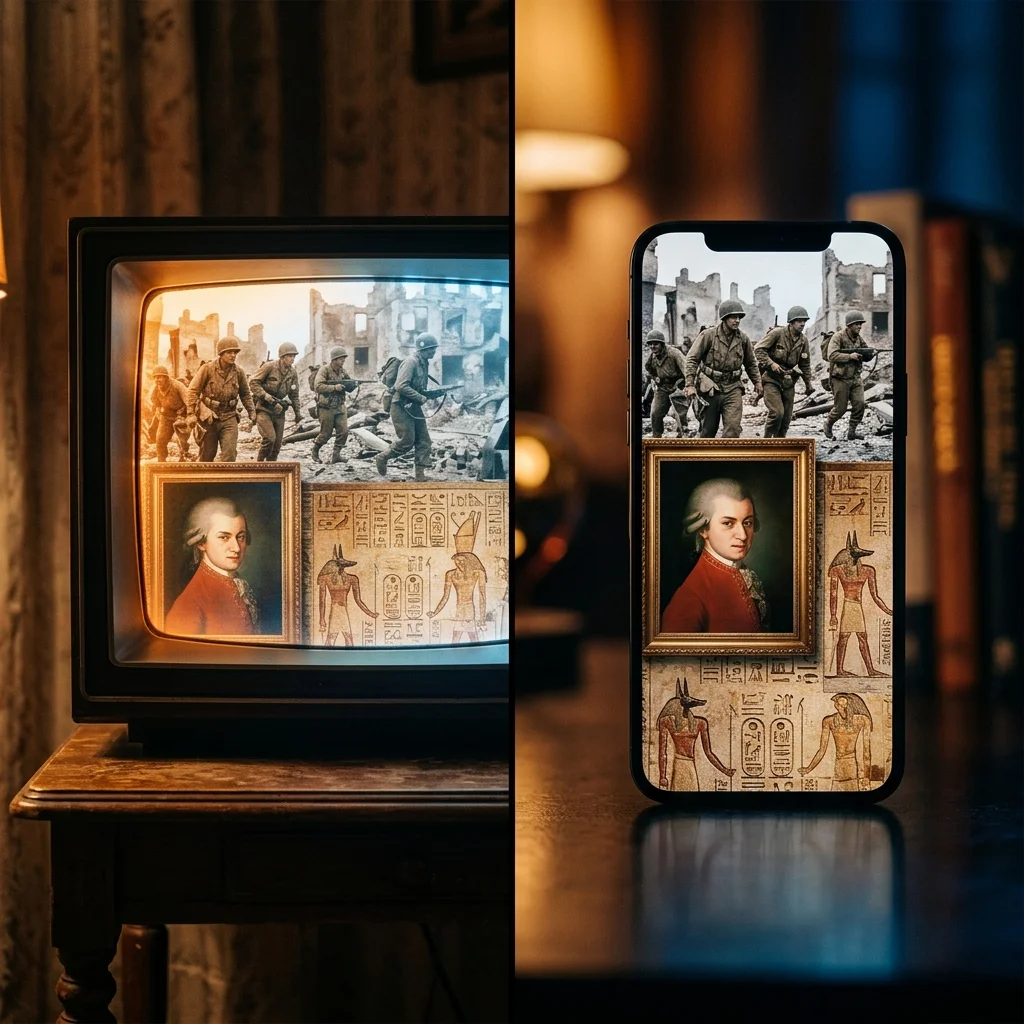
[IMAGE: A final split composition: left side shows a vintage TV silhouette with a glowing screen depicting a collage of historical scenes (WWII soldiers, Mozart’s portrait, ancient Egyptian hieroglyphs); right side shows a modern smartphone streaming the same collage. Warm amber and deep blue tones. Cinematic lighting.]
The channel’s journey from linear broadcast to hybrid distribution is not just a story about television—it is a story about how we consume the past in the present. And as long as there are viewers who want to understand how we got here, there will be a market for history, packaged intelligently.
(All rights reserved by Global Beacon Chronicle. Unauthorized reproduction is prohibited.)
Liu Yan / Liu Yan
Business historian researching the intersection of tech and society.