The Economic Backbone of Ancient Civilizations: How Administrative Technologies
From Sumerian cuneiform to Roman roads, the key components of civilization—writing,

The Economic Backbone of Ancient Civilizations: How Administrative Technologies Built the First Global Markets
Introduction: The Hidden Economic Logic of Civilization
When we think of ancient civilizations, our minds drift to majestic pyramids, intricate temples, and monumental sculptures. Yet these cultural artifacts, however impressive, were not the primary drivers of societal transformation. The true engine of civilization was a far less glamorous set of innovations: administrative technologies that solved fundamental coordination problems—taxation, trade, and labor management at unprecedented scale.
The earliest civilizations of Mesopotamia, Egypt, and the Indus Valley emerged between 4000 and 3000 B.C.E., not merely because of agricultural surplus, but because they developed tools to record, standardize, and enforce economic transactions. These tools enabled the first large-scale economies to function across vast territories and diverse populations. [IMAGE: A timeline map showing early civilizations and their key administrative innovations—cuneiform in Mesopotamia, hieroglyphics in Egypt, and Indus Valley seals—with dates labeling each emergence]
This article explores how writing systems, roads, standardized communication, and bureaucratic infrastructure created the first global markets. By examining Mesopotamia, the Islamic Golden Age, Great Zimbabwe, the Inca Empire, and Rome, we uncover the hidden economic logic behind the rise of civilization—and reveal how these ancient innovations foreshadowed modern supply chains, information systems, and even artificial intelligence.
Writing as Economic Technology: From Tax Records to Global Commerce
The invention of writing is often celebrated as a cultural milestone, but its origins were profoundly economic. Sumerian cuneiform, etched into clay tablets around 3100 B.C.E., was not created for poetry or religious texts—it was the world’s first accounting software. The earliest known cuneiform tablets record barley rations, livestock inventories, and tax receipts. Without this technology, the temple economies of Uruk and Ur could never have managed the complex redistribution of grain, textiles, and labor that sustained tens of thousands of inhabitants.
[IMAGE: A side-by-side comparison of a Sumerian cuneiform tax tablet (circa 3000 B.C.E.) and an Inca khipu, with a caption: "Both systems recorded economic data—one with wedge-shaped impressions, the other with knotted cords"]
Writing solved a fundamental economic problem: trust and memory. When a merchant shipped goods from Ur to Dilmun (modern Bahrain), a clay tablet sealed in an envelope of clay provided irrefutable proof of the transaction. This innovation reduced disputes, lowered transaction costs, and allowed trade to scale beyond face-to-face relationships. By the time of Hammurabi (c. 1750 B.C.E.), legal codes written in cuneiform standardized commercial practices—interest rates, debt repayment terms, and liability for damaged goods—creating a predictable legal environment for long-distance trade.
Centuries later, the Islamic Golden Age (7th–13th centuries) took this logic further. The adoption of Arabic as a shared administrative language across the caliphates—from Spain to India—enabled merchants, scholars, and bureaucrats to communicate across thousands of miles. More critically, the introduction of Arabic numerals (borrowed from India and refined by Persian mathematicians like Al-Khwarizmi) revolutionized calculation, allowing for complex accounting, currency conversions, and interest calculation that facilitated cross-continental trade networks.
Meanwhile, across the Atlantic, the Inca Empire built one of the world's most sophisticated administrative systems without a written script. Instead, they used the khipu—a set of knotted strings of varying colors and lengths—to record census data, tax obligations, and warehouse inventories. Khipu were not merely memory aids; they were encoding devices that allowed a small class of trained administrators (khipukamayuq) to manage the labor and resources of an empire spanning 2,500 miles. This demonstrates that the economic function of writing—standardized, verifiable record-keeping—can be achieved through multiple physical forms.
Infrastructure as Trade Enabler: Roads, Aqueducts, and Market Hubs
If writing provided the software of ancient economies, infrastructure provided the hardware. The most famous example is the Roman road network. Over the course of several centuries, Rome built approximately 50,000 miles of paved roads, connecting Britain to Syria and North Africa to the Danube. These were not simple dirt tracks; they were engineered with layers of gravel, sand, and stone, with drainage systems and milestones marking distances. A legionary could march 20 miles in a day, and a courier could travel twice that on horseback. [IMAGE: A cross-section illustration of a Roman road showing the layered construction (statumen, rudus, nucleus, summum dorsum) alongside a map of major Roman roads radiating from Rome]
The economic impact was transformative. Roads enabled the movement of grain from Egypt to Rome, wine from Gaul to Britannia, and olive oil from Spain to the capital. More importantly, they created a unified economic zone where merchants could predict transit times, calculate shipping costs, and plan supply chains. The Roman aqueducts, meanwhile, supplied water to cities, enabling urban density and sanitation—both prerequisites for sustained economic specialization.
But Rome was not alone in building trade-enabling infrastructure. Great Zimbabwe (1100–1450 C.E.), the capital of a Shona kingdom in southern Africa, was home to more than 10,000 inhabitants and served as a central node in a vast trading network. The city's massive stone walls—some 11 meters high—enclosed not only royal residences but also workshops and marketplaces. Archaeological evidence reveals that Great Zimbabwe exported gold and ivory to the Swahili coast, where Arab and Indian merchants carried these goods to China, India, and Persia. In return, the kingdom imported glass beads, textiles, and Chinese porcelain. [IMAGE: A map showing trade routes from Great Zimbabwe to the Swahili Coast, then across the Indian Ocean to India and China, with labeled commodities]
Further north in Mesoamerica, the city of Teotihuacan (peak population ~200,000 between 300–600 C.E.) demonstrated how built infrastructure drives regional specialization. The city's grid layout, canal systems, and causeways facilitated the movement of obsidian, pottery, and textiles from surrounding workshops into central markets. Teotihuacan's obsidian trade alone reached as far as modern-day Guatemala and Honduras—a testament to how physical infrastructure reduces the cost of connecting producers and consumers.
Shared Communication as Market Unifier: Language, Numerals, and Legal Codes
Physical infrastructure and recording technologies are powerful, but they achieve their full potential only when paired with shared communication systems that allow disparate groups to transact with confidence. In this domain, ancient civilizations invented the precursors to modern standards—the rules, languages, and legal frameworks that make markets possible.
Rome understood this better than most. Latin served as a common administrative language across the empire, allowing a merchant from Gaul to file a contract with a Syrian trader using terms both understood. The Roman legal system, codified in the Twelve Tables (c. 450 B.C.E.) and later expanded under Emperor Justinian, standardized concepts of property, contract, and liability. A Roman citizen could enforce a debt in Germania or Egypt because the legal system was consistent. This predictability reduced risk and encouraged long-distance investment.
[IMAGE: A depiction of a Roman legal document (tabula) being sealed with a witness's signet, alongside an Islamic Golden Age astrolabe and a page of Arabic numerals showing commercial arithmetic]
The Islamic Golden Age took standardization to new heights. The Arabic language unified a linguistic territory from Morocco to Central Asia, but it was the adoption of Arabic numerals—and the mathematical innovations of scholars like Al-Khwarizmi (whose name gave us "algorithm")—that truly revolutionized commerce. Merchants could now compute fractions, calculate interest, and convert currencies with unprecedented accuracy. The widespread use of bills of exchange (suftaja) allowed traders to move money across the caliphate without physically transporting coins, a system that resembles modern letters of credit.
Similarly, Inca administrators used the khipu to standardize taxation across an empire of diverse ethnic groups and languages. The state required each community to contribute labor and goods according to a fixed schedule, and the khipu provided a common format for recording obligations. A provincial governor could read the same type of knot system used in Cusco, ensuring uniform enforcement of economic policy.
Legal codes also played a crucial role in unifying markets. The Code of Hammurabi is the most famous early example, but similar codes existed in ancient India (the Laws of Manu) and China (the Qin legal statutes). These codes defined weights and measures, established penalties for fraud, and regulated debt—creating a stable environment in which commerce could flourish. In effect, they were the ancient equivalent of regulatory agencies.
The Bureaucratic Machine: How Administration Fueled Economic Complexity
Behind every successful ancient economy stood a corps of administrators: scribes, tax collectors, inspectors, and warehouse keepers. These bureaucrats were the unsung heroes of economic history, turning abstract systems into daily practice.
In Mesopotamia, the temple complex at Uruk employed hundreds of scribes who tracked everything from wool shipments to beer rations. Their clay tablets reveal a sophisticated inventory management system: goods were categorized by type, quantity, origin, and destination, with notations for spoilage and losses. This allowed temple administrators to plan production cycles years in advance.
The Inca Empire perfected this bureaucratic art. The state maintained vast storehouses (qollqa) scattered across the Andes, each filled with food, textiles, and tools. Using khipu records, administrators could calculate exactly how much grain a region produced, how much it needed for local consumption, and how much surplus could be redirected to support the army or feed drought-stricken areas. This system of "vertical archipelago" management—exploiting different ecological zones at different altitudes—required detailed knowledge of harvests and population movements, all encoded in knotted strings.
[IMAGE: An illustration of a record-keeping process, showing a Sumerian scribe with stylus and clay tablet on one side, and an Inca khipukamayuq (record-keeper) holding a khipu on the other, with a schematic of information flow]
China's Qin and Han dynasties (3rd century B.C.E. to 3rd century C.E.) created perhaps the most elaborate bureaucracy of the ancient world. The state conducted regular censuses, standardized axle widths for roads, and issued standardized coinage. The Great Wall was not merely a defensive structure; it was a logistical project requiring administrators to coordinate hundreds of thousands of laborers across multiple provinces. The emperor's court maintained detailed records of grain yields, population figures, and tax revenues—data that allowed the state to redistribute resources during famines and fund large-scale irrigation projects.
These bureaucratic systems generated economic complexity by enabling specialization. When a state can reliably track production and consumption, individuals are freed to focus on what they do best—whether crafting bronze vessels, weaving silk, or teaching mathematics. The administrative machine created the conditions for division of labor, the very foundation of economic growth.
Conclusion: Ancient Innovations in the Age of AI
The economic history of ancient civilizations reveals a striking truth: the challenges that drove administrative innovation thousands of years ago are fundamentally similar to those we face today. Managing supply chains, verifying transactions, standardizing communication, and scaling governance—these were the problems that cuneiform, Roman roads, and khipu solved in their time.
When we look at modern artificial intelligence and blockchain technology, we are essentially building new tools for the same tasks. Algorithms that track inventory in global warehouses echo the Sumerian scribe's clay tablet. Cryptocurrency ledgers, with their immutable records, perform the same function as the Roman contract sealed with witnesses. Machine translation breaks language barriers just as Latin and Arabic did for their respective empires.
But there are critical differences. Ancient administrative technologies were slow to change and required enormous investments in training scribes or building roads. Modern digital systems can be updated overnight and scaled globally at negligible marginal cost. This speed and flexibility offer unprecedented opportunities for economic inclusion—but also risks. Ancient systems, for all their flaws, were embedded in cultures that valued personal relationships and local knowledge. Modern systems can be abstract, impersonal, and prone to surveillance.
The lesson from history is not that technology determines everything. Rather, it is that successful societies combine technological innovation with sound institutions: legal frameworks that ensure fairness, communication standards that enable cooperation, and administrative capacity that delivers public goods. As we build the digital infrastructure of the 21st century, we would do well to remember that the first global markets were not created by algorithms alone, but by the human ingenuity that transformed clay and stone, roads and knots into the backbone of civilization.
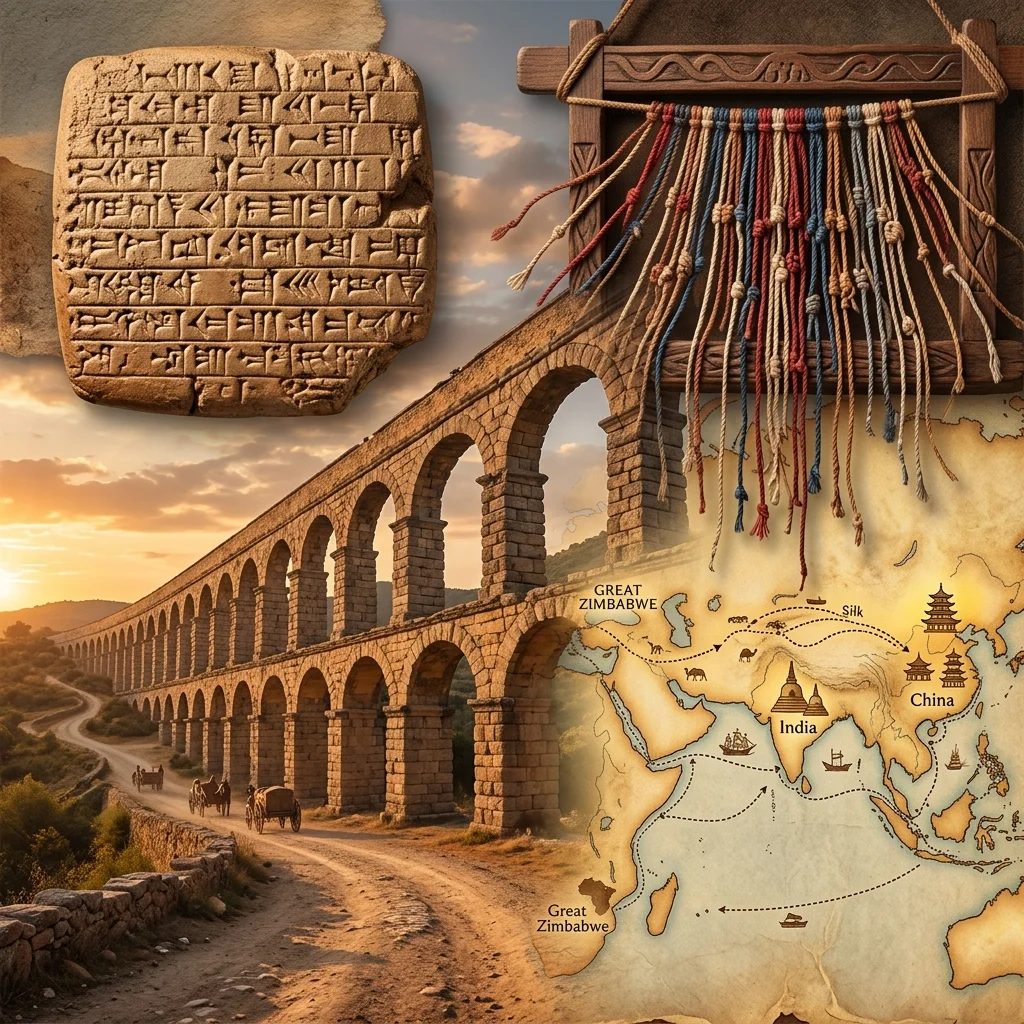
[IMAGE: A panoramic collage blending ancient artifacts: a Sumerian clay tablet with cuneiform script, a Roman aqueduct arching over a dusty road, an Inca khipu hanging from a wooden frame, and a stylized map showing trade routes from Great Zimbabwe to India and China. Warm sunset lighting, realistic textures. The composition suggests connectivity and infrastructure.]
(All rights reserved by Global Beacon Chronicle. Unauthorized reproduction is prohibited.)
Liu Yan / Liu Yan
Business historian researching the intersection of tech and society.