The Digital Alexandria: When PDFs Become Unreadable and the Fragile Legacy
A single PDF file with compressed binary data—no text extracted. This seemingly

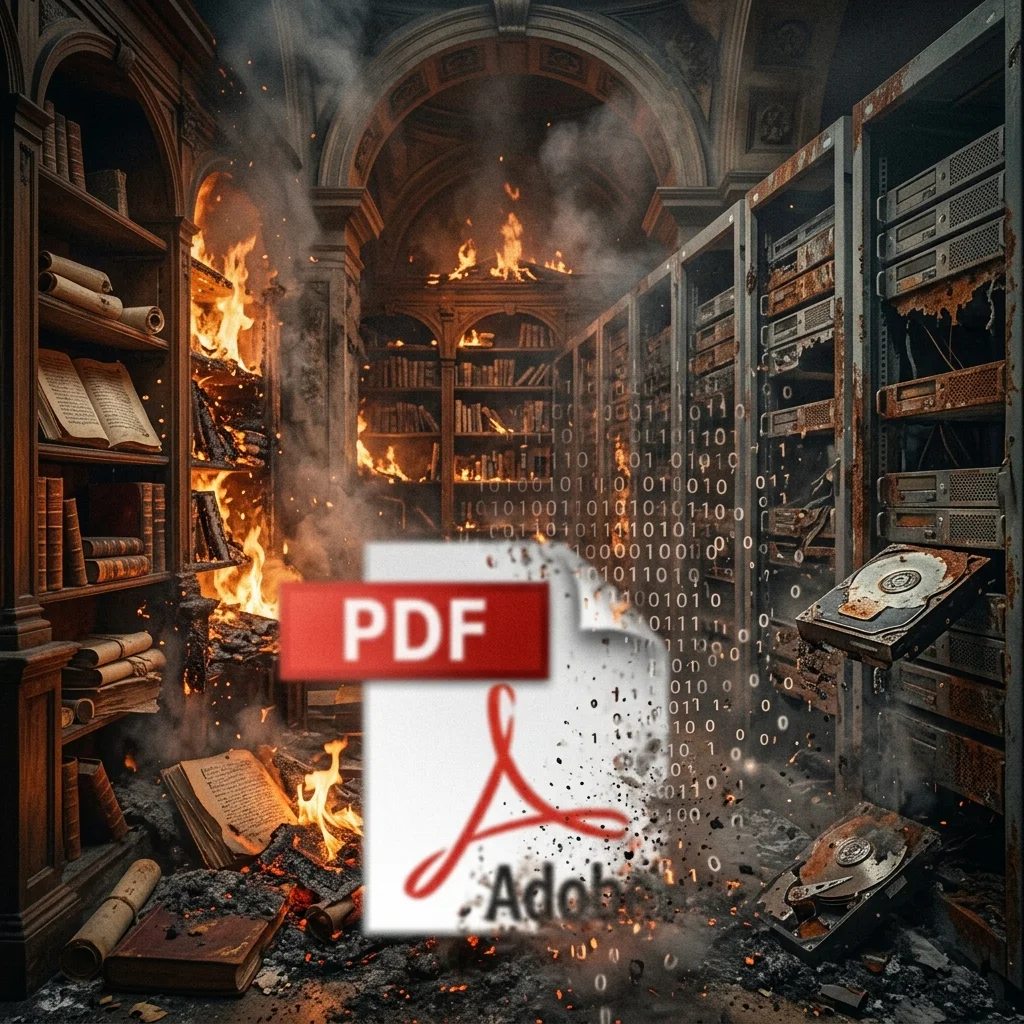
The Digital Alexandria: When PDFs Become Unreadable and the Fragile Legacy of Civilization
Imagine a single PDF file. It opens, but the screen is blank—no text, no images, only a silent error message. The file contains compressed binary data that no modern reader can parse into human-readable content. This is not a rare anomaly. It is a quiet, everyday symptom of a crisis that spans the entire digital age. And it raises an uncomfortable question: if a five-year-old document can become unreadable, what does that mean for the record of an entire civilization?
The Unreadable PDF as a Warning Signal
Digital files are born fragile. A PDF created with an obscure compression algorithm, encoded in a proprietary subset of the standard, or corrupted by a minor bit-flip can instantly become a dead object. Unlike a clay tablet from Mesopotamia, which can still be deciphered after 4,000 years of burial, or a medieval parchment that retains its text under gentle handling, a digital record depends on an unbroken chain of software, hardware, and human intent. A five-hundred-year-old book can be opened and read by anyone who knows the language. A five-year-old PDF, on the other hand, may already be trapped inside a format that no longer has a decoder.
[IMAGE: Split image: left side a well-preserved ancient scroll with visible handwriting; right side a corrupted PDF file with error symbols like “Could not extract text” or garbled characters.]
The contrast is unsettling. The Sumerians incised cuneiform into wet clay, which hardened into a nearly indestructible medium. The Egyptians wrote on papyrus that, when kept dry, survives millennia. Even the fragile papyri of Herculaneum, carbonized by the eruption of Vesuvius, have yielded their secrets to modern imaging. But our digital records—the emails, spreadsheets, scientific papers, government archives, personal photos—depend on a stack of technologies that are constantly replaced, updated, or abandoned. The unreadable PDF is a microcosm of this macro problem. It is a warning signal that the primary record-keeping medium of our era is inherently ephemeral.
What does it mean for a civilization when its most trusted repository—the digital file—can vanish in a generation? Historians of the future may look back on the 21st century as a dark age of lost knowledge, not because of a single apocalyptic event, but because of a million silent failures in format migration, storage decay, and software obsolescence.
The Hidden Economics of Digital Preservation
If digital knowledge is so fragile, why don’t we preserve it better? The answer lies in a perverse economic equation. Storage is cheap. A terabyte hard drive costs less than a dinner out. But active preservation—the ongoing process of format migration, metadata maintenance, software emulation, and integrity checking—is expensive and rarely budgeted for. The cost of keeping a single PDF readable for 100 years is not the cost of storing its bits, but the cost of repeatedly translating those bits into new formats that future systems can understand.
Organizations routinely underestimate this cost. A university library might archive doctoral dissertations in plain PDF, only to discover a decade later that the compression algorithm used (say, JBIG2) is no longer supported by the latest PDF readers. The cost to convert every file into a truly archival format like PDF/A, and to continue doing so every few years, is often deemed too high. The market forces that drive digital efficiency—smaller file sizes, faster transmission, seamless cloud integration—actively work against long-term readability. Proprietary encodings create vendor lock-in and eventual decay. Open formats are better, but even they require active stewardship.
[IMAGE: Graph showing declining cost of storage (blue line, steep drop) vs. rising cost of format migration (red line, gradual increase) over a 50-year timeline.]
Consider the case of PDF/A, the ISO-standardized archival format designed for long-term preservation. It embeds all necessary fonts, metadata, and color profiles, and it prohibits features like encryption or external references that might break in the future. Creating a PDF/A file is a deliberate, slightly more expensive process than saving a compressed PDF. Most organizations do not make that investment. The gap between what could be preserved and what actually is preserved is a gap of conscious economic choice. And that choice, repeated millions of times every day, is silently eroding our collective memory.
Technology Trends: Compression as a Double-Edged Sword
Compression algorithms are the unsung heroes of the digital world. They shrink massive image files, stream video across limited bandwidth, and pack thousands of pages into a single portable document. But compression comes at a cost: it trades immediate readability for space. Algorithms like FlateDecode (a variant of deflate), JBIG2 for bi-level images, or JPEG2000 for continuous-tone images embed intricate decoding logic that must be perfectly replicated by any future reader. When a compression standard is superseded, the files created with it become orphans.
The trend is accelerating. Early PDFs used simple LZW compression; later versions added a cascade of new codecs. With each iteration, backward compatibility becomes more complex. Software vendors, focused on new features and performance, often deprecate older decompression routines. Even well-maintained projects like Adobe Acrobat or open-source libraries like Poppler occasionally drop support for rarely used encodings. The result: a PDF that opens perfectly today may fail tomorrow, not because the bits have decayed, but because the decoder has disappeared.
[IMAGE: Timeline showing compression standards from PDF 1.0 (1993) to PDF 2.0 (2022), with red X marks at points where backward compatibility was broken for specific codecs.]
Cloud-based PDF services add another layer of fragility. When a user uploads a document to a web platform, the service often parses and re-encodes the content into a proprietary internal format. The original file is stored, but the user loses direct access to the raw bytes. If the company shuts down or changes its architecture, the documents may become unreachable. This is the “digital dark age” scenario writ small: a file format that was once widely supported becomes a locked vault, and the key is lost when the service stops.
The unreadable PDF is thus not an anomaly but a natural byproduct of a system optimized for efficiency over durability. It is a quiet reminder that every byte we compress is a future puzzle for digital archaeologists.
Cultural and Historical Implications: What Future Historians Will Miss
The Library of Alexandria is the archetype of catastrophic knowledge loss. When it burned, centuries of irreplaceable works—philosophy, science, literature—were lost forever. Today, we imagine ourselves immune to such a fate. Our knowledge is distributed across servers, backed up in multiple locations, and replicated across the globe. Yet the most insidious loss is not a single fire; it is the slow, silent rot of unreadable files. Millions of PDFs sit on hard drives, in cloud archives, and on forgotten USB sticks, their content locked inside compression schemes that no one remembers how to decode.
Digital archaeology is already a real field. Researchers have spent years recovering data from floppy disks, ZIP drives, and early word processor formats. Each recovery project is a painstaking, expensive forensic operation. But the scale of the problem dwarfs these efforts. Billions of documents are created every day. Most will never be migrated. Future historians, like the scholars of Alexandria after the fire, will face a frustrating silence—not because the knowledge was destroyed, but because it was encoded in a medium that no longer speaks.
[IMAGE: A moody image of a server room with hard drives stacked in piles, some with visible rust or decay, overlaid with ghostly silhouettes of ancient scrolls and manuscripts.]
The cultural implications extend beyond academic history. Legal records, medical research, architectural blueprints, literary manuscripts—all are at risk. The current generation has experienced an unprecedented explosion of documented human experience, from social media posts to scientific preprints. But that explosion may be followed by a contraction as formats become obsolete faster than institutions can adapt. The digital preservation crisis is not a technical niche; it is a civilizational blind spot.
We have built the most extensive and accessible record of human activity in history, yet we have built it on a foundation of sand. The unreadable PDF is a canary in the coal mine. It asks us to reconsider the values we embed in our technology: efficiency over durability, convenience over stewardship, speed over permanence. The answer is not to abandon digital records—we cannot—but to treat digital preservation as a core infrastructure investment, as vital as roads, bridges, and libraries. It means choosing open formats, funding format migration, and teaching a new generation of digital stewards.
The Library of Alexandria was lost in fire. The Digital Alexandria is being lost in silence, one unreadable PDF at a time. The question is whether we will act before the silence becomes deafening.
(All rights reserved by Global Beacon Chronicle. Unauthorized reproduction is prohibited.)
Liu Yan / Liu Yan
Business historian researching the intersection of tech and society.