Beyond Civilized Progress: The Enduring Tension Between Culture and Civilization
This article explores the deep sociological distinction between culture

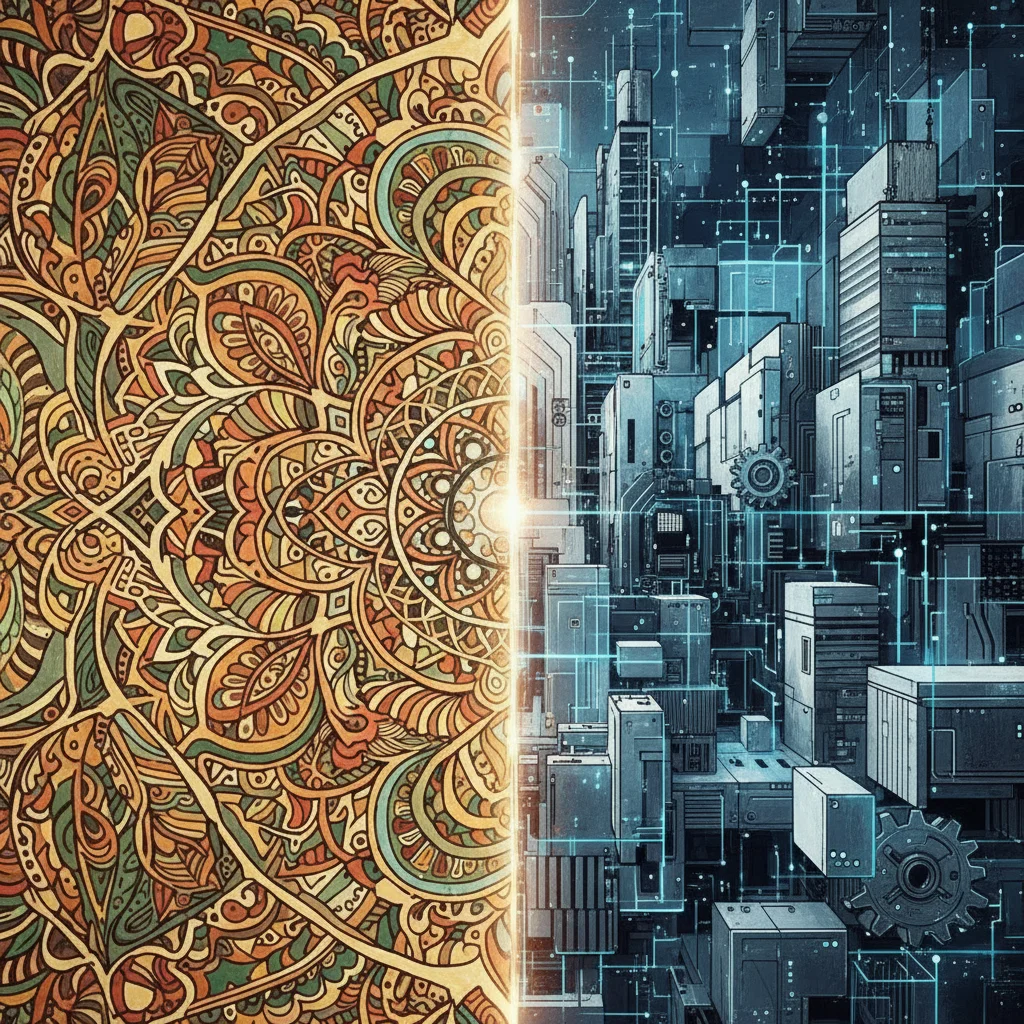
The Enduring Tension Between Culture and Civilization in History
Introduction: The Two Selves of Society
"Civilization is what we have; culture is what we are." — R.M. MacIver
This single sentence captures a distinction that runs deeper than most academic definitions admit. When we look at a society, we see two layers: one visible, measurable, transferable; the other invisible, intangible, and deeply rooted. The first is civilization—the machinery of tools, roads, governments, and economic systems that humans build to control their environment. The second is culture—the web of values, beliefs, art, and rituals that define who we are and why we exist.
This distinction is not merely intellectual. It shapes how nations develop, how policies succeed or fail, and where social friction emerges. A country can import a foreign railway system or adopt another nation's legal code relatively quickly, but it cannot import another people's sense of meaning, their relationship to time, or their unspoken moral assumptions. The failure to recognize this divide has driven countless modernization projects into crisis, from colonial administrations to contemporary development programs.
Three thinkers offer the clearest lenses for understanding this tension. Matthew Arnold, the Victorian poet and critic, saw culture as "the pursuit of our total perfection by means of getting to know, on all the matters which most concern us, the best which has been thought and said in the world." For Arnold, culture was an inward condition of the mind and spirit—a refinement that could not be measured in horsepower or GDP. R.M. MacIver, the Canadian sociologist, drew a sharper boundary: civilization is the mechanism and organization humans design to control the conditions of life; culture is the expression of our nature in our ways of living and thinking. And Oswald Spengler, the controversial German philosopher, went further, arguing that every great society passes through a natural lifecycle: an early, vital, creative cultural phase, followed by a rigid, mechanical, declining civilization.
[IMAGE: Split image: left side shows a traditional cultural scene, such as a tribal dance or Renaissance painting, with warm earthy tones; right side shows a modern city skyline at night with cold blue and steel tones. A faint vertical line separates the two halves.]
Defining the Divide: Inner Life vs. Outer Architecture
The word culture derives from the Latin cultus, meaning to cultivate, to tend, to refine. Originally applied to the tilling of soil, it came to describe the cultivation of the human mind and spirit. Culture encompasses art, religion, morals, customs, and values—all that is subjective, internal, and expressive of a people's soul. As Matthew Arnold wrote in Culture and Anarchy: "Culture is the study of perfection… It seeks to do away with classes; to make the best that has been thought and known in the world current everywhere; to make all men live in an atmosphere of sweetness and light."
Civilization, in contrast, comes from the Latin civis — citizen, city-dweller. It refers to the tangible infrastructure of urban life: technology, governance, economic systems, public works, and legal codes. MacIver defined civilization as "the whole apparatus of means whereby we adjust ourselves to our physical environment." A water purification plant, a tax collection system, a highway network—these are the instruments of civilization. They are means to ends, not ends in themselves.
This points to a fundamental economic logic: civilization is tool-making; culture is meaning-making. A plow is civilization; the ritual that blesses the first furrow is culture. A court of law is civilization; the sense of justice that animates it is culture. We can measure the efficiency of a tool—a power loom produces more cloth than a handloom—but we cannot measure the value of a song or the depth of a belief. One belongs to the realm of utility, the other to the realm of purpose.
[IMAGE: Simple diagram: left side labeled "Culture" with icons of a heart, a book, and a paintbrush; right side labeled "Civilization" with icons of a gear, a skyscraper, and a government building. Arrows indicate culture as inner, civilization as outer.]
The Transmission Divide: Why Tools Travel, But Traditions Don't
Perhaps the most striking difference between culture and civilization lies in how they move through history and across borders. Civilization is easily transmitted and borrowed. A jet engine can replace a steam engine anywhere in the world with minimal cultural friction. A country can adopt the metric system, build a centralized banking authority, or install a fiber-optic network without altering its core identity. This is because civilization is defined by measurable efficiency: a lorry runs faster than a bullock cart; a power loom produces more than a handloom. The logic is universal, and the tool is evaluated by its output.
Culture, by contrast, resists simple transfer. You cannot impose another people's values by importing their technology. The British built railways across India, but they could not transplant English notions of individualism or Protestant work ethic into the subcontinent. The Japanese adopted Western industrial machinery in the Meiji era, yet their underlying cultural fabric—hierarchical, communal, ritualistic—remained deeply distinct. Culture requires immersion, adaptation, and the slow work of shared experience. It is not a product to be purchased; it is a way of being to be lived.
This asymmetry has profound consequences. Pre-literate societies often had rich, sophisticated cultures—complex kinship systems, elaborate mythologies, deeply nuanced oral traditions—but minimal civilization in the sense of large-scale technology or centralized governance. When colonizers arrived with superior tools (guns, ships, writing), they often mistook their technological advantage for cultural superiority. The resulting destruction was not just political or economic; it was spiritual. Communities lost not only their land but the entire framework of meaning that made life coherent.
Today, this dynamic plays out in globalization. A teenager in Jakarta can stream the same Netflix series as a teenager in Stockholm, wear the same sneakers, and use the same smartphone. But the cultural context in which those goods are received—family structure, religious obligation, concept of time—remains vastly different. The surface of civilization homogenizes; the depths of culture persist, sometimes stubbornly, sometimes explosively.
Spengler's Cycle: From Vital Culture to Rigid Civilization
Oswald Spengler's magnum opus, The Decline of the West (1918), remains the most ambitious attempt to theorize the relationship between culture and civilization as a historical life cycle. For Spengler, every great civilization—Egyptian, Classical, Chinese, Western—follows the same arc. It begins as a culture: a period of organic growth, creative energy, religious depth, and artistic flowering. Think of Periclean Athens, or the European High Middle Ages, or the Tang Dynasty. In this phase, society is driven by inner conviction, not external efficiency. Art is sacred; thought is fresh; institutions are flexible and alive.
But this vital phase cannot last. As a culture matures, it gradually hardens into civilization. The creative impulse gives way to rational calculation. Faith yields to skepticism. Art becomes academic, then commercial. The city—once a meeting place of minds—becomes a machine for production and consumption. Spengler wrote: "Civilization is the inevitable destiny of the culture… The transition from culture to civilization was accomplished in the Classical world in the 4th century, in the Western world in the 19th century."
In this civilizational phase, what was once lived is now administered. The soul of the society becomes "world-city" rather than "countryside"—uprooted, intellectual, cosmopolitan, but also sterile. Technology advances rapidly, but spiritual life atrophies. Money replaces meaning. Power becomes an end in itself. The great works of the culture phase become museum pieces, preserved but no longer produced.
Spengler's thesis is controversial, and many historians reject its determinism. Yet the pattern he identified resonates across multiple societies. The Roman Republic gave way to the Imperial machine; the creative explosion of Renaissance Italy was followed by centuries of foreign domination; even the United States, born from Enlightenment ideals, has seen its civic culture increasingly displaced by bureaucratic and commercial logic.
[IMAGE: Illustration of Spengler's cycle: a curve rising from "Birth" (organic, green, cultural phase) to "Peak" (flowering) then descending into "Civilization" (gray, geometric, rigid), with examples: Classical Athens → Roman Empire; Medieval Europe → Modern industrial state.]
The Modern Crisis: Technology Accelerates, Authenticity Erodes
If Spengler's diagnosis holds any truth, we are living through the late phase of Western civilization. Our era is defined by breathtaking technological acceleration: artificial intelligence, global communications, genetic engineering, space exploration. Yet alongside this progress runs a pervasive sense of loss. Cultural authenticity—the rootedness in place, tradition, and shared meaning that characterized earlier societies—seems to erode with every new innovation.
Consider the commodification of heritage. Ancient temples become Instagram backdrops. Traditional crafts are mass-produced for tourists. Folk music is sampled for pop hooks. The forms survive, but the living connection to a community's inner life often does not. This is what the philosopher Charles Taylor calls the "malaise of modernity": a world where instrumental reason has triumphed, but the deeper questions of purpose and belonging go unanswered.
Identity politics, in its various forms, can be understood as a reaction to this crisis. When the global civilizational machine homogenizes culture, groups cling more fiercely to the particular—to language, religion, ethnicity, or local custom. The rise of nationalism, the resurgence of religious fundamentalism, the proliferation of "cultural appropriation" debates—all reflect the tension between the universal logic of civilization (efficiency, connectivity, standardization) and the particular logic of culture (belonging, meaning, distinctiveness).
This is not a simple conflict of "good" culture versus "bad" civilization. Neither can exist without the other. Culture without civilization remains fragile, vulnerable to conquest and famine. Civilization without culture becomes a hollow machine, efficient but soulless. The question is one of balance: can technological society sustain the depth of inner life that makes it worth living?
Conclusion: Living in the Tension
The distinction between culture and civilization is not a relic of nineteenth-century philosophy. It is a living framework for understanding the most pressing issues of our time: the clash between global integration and local identity, the tension between economic development and cultural preservation, the anxiety that progress might be emptying our lives of meaning.
R.M. MacIver's formulation remains the most elegant: "Civilization is what we have; culture is what we are." We have smartphones, satellites, and supply chains. But we are still creatures who need stories, rituals, and relationships that no algorithm can replicate. The danger is not that civilization advances—it is that we mistake its tools for our purpose.
As technology continues to shrink the world and accelerate change, the enduring tension between culture and civilization will only grow more acute. Understanding this tension is the first step toward navigating it wisely—not by rejecting progress, but by remembering that progress is a means, not an end. The end is, and always has been, the cultivation of the human spirit in all its depth, diversity, and dignity.
(All rights reserved by Global Beacon Chronicle. Unauthorized reproduction is prohibited.)
Liu Yan / Liu Yan
Business historian researching the intersection of tech and society.