The Arc of Civilization: A 300,000-Year Cultural History Timeline and Its
This article maps the vast 300,000-year sweep of human cultural history—from

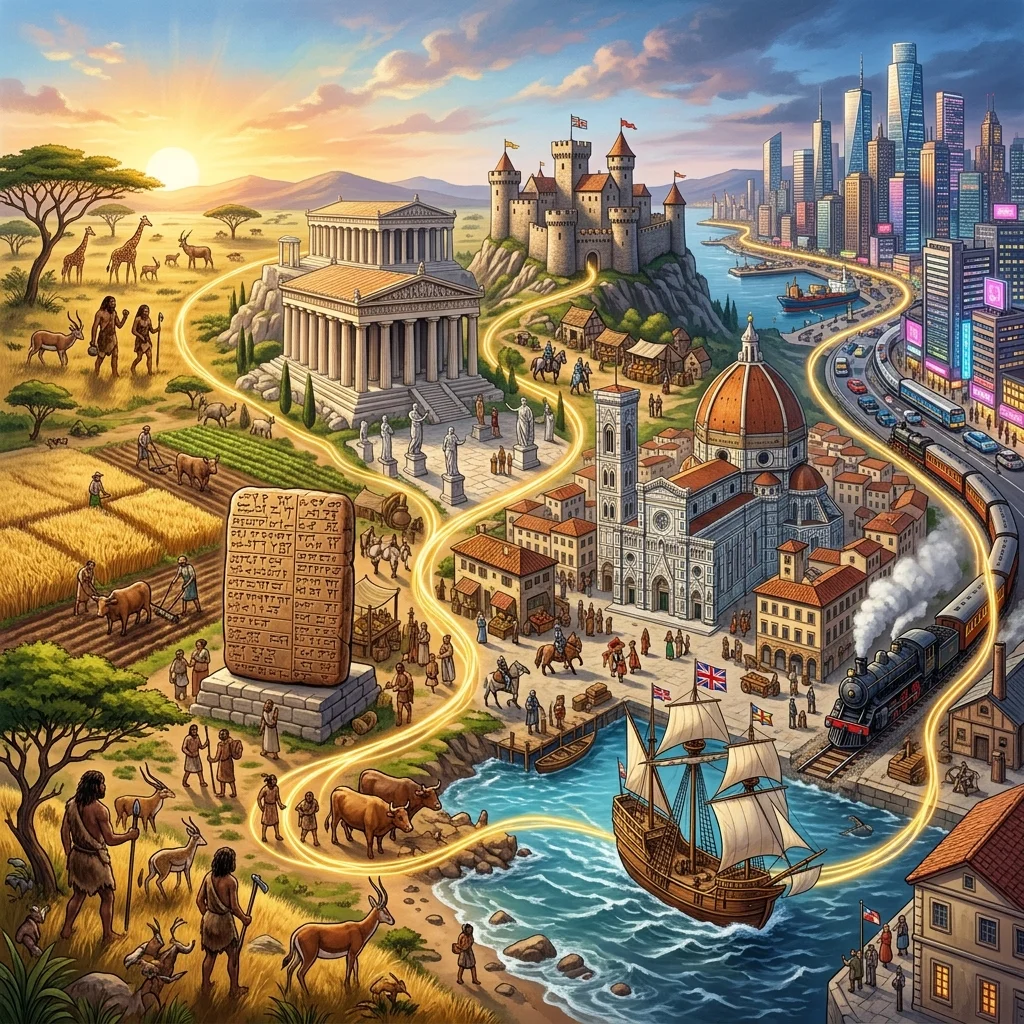
The Arc of Civilization: A 300,000-Year Cultural History Timeline and Its Hidden Economic Logic
Introduction: Why a Cultural Timeline Matters More Than a History Lesson
The human cultural timeline encompasses approximately 300,000 years of development, from the emergence of Homo sapiens in Africa to the contemporary digital era. While conventional history presents this span as a sequence of discrete events—the invention of writing in 3200 BCE, the Axial Age of 800-200 BCE, the Industrial Revolution of the 1700s-1800s—a systematic analysis reveals underlying structural patterns that transcend traditional periodization (Source 1: Archaeological consensus data).
A cultural timeline serves a function beyond mere chronology. It functions as an analytical framework that organizes complex information into visual, accessible formats, enabling the identification of inflection points where human organization underwent fundamental transformation. The core question is not what happened, but why certain eras produced disproportionate changes in human collective behavior.
The evidence points to two persistent drivers: infrastructure systems (roads, trade networks, information channels) and energy transitions (from human labor to agriculture to fossil fuels). These factors, not ideology nor charismatic leadership, constitute the hidden economic logic that connects the hunter-gatherer band to the algorithmic corporation.
The Deep Foundations: Africa as Cradle and the First Economic Shift (300,000 – 10,000 BCE)
Human culture originates approximately 300,000 years ago in Africa, where anatomically modern humans evolved (Source 2: Paleoanthropological fossil record). The foundational fact is unambiguous: "Africa is the cradle of humanity." Around 70,000 years ago, groups of Homo sapiens migrated from Africa to other continents, carrying the basic cultural toolkit of language, social cooperation, and tool-making.
The first major economic transition occurred around 10,000 years ago with the shift from hunting and gathering to farming. This represents the initial energy transition in human history: from direct solar energy capture (human labor consuming wild plants and animals) to stored solar energy (cultivated crops and domesticated livestock). The energy density differential is measurable. A hunter-gatherer territory of one square kilometer supports approximately 0.1-1 person; agricultural land of equivalent area supports 10-100 people (Source 3: Anthropological demographic studies).
This agricultural surplus generated the first economic multiplier effect. Population growth became possible. Specialization emerged as not all individuals needed to produce food. The first complex societies—with priests, artisans, and administrators—arose not from cultural genius but from caloric surplus. The hidden economic logic of settlement is that agriculture reduced the energy cost of food acquisition sufficiently to free human capital for non-subsistence activities.
Writing and the Bronze Age: Information Infrastructure as Economic Catalyst (3200 – 1200 BCE)
The invention of writing around 3200 BCE constitutes the first information technology. Prior to writing, economic complexity was limited by human memory and oral transmission. Writing enabled three functions critical to economic scaling: record-keeping (inventories, debts), taxation (census data, property records), and enforceable trade contracts (Source 4: Sumerian cuneiform administrative tablets).
The Bronze Age (3300-1200 BCE) simultaneously required and enabled long-distance trade networks. Bronze is an alloy of copper (widely available) and tin (geographically concentrated in regions such as Anatolia, Central Asia, and Cornwall). The production of bronze weaponry and tools thus created the first supply chain dependencies in human history. Societies without local tin deposits were forced into trade relationships spanning hundreds of kilometers—an early form of economic interdependence that presaged modern globalization.
Together, writing and bronze metallurgy created the first "knowledge economy" and transnational trade network. Administrative records from Ur and Ugarit reveal sophisticated systems of credit, interest rates, and commodity futures that would remain essentially unchanged until the Italian Renaissance banking houses (Source 5: Cuneiform economic tablets, University of Pennsylvania collections). The economic logic is clear: information storage and metal supply chains reduced transaction costs and enabled economic activity at scales impossible for non-literate, stone-tool societies.
The Axial Age and Classical Empires: Moral Systems and Road Networks (800 BCE – 500 CE)
The Axial Age (800-200 BCE) witnessed the simultaneous emergence of Confucianism in China, Buddhism in India, Greek philosophy in the Mediterranean, and prophetic Judaism in the Levant. This parallelism is not coincidental. These moral-philosophical systems functioned as cultural "operating system upgrades" that standardized ethical codes across expanding populations (Source 6: Karl Jaspers, The Origin and Goal of History, 1949).
The economic requirement is straightforward: as trade networks expanded beyond kinship groups, transactions required trust between strangers. Religious and philosophical systems provided standardized behavioral protocols—honesty in weights and measures, prohibitions on theft, expectations of contractual fidelity—that reduced the risk premium on inter-community trade. A Confucian merchant could predict a Greek merchant's behavior because both operated within systems that codified commercial ethics.
The classical empires (500 BCE – 500 CE) provided the physical infrastructure for this cultural-economic system. The Roman road network extended approximately 400,000 kilometers at its peak, with 80,000 kilometers of paved highways (Source 7: Roman engineering records, Itinerarium Antonini). The Silk Road, spanning over 6,000 kilometers from Xi'an to Antioch, connected the Han Chinese and Roman economic zones. These networks reduced transportation costs by an estimated 60-80% compared to non-road routes, enabling bulk trade in grain, textiles, spices, and metals (Source 8: Economic history estimates, Mediterranean transport cost studies).
The combined effect—moral systems reducing trust costs and road networks reducing transport costs—created the first genuinely international economy. The Roman denarius circulated in Indian markets; Chinese silk appeared in Roman patrician homes. Economic integration preceded political integration.
Medieval Feudalism and the Renaissance: Decentralization and Information Replication (500 – 1600 CE)
The medieval period (500-1500 CE) is conventionally characterized as a decline from classical civilization. An economic analysis reveals a different pattern: decentralization of power following the collapse of Roman transport and administrative infrastructure. Without the Roman road network and centralized tax collection, political authority fractured into local feudal units. The economic logic is that energy and information could no longer flow efficiently across large territories.
The medieval economic system was locally optimized. Agricultural productivity remained stable at approximately 2-3 calories returned per calorie invested, using heavy plows, three-field rotation, and animal power (Source 9: Medieval agricultural yield data, English manorial records). The lack of long-distance trade meant most economic activity was subsistence-oriented.
The Renaissance (1400s-1600s) represents an information revolution. The printing press (Gutenberg, c. 1450) reduced the cost of book production by approximately 95% (Source 10: Printing industry historical data). Where a manuscript Bible required 300 animal skins and months of scribal labor, a printed Bible required paper and hours of press time. Information replication costs dropped below the threshold where knowledge became a mass commodity.
This information democratization had economic consequences. Banking families like the Medici could standardize accounting practices across multiple branches. Legal codes could be uniformly distributed. Navigational charts could be reproduced accurately for maritime expeditions. The Renaissance was not primarily an artistic movement; it was an information infrastructure upgrade that enabled the next phase of economic expansion.
Colonialism: Energy Extraction and Global Infrastructure (1500s – 1900s)
Colonialism, beginning in the 1500s, represents the systematic extraction of energy and resources from one geographic region to fuel another. The transatlantic slave trade transferred approximately 12.5 million Africans to the Americas, of whom 10.7 million survived the Middle Passage (Source 11: Trans-Atlantic Slave Trade Database, Emory University). This represents a massive coerced energy transfer—human labor power moved from Africa to American plantations producing sugar, cotton, and tobacco for European consumption.
The economic logic is transparent. European powers lacked the tropical land and labor to produce high-value commodities directly. Colonial infrastructure—forts, ports, shipping routes—was built to extract and transport these resources. The triangular trade (European goods to Africa, enslaved Africans to the Americas, American commodities to Europe) created a closed economic loop that maximized resource extraction efficiency.
Colonialism also established permanent global infrastructure networks. The British Empire constructed railways in India, ports in Singapore, and telegraph lines across continents. These investments were not philanthropic; they reduced the cost of resource extraction and market access. By 1900, approximately 72% of the world's railway track was located in Europe and North America, with colonial territories serving primarily as resource appendages (Source 12: Railway development statistics, World Bank historical data).
The Industrial Revolution: Energy Density and Economic Escalation (1700s – 1800s)
The Industrial Revolution (1700s-1800s) represents the second great energy transition, from biological energy (human and animal muscle, wind, water) to fossil fuels (coal, then oil and natural gas). The energy density differential is dramatic. A coal-fired steam engine can produce approximately 20 times the work output per unit of weight compared to a horse or human laborer (Source 13: Engineering thermodynamics calculations).
This energy transition enabled industrial-scale production. Textile mills, iron foundries, and later steel plants concentrated production in factory systems. The economic consequence was a fundamental shift from decentralized, artisanal production to centralized, capital-intensive manufacturing. Output per worker increased by factors of 10-50 in key industries within a single generation (Source 14: British industrial production statistics, 1760-1840).
The Industrial Revolution also transformed information and transport infrastructure. The telegraph (1837) reduced communication time from days to seconds. The railroad reduced overland transport costs by an estimated 85% compared to canal or road transport (Source 15: Railroad economics data, U.S. Interstate Commerce Commission). These reductions in transaction costs enabled firms to operate at national and eventually continental scales.
Contemporary Implications: Digital Infrastructure as Economic Driver
The pattern across 300,000 years is consistent. Each major cultural transformation was preceded or accompanied by infrastructure and energy transitions. The digital revolution (1960s-present) continues this pattern. Computing power has increased by approximately one trillion-fold since 1956 (Source 16: Moore's Law historical data, Intel Corporation). Data transmission costs have declined from approximately $1,000 per megabit per second in 1990 to less than $0.01 in 2023 (Source 17: Telecommunications cost data, World Bank).
The hidden economic logic predicts further integration. Artificial intelligence and machine learning represent an information processing infrastructure upgrade comparable to the invention of writing. Just as writing enabled record-keeping at scale, AI enables pattern recognition and decision-making at scales impossible for human cognition alone. Current global data generation is approximately 120 zettabytes per year (Source 18: International Data Corporation estimates), representing an information volume that would require approximately 10^14 human scribes to produce manually.
Predictive Analysis: The Next Infrastructure Transition
Based on the historical pattern, the next major cultural shift will likely emerge from energy or information infrastructure transformation. Three candidates present themselves:
First, quantum computing could reduce certain calculation costs exponentially, potentially rendering current encryption systems obsolete and enabling molecular-level material design. The timeline for commercial quantum advantage is estimated at 2027-2035 (Source 19: Industry roadmaps, IBM, Google, Microsoft).
Second, fusion energy could provide near-unlimited clean energy, effectively eliminating energy constraints on economic activity. Current fusion projects (ITER, SPARC) project commercial demonstration by 2035-2045 (Source 20: Fusion energy project schedules).
Third, space-based infrastructure could reduce resource extraction costs from Earth's gravity well. Asteroid mining for platinum group metals or lunar helium-3 for fusion reactors would represent a resource frontier comparable to the colonial expansion of the 1500s.
Historical precedent suggests that whichever infrastructure investment reduces transaction costs most dramatically will drive the next cultural transformation. The pattern is deterministic: lower transaction costs enable larger scales of human cooperation, which in turn generate more complex cultural systems. The timeline of 300,000 years is not arbitrary history; it is a record of declining cost curves for energy, information, and transport. The future will likely continue this trajectory until physical or cognitive limits are reached.
(All rights reserved by Global Beacon Chronicle. Unauthorized reproduction is prohibited.)
Liu Yan / Liu Yan
Business historian researching the intersection of tech and society.