10 Ancient Civilizations That Thrived: Unlocking the Secrets of Their Success
From Mesopotamia to the Maya, only a handful of ancient civilizations achieved

10 Ancient Civilizations That Thrived: Unlocking the Secrets of Their Success and Lasting Benefits
Of the estimated 117 billion humans who have ever walked the Earth, only about 7 percent were alive in 2020. That staggering figure, derived from demographic research, frames a deeper question: Why did so few societies achieve sustained prosperity? Most human groups remained small bands or transient settlements. A handful, however, grew into civilizations that flourished for centuries or even millennia. What separated them from the rest?
This article examines 10 ancient civilizations that not only survived but thrived, using a framework drawn from historian V. Gordon Childe’s definition of civilization and four core engines of success—trade, conflict, exploration, and innovation. We also explore the three collapse factors that eventually brought each down: external pressure, internal change, and environmental collapse. The goal is not mere historical review, but a search for hidden economic and social patterns that determine a civilization’s fate.
---
What Makes a Civilization? Childe’s Checklist and the Four Engines of Thriving
In the 1930s, archaeologist V. Gordon Childe proposed a set of criteria that still defines what we mean by “civilization.” His checklist includes urban settlement, division of labor, a recording system (writing or equivalent), class interdependence, a ruling class, monumental architecture, organized religion, and a system of food surplus payments (taxation or tribute). By these measures, only a handful of societies qualify as early civilizations.
Yet meeting Childe’s criteria is only a starting point. The real question is what allowed a civilization to thrive—to grow, adapt, and persist. Four engines seem to drive this process:
- Trade: Economic exchange of goods, ideas, and technologies across regions.
- Conflict: Inter-state rivalry and warfare, which often spurred technological leaps and territorial consolidation.
- Exploration: The push to expand geographical knowledge and access new resources.
- Innovation: Breakthroughs in tools, governance, agriculture, and social organization.
These engines are balanced by three collapse factors that eventually overwhelm every civilization: external pressure (invasion, war), internal change (population shifts, disease, weakening trade networks), and environmental collapse (floods, droughts, volcanic eruptions).
Yuval Noah Harari, in Sapiens, argues that a key intangible factor binds strangers into a common identity: collective imagination. Shared myths, legal codes, and religious beliefs allowed large-scale cooperation. This, more than any single invention, was the glue of thriving societies.
---
Civilization 1: Mesopotamia (5000–2000 B.C.E.) – The Cradle of Writing and Law
Mesopotamia, the land between the Tigris and Euphrates rivers, is often called the first true civilization. It gave humanity cuneiform writing, the Code of Ur-Nammu (predecessor to Hammurabi’s Code), early astronomy, and the wheel. Its success depended on all four engines:
- Trade: River-based commerce linked city-states like Ur, Uruk, and Lagash, enabling the exchange of grain, textiles, and metals.
- Conflict: Constant rivalry between city-states drove innovations in military organization and irrigation.
- Exploration: River navigation extended trade routes to the Persian Gulf and beyond.
- Innovation: The invention of writing for record-keeping and law, plus advanced irrigation systems that turned arid plains into fertile farmland.
The collapse of Mesopotamia came from a combination of internal change (declining agricultural yields from salinization) and external pressure (invasions by Akkadians and later Elamites). By 2000 B.C.E., its golden age had faded, but its legacy—writing, law, astronomy—endures.
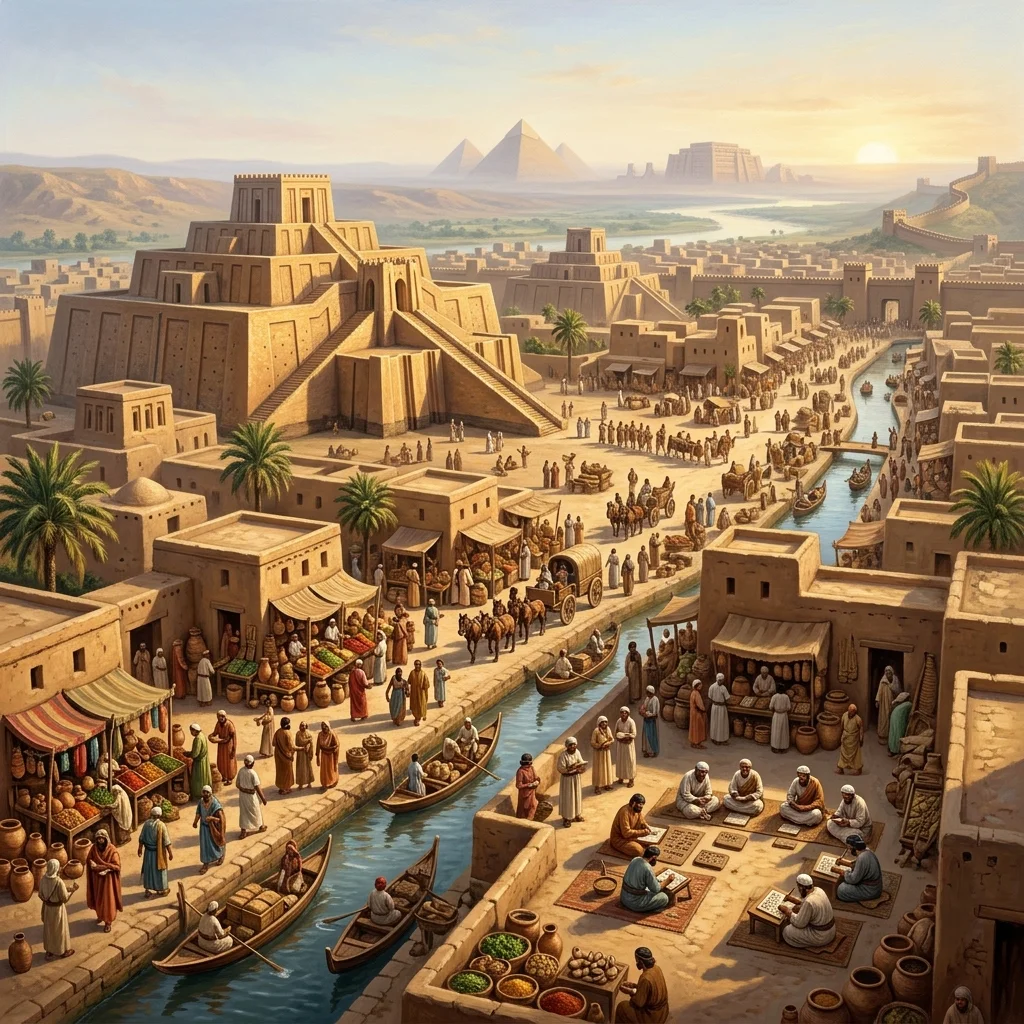
[IMAGE: A panoramic digital painting of a thriving ancient Mesopotamian city at dawn, with ziggurats, bustling marketplaces, and scholars writing on clay tablets. Sunlight illuminates the scene, symbolizing innovation and trade.]
---
Civilization 2: Ancient Egypt (3100–1070 B.C.E.) – Stability Along the Nile
Egypt’s civilization survived for more than two millennia, thanks largely to the predictable floods of the Nile. The four engines worked differently here: trade (along the Nile and across the Red Sea), conflict (unification under Narmer and later defense against Hyksos), exploration (expeditions to Punt and Nubia), and innovation (pyramid construction, hieroglyphics, medicine).
Egypt’s success lay in its ability to absorb external pressure and adapt. The three collapse factors eventually caught up: environmental collapse (prolonged drought and Nile failures around 2200 B.C.E. contributed to the First Intermediate Period), internal change (centralized power eroded by priestly factions), and external pressure (invasions by Assyrians, Persians, and eventually Romans). Yet Egypt’s monuments and spiritual concepts shaped later Mediterranean culture profoundly.
---
Civilization 3: Indus Valley Civilization (3300–1300 B.C.E.) – The Urban Planners
The Indus Valley (Harappan) civilization, centered in present-day Pakistan and northwest India, was one of the largest ancient cultures. Its cities—Mohenjo-daro, Harappa—featured advanced drainage systems, standardized brick sizes, and extensive trade networks reaching Mesopotamia.
Success came from trade (seals and goods found across the Gulf), innovation (urban planning and metallurgy), and exploration (maritime routes). Conflict seems to have been minimal—Indus cities had few fortifications. The collapse around 1900–1300 B.C.E. is likely due to environmental collapse (shifts in monsoon patterns and river drying) and internal change (overexploitation of resources). The writing system remains undeciphered, but its influence on later Indian cultures is undeniable.
---
Civilization 4: Shang and Zhou China (1600–256 B.C.E.) – The Mandate of Heaven
China’s earliest historically verified dynasty, the Shang, built a powerful bronze-age civilization in the Yellow River valley. The Zhou that followed introduced the concept of the Mandate of Heaven—a moral justification for rule that allowed dynastic change without collapse.
Trade in bronze, silk, and jade connected regional lords. Conflict between city-states and nomadic tribes spurred military innovation (chariots, later crossbows). Exploration pushed southward into the Yangtze basin. Innovation included the development of a written script (oracle bones) and sophisticated irrigation.
The Zhou eventually fractured under internal change (feudal fragmentation, economic strain) and external pressure (nomadic invasions), leading to the Warring States period. Yet China’s civilization never truly collapsed—it adapted, and its core institutions survived.
---
Civilization 5: Minoan Crete (2700–1450 B.C.E.) – The Maritime Traders
On the island of Crete, the Minoan civilization built palace complexes like Knossos and dominated eastern Mediterranean trade. Their success relied heavily on trade (ships carrying pottery, olive oil, and wine) and exploration (maritime routes to Egypt and the Levant). Innovation in fresco painting and plumbing created a sophisticated culture.
Conflict was relatively minor—Minoan palaces were unfortified. The collapse likely came from a combination of environmental collapse (the volcanic eruption of Thera around 1600 B.C.E. causing tsunamis and ash fallout) and external pressure (Mycenaean conquest). Minoan art and mythology influenced later Greek civilization.
---
Civilization 6: Classical Greece (800–146 B.C.E.) – The Birth of Democracy
Greece’s city-states—Athens, Sparta, Corinth—achieved a cultural and intellectual flourishing that still shapes modern thought. The four engines were especially pronounced:
- Trade: Greek colonies and ships connected the Black Sea to Spain.
- Conflict: The Persian Wars and Peloponnesian War drove military and political innovation (phalanx formations, trireme ships, democratic reforms).
- Exploration: Alexander the Great’s campaigns opened Central Asia.
- Innovation: Philosophy, drama, architecture, and science.
The collapse came from internal change (exhausting wars, population decline) and external pressure (Macedonian and then Roman conquest). Yet the benefits—democracy, theater, logic—are still with us. Victor Hugo once wrote, “A society can be destroyed by war; it can be reborn by thought.” Greece’s thought outlasted its empire.
---
Civilization 7: Ancient Rome (753 B.C.E. – 476 C.E.) – Law, Governance, and Engineering
Rome transformed from a small village to a Mediterranean superpower. Its success hinged on trade (a unified currency and roads), conflict (systematic conquest and the pax Romana), exploration (military campaigns into Britain, Dacia, Mesopotamia), and innovation (concrete, aqueducts, Roman law).
The collapse factors are well-known: external pressure (barbarian invasions), internal change (political corruption, economic inflation, division of the empire), and environmental collapse (lead poisoning theories, plague outbreaks). Rome’s lasting benefits include law codes, language, and engineering principles that underpin Western civilization.
[IMAGE: An infographic showing the human population timeline from 200,000 B.C.E. to 2020, with a highlight on the 7% living today.]
---
Civilization 8: The Maya (2000 B.C.E. – 1500 C.E.) – Astronomy and Urban States
The Maya civilization of Mesoamerica built impressive city-states with pyramids, writing (hieroglyphs), and a precise calendar. Trade in jade, obsidian, and cacao linked cities across the Yucatán. Conflict between city-states (Tikal, Calakmul) drove political competition. Exploration extended Maya influence into lowland regions. Innovation produced the concept of zero in mathematics.
The Classic Maya collapse around 800–900 C.E. is a textbook case of environmental collapse (severe droughts) combined with internal change (overpopulation, deforestation) and external pressure (Chichén Itzá later conquests). Despite the collapse of political centers, Maya culture and language survive today.
---
Civilization 9: The Inca Empire (1438–1533 C.E.) – Mountain Empire Without Wheels
The Inca built the largest empire in pre-Columbian Americas, spanning the Andes. Trade (state-managed redistribution of goods) and innovation (terrace agriculture, quipu record-keeping) were key. Conflict (conquest of neighboring peoples) and exploration (expanding the road network across 25,000 miles) consolidated power.
Collapse came swiftly from external pressure (Spanish invasion and disease) and internal change (civil war between Huáscar and Atahualpa). The Inca’s lasting benefits include their agricultural techniques and road system, still visible in the Andes.
---
Civilization 10: The Kingdom of Kush (1070 B.C.E. – 350 C.E.) – Iron, Gold, and Pyramids
South of Egypt along the Nile, the Kingdom of Kush (with capitals at Napata and Meroë) flourished as a trade hub. Trade in iron, gold, ivory, and slaves connected sub-Saharan Africa to the Mediterranean. Innovation in iron smelting gave Kush a technological edge. Conflict with Egypt and later Rome shaped its military. Exploration sent missionaries and traders down the Nile.
Collapse occurred due to environmental changes (desertification, shifting trade routes) and external pressure (invasion by Aksum). Kush left behind hundreds of pyramids—more than in Egypt—and a written script derived from Egyptian hieroglyphs, but still in use.
---
The Hidden Patterns: Why Thriving Matters
The 10 civilizations above represent only a fraction of human history, but they illustrate recurring patterns. Trade, conflict, exploration, and innovation create positive feedback loops. When one engine falters—when trade routes are cut or innovation stagnates—the civilization becomes vulnerable to the three collapse factors.
Harari’s insight about collective imagination is critical: The most successful civilizations, from Mesopotamia to Rome, created shared stories—legal codes, religious narratives, national identities—that allowed millions to cooperate. These stories outlasted the physical structures that housed them.
Victor Hugo’s observation that war costs more than lives—it costs opportunity—also rings true. The great wars of Greece and Rome ultimately drained their resources, but the knowledge they generated (philosophy, engineering, law) became a permanent inheritance.
Today, with 7.8 billion people on Earth (just 7% of all humans who ever lived), we face similar pressures: environmental collapse, internal change, external competition. The ancient civilizations remind us that success is never permanent. It must be continually renewed through trade, innovation, and the stories we tell ourselves about who we are and what we can become.
In the end, the secrets of their success are not mysterious. They lie in the same human ingenuity—our ability to cooperate, adapt, and learn—that brought writing from Mesopotamia, democracy from Greece, and law from Rome. The question is whether we can keep them alive.
[IMAGE: A diagram of Childe’s checklist with icons for each criterion, plus arrows showing how the four engines feed into civilization stability.]
(All rights reserved by Global Beacon Chronicle. Unauthorized reproduction is prohibited.)
Liu Yan / Liu Yan
Business historian researching the intersection of tech and society.