Cradle of Civilization: How River Valleys Shaped Human Progress – A Deep Dive
This article explores the four great ancient civilizations that emerged

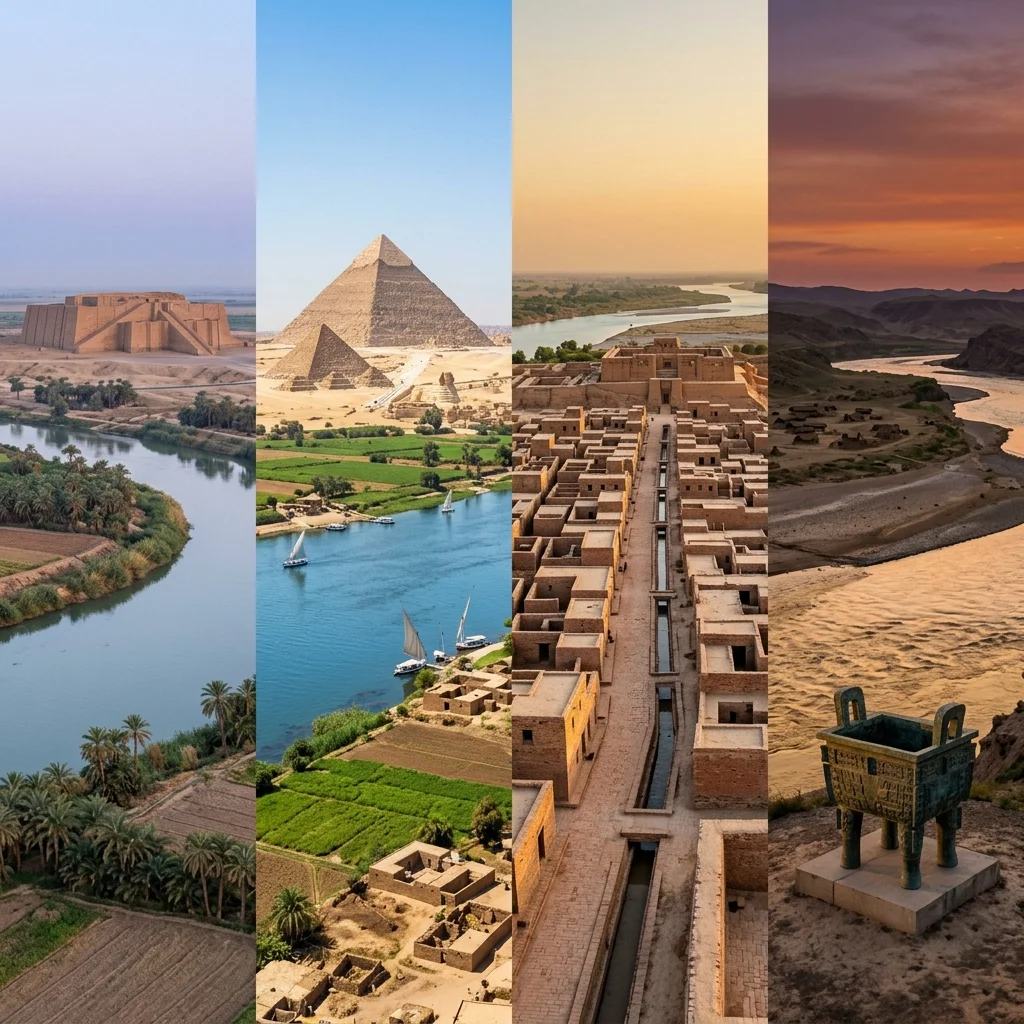
Cradle of Civilization: How River Valleys Shaped Human Progress – A Deep Dive into Ancient Sumer, Egypt, Indus, and China
Introduction: The Four Cradles of Humankind
The emergence of complex human societies between 3200 and 1040 BCE occurred in four distinct river valleys: the Tigris/Euphrates (Mesopotamia), the Nile (Egypt), the Indus (South Asia), and the Yellow River (China). These geographic corridors provided consistent water supply and nutrient-rich silt through seasonal flooding, enabling agricultural surpluses that exceeded subsistence requirements. Surplus production permitted occupational specialization – scribes, priests, craftsmen, administrators – which in turn catalyzed urbanization, state formation, and the invention of writing.
This article conducts a systematic “slow analysis” audit of these civilizations, tracing the hidden economic logic of water management as the original supply chain. The analysis examines how control over water and land determined settlement patterns, governance structures, and technological innovation. The timeline begins with the development of farming around 8500 BCE, leading to permanent settlements such as Jericho (c. 8000 BCE), and concludes with the Shang Dynasty in China (1750–1040 BCE).
Key timeline (Source: [Archaeological consensus on early agriculture and urbanism]):
- 8500 BCE: Emergence of systematic farming in the Near East.
- 8000 BCE: Jericho settled – earliest known walled urban center.
- 5000 BCE: Permanent villages appear in the Nile Valley.
- 3200 BCE: Sumerian city-states arise; Pharaoh Menes unifies Egypt.
- 2500 BCE: Completion of the Great Pyramid of Giza.
- 1750–1040 BCE: Shang Dynasty in the Yellow River region.
- 771–221 BCE: Development of Daoism, Confucianism, and Legalism in China.
The Agricultural Revolution: From Nomads to Settled Communities
The transition from hunting and gathering to agriculture around 8500 BCE represents the first large-scale economic transformation in human history. Domestication of cereals (wheat, barley, rice) and animals (sheep, goats, cattle) allowed populations to remain in fixed locations. Food surpluses required organized storage – granaries, pits, and later centralized redistribution systems.
Jericho, occupied by 8000 BCE, demonstrates early urban planning: a defensive stone wall, a tower, and residential structures. Its location near the Jordan River and abundant spring water allowed year-round cultivation. The site contains evidence of trade in obsidian and shells, indicating that surplus enabled exchange networks (Source: [Kenyon, K. “Digging Up Jericho,” 1957]).
In the Nile Valley, villages appear by 5000 BCE (Source: [Hassan, F. “The Predynastic of Egypt,” 1988]). The Indus and Yellow River regions, settled later, followed the same pattern: reliance on annual flooding that deposited fertile silt, reducing the need for artificial fertilization. Controlled irrigation – canals, levees, and basin systems – emerged as the first infrastructure requiring coordinated labor and management.
Mesopotamia: Sumer, City-States, and the Invention of Writing
The region between the Tigris and Euphrates rivers – Mesopotamia, meaning “the land between two rivers” in Greek – saw the rise of Sumerian civilization from approximately 3200 to 2360 BCE. Unlike the unified Nile Valley, Sumer was organized into autonomous city-states: Lagash, Uruk, Ur, Kish, and Nippur. Each city had its own ruler, patron deity, and defensive walls.
King Enmebaragesi of Kish is recorded as the first ruler to unify the twelve major city-states under a single authority (Source: [Sumerian King List, c. 2100 BCE]). His son Agga was besieged at Uruk according to the Epic of Gilgamesh, a literary work that provides one of the earliest accounts of warfare and diplomacy.
The most enduring Sumerian innovation was cuneiform writing, developed around 3200 BCE for administrative record-keeping – tracking grain storage, livestock inventories, and tax payments. Clay tablets with wedge-shaped impressions have been recovered from temple archives across the region. This system of writing was adopted by successive powers – the Akkadians, Hittites, and Assyrians – and remained in use for over two millennia (Source: [Michalowski, P. “The Correspondence of the Kings of Ur,” 2011]).
Sumerian city-states also pioneered ziggurats – stepped temple towers that served as administrative and religious centers. These structures required centralized planning and resource mobilization, demonstrating the organizational capacity that water-surplus agriculture enabled.
Egypt: Unified Kingship and Monumental Infrastructure
The Nile River’s predictable annual flood cycle provided a more stable agricultural base than the irregular Tigris/Euphrates. Villages along the Nile date to at least 5000 BCE. Around 3200 BCE, Pharaoh Menes (often identified with Narmer) unified Upper and Lower Egypt, establishing Memphis as the capital (Source: [Wilkinson, T. “Early Dynastic Egypt,” 1999]).
Egypt’s political consolidation allowed for large-scale public works. The Great Pyramid of Giza, completed around 2500 BCE for King Khufu (Cheops), required the quarrying and transport of approximately 2.3 million stone blocks, each weighing two to three tons. The labor force, estimated at 20,000–30,000 workers, was fed and housed by the state’s grain surplus – an early example of a state-directed supply chain (Source: [Lehner, M. “The Complete Pyramids,” 1997]).
Egypt was ruled by thirty successive dynasties until the Persian invasion in 341 BCE. Subsequent conquests by Greeks (332 BCE under Alexander), Romans (30 BCE), and Muslim Arabs (7th century CE) introduced new administrative and religious systems. Muslim rule lasted six centuries until the Ottoman Turkish conquest in 1517 CE. The longevity of Egyptian state structures – over three millennia – demonstrates how river-based surplus can sustain institutional continuity.
The Indus Valley Civilization: Grid-Planned Urbanism and Sanitation
The Indus Civilization, covering present-day Pakistan, parts of northwestern India, and eastern Afghanistan, flourished during the second millennium BCE (approximate dating, pending further radiocarbon refinement). Major cities such as Mohenjo-Daro and Harappa housed thousands of residents. Street layouts followed a rigid grid pattern, with main thoroughfares oriented north–south and east–west (Source: [Kenoyer, J.M. “Ancient Cities of the Indus Valley Civilization,” 1998]).
The most distinctive feature of Indus cities is their sanitation infrastructure: brick-lined drainage channels ran beneath streets, connected to individual household toilets and bathing platforms. Covered drains carried wastewater outside the city walls. This system represents the earliest known urban sewer network, predating Roman aqueducts by more than a millennium.
Indus city planning implies a coordinating authority – likely a merchant or priestly council – capable of enforcing building standards across thousands of residences. Artifacts include standardized weights and measures, seals inscribed with an undeciphered script, and trade goods (lapis lazuli, carnelian) sourced from Central Asia and the Persian Gulf. The civilization declined around 1900–1500 BCE, possibly due to river course changes or climate shifts, but left a legacy in urban design and hydraulic engineering.
China’s Yellow River: The Shang Dynasty and the Foundations of Chinese Civilization
The Yellow River (Huang He) in northern China supported the Shang Dynasty, which ruled from approximately 1750 to 1040 BCE. Shang society was stratified: a king, aristocratic warriors, bronze artisans, and peasant farmers. The capital, Anyang, contained palace foundations, royal tombs, and workshops (Source: [Keightley, D.N. “The Ancestral Landscape,” 2000]).
Shang metallurgists achieved mastery in bronze casting, producing ritual vessels, weapons, and chariot fittings. The lost-wax method allowed detailed decoration. Early Chinese writing – oracle bone script – recorded divination queries on turtle shells and animal bones. Over 150,000 oracle bones have been excavated, providing the oldest corpus of Chinese written records.
During the subsequent Zhou period (771–221 BCE), philosophical schools emerged – Daoism, Confucianism, and Legalism – that would shape East Asian governance for two millennia. The Yellow River’s propensity for devastating floods also necessitated massive levee systems, creating a tradition of centralized hydraulic engineering that continued into the imperial period.
Long-Term Impacts: Infrastructure, Governance, and Cultural Transmission
The four river-valley civilizations share common features that influenced later societies:
- Water management as original infrastructure: Canals, dams, and reservoirs became models for subsequent hydraulic projects. Mesopotamia’s irrigation systems, Egypt’s basin fields, and China’s flood-control levees established the principle that state authority rests in part on its ability to control water (Source: [Wittfogel, K. “Oriental Despotism,” 1957]).
- Writing as administrative technology: Cuneiform, hieroglyphs, Indus seals, and oracle-bone script all originated from record-keeping needs. Writing enabled taxation, legal codification, and the transmission of knowledge across generations.
- Urban grid planning: Sumerian irregular street patterns differ from Indus orthogonal grids, but both represent deliberate spatial organization. Modern cities continue to use similar principles for drainage and circulation.
- Standardized trade systems: Weights, measures, and common currency (Egyptian deben, Mesopotamian shekel) facilitated long-distance exchange across cultural boundaries.
Future trends: As modern infrastructure systems face climate-change-induced water stress, ancient hydraulic strategies – seasonal storage, decentralized drainage, floodplain management – are being reexamined by engineering firms and urban planners. The economic logic of river-valley civilizations – that water surplus enables specialization – remains operative in contemporary agribusiness and water-intensive industries. Societies that cannot secure reliable water supplies will continue to face structural constraints on growth.
Conclusion
The four great river-valley civilizations – Sumer, Egypt, Indus, and Shang China – demonstrate that agricultural surplus created by controlled river flooding was the necessary condition for the emergence of specialized labor, writing, state formation, and monumental architecture. Each civilization developed distinct solutions to the problem of water management: Sumerian city-states competed for irrigation rights; Egypt centralized flood control under a divine pharaoh; Indus cities prioritized sanitation; Chinese dynasties invested in flood levees and bureaucratic record-keeping.
These ancient innovations – irrigation systems, codified writing, urban grids, and administrative hierarchies – established foundational supply chains that persist in modified form. Modern infrastructure, from water-treatment plants to tax databases, traces its conceptual lineage to the river valleys of 3000 BCE. The slow audit of these origins reveals that civilization, at its root, is a system for converting water and land into human organization.
---
Sources cited:
- Kenyon, K. Digging Up Jericho (1957).
- Hassan, F. “The Predynastic of Egypt” (1988).
- Sumerian King List (c. 2100 BCE).
- Michalowski, P. The Correspondence of the Kings of Ur (2011).
- Wilkinson, T. Early Dynastic Egypt (1999).
- Lehner, M. The Complete Pyramids (1997).
- Kenoyer, J.M. Ancient Cities of the Indus Valley Civilization (1998).
- Keightley, D.N. The Ancestral Landscape (2000).
- Wittfogel, K. Oriental Despotism (1957).
(All rights reserved by Global Beacon Chronicle. Unauthorized reproduction is prohibited.)
Liu Yan / Liu Yan
Business historian researching the intersection of tech and society.