Beyond the Barrel: How Cost Structures & Hedging Strategies Determine Oil
While falling oil prices from over $90 to around $80 per barrel universally

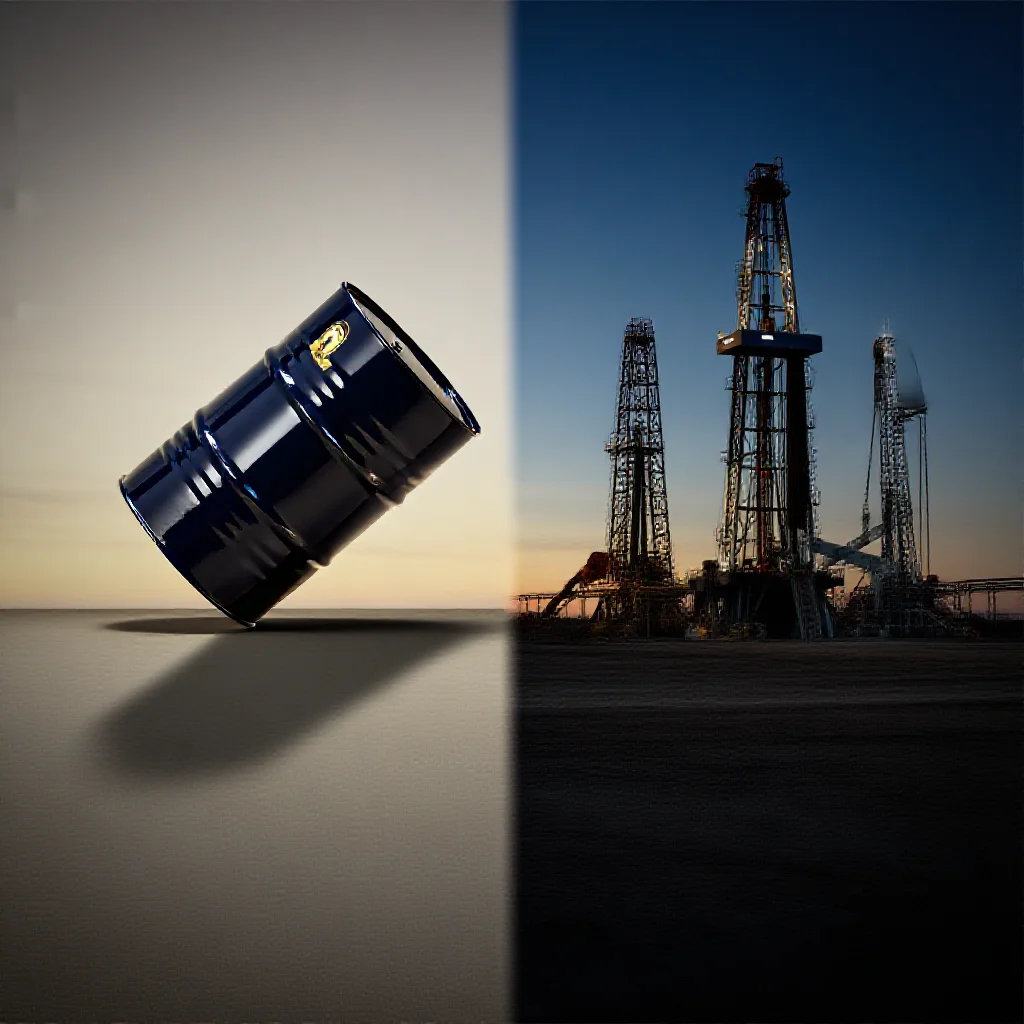
Beyond the Barrel: How Cost Structures & Hedging Strategies Determine Oil Company Resilience in a Downturn
The Price Plunge is Just the Trigger, Not the Story
The recent decline in West Texas Intermediate (WTI) crude from over $90 per barrel to approximately $80 represents a significant market shift (Source 1: [Primary Data]). This move, while notable, operates within the established band of commodity price volatility. It functions not as an anomalous event, but as a standardized stress test for upstream producers. The uniform nature of the price shock reveals the non-uniform architecture of corporate resilience. This analysis examines Devon Energy (DVN), Diamondback Energy (FANG), and Coterra Energy (CTRA) as discrete case studies in strategic differentiation. The core thesis is that the engineered financial and operational design of a company now matters more than the absolute price on the commodity ticker.
The Resilience Triad: Cost, Mix, and Financial Armor
Corporate resilience in a downturn is determined by three interdependent strategic levers: all-in sustaining cost per barrel, production mix, and hedging sophistication. A low break-even cost provides a fundamental margin of safety, allowing operations to remain profitable at lower price thresholds. Diamondback Energy, as a pure-play Permian Basin operator, exemplifies this model, where relentless operational efficiency creates a structural buffer absent in higher-cost basins.
The production mix—the ratio of oil to natural gas output—introduces a second variable. A company weighted heavily toward oil, like Devon Energy, experiences direct correlation to WTI price movements. A diversified producer like Coterra Energy carries exposure to both oil and natural gas markets. This diversification can act as a hedge if commodity prices are inversely correlated, or as a compounded drag if both markets decline concurrently. The third lever, financial hedging, serves as engineered insulation. Through derivative contracts, a company can lock in future sale prices, decoupling near-term cash flows from spot market volatility. The sophistication and scale of this program directly determine near-term earnings stability.
Company Deep Dive: Architectural Strengths Under Pressure
Devon Energy (DVN): The Oil-Weighted Producer
Devon Energy’s production profile is weighted toward oil (Source 2: [Primary Data]). This provides leveraged exposure to oil price rallies but corresponding vulnerability to declines. Its resilience, therefore, is not derived from commodity diversification but from its cost management and, critically, its hedging program. Analysis indicates that prior to the price drop, Devon likely executed hedges locking in sale prices above the current ~$80 benchmark. This provides temporary insulation for cash flow and earnings, though the duration and degree of this protection are finite. Once hedges roll off, its financial performance will correlate more directly with the spot market, placing greater emphasis on its underlying operating cost structure.
Diamondback Energy (FANG): The Low-Cost Pure-Play
Diamondback Energy operates almost exclusively within the Permian Basin, a region synonymous with low-cost, high-efficiency production (Source 3: [Primary Data]). Its strategic architecture is built for resilience through operational superiority, not financial engineering. The company’s break-even cost is among the lowest in the sector, meaning its operations likely remain cash-flow generative even at sustained prices near or slightly below current levels. However, this model often correlates with minimal hedging, based on a philosophy that its low costs negate the need for price insurance. Consequently, while its margins compress less than peers, its earnings and cash flow exhibit near-full exposure to spot price movements, offering no quarterly earnings cushion.
Coterra Energy (CTRA): The Diversified Hedger
Formed from the merger of Cabot Oil & Gas and Cimarex Energy, Coterra Energy possesses a deliberately diversified production mix of natural gas and oil (Source 4: [Primary Data]). This creates a unique risk profile. In a scenario where oil prices fall but natural gas prices remain stable or rise, the gas segment provides an offsetting revenue stream. However, in a broad energy market downturn, this duality can become a source of double exposure. Coterra’s strategy typically incorporates active hedging across both commodities. Therefore, its near-term resilience is a function of two variables: the relative price performance of the two commodities and the specific details of its multi-commodity hedging book, which can lock in margins on a portion of its output.
The Hidden Market Pattern: Capital Discipline as the New Litmus Test
The current downturn serves as the first significant test of the energy sector’s post-shale-boom commitment to capital discipline. The market’s valuation of producers has shifted from rewarding production growth at any cost to prioritizing free cash flow and shareholder returns. This environment filters companies based on strategic coherence.
Devon’s hedging represents a form of disciplined capital allocation aimed at smoothing returns. Diamondback’s cost focus is a direct operational manifestation of capital discipline, ensuring profitability across cycles. Coterra’s diversification and hedging can be interpreted as a risk-management discipline. The strategic architectures of these three companies illustrate different pathways to the same stated goal: sustainable returns.
A sustained period of lower prices will accelerate industry consolidation. Companies with high break-even costs, undiversified exposure, and weak balance sheets will face existential pressure. In contrast, operators with the low-cost structures of Diamondback, the proactive financial insulation of Devon, or the balanced, hedged portfolio of Coterra are positioned as likely consolidators. The market is enacting a filtration process, where resilience is no longer a function of commodity prices alone, but of the deliberate corporate engineering beneath them.
(All rights reserved by Global Beacon Chronicle. Unauthorized reproduction is prohibited.)
Wang Jing / Wang Jing
Capital markets analyst and CFA charterholder.