Beyond the Burrito Bowl: Decoding Chipotle''s 2023 Surge as a Blueprint for
Chipotle Mexican Grill's (CMG) remarkable 2023 performance, featuring a >50%

Beyond the Burrito Bowl: Decoding Chipotle's 2023 Surge as a Blueprint for High-Growth Stock Selection
The Chipotle Phenomenon: More Than a Burrito, a Market Signal
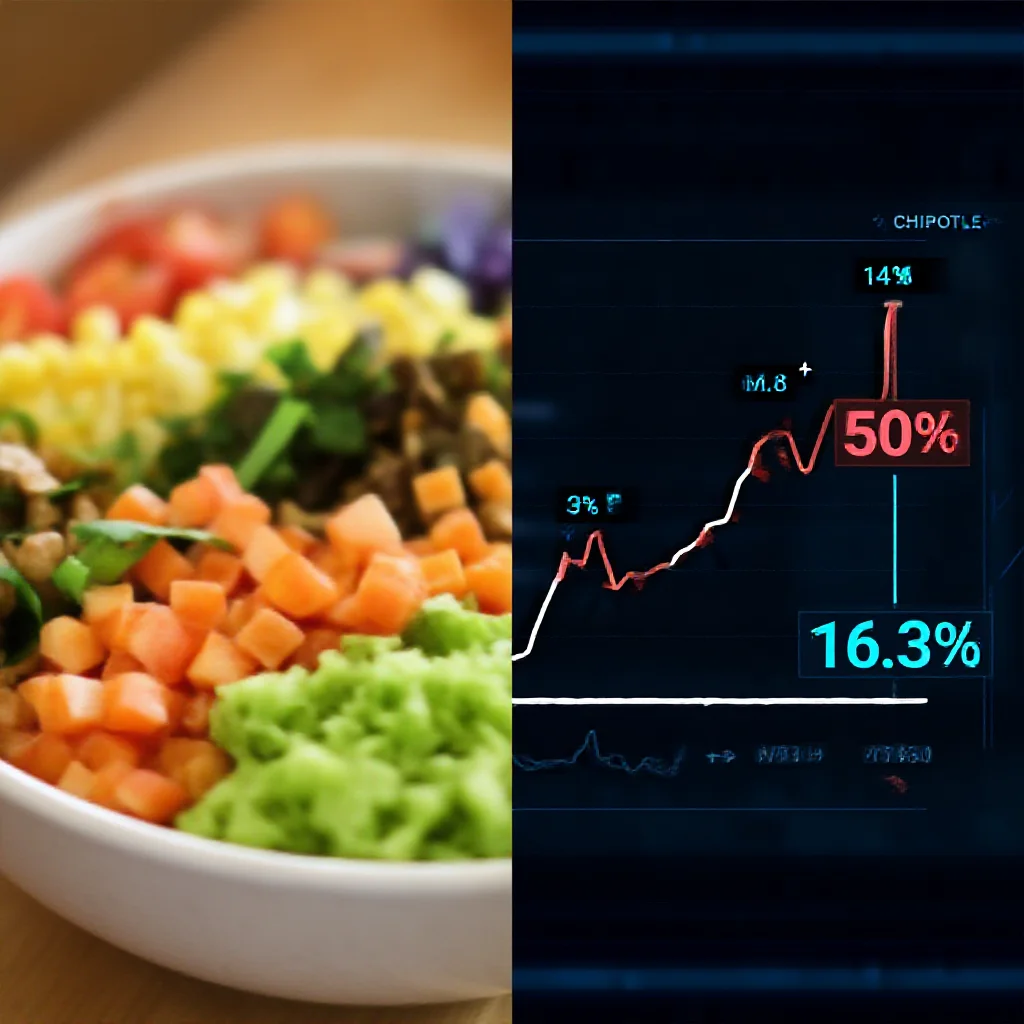
The 2023 performance of Chipotle Mexican Grill (CMG) functions as a microcosm of successful growth investing. The company’s stock appreciated by more than 50% over the calendar year (Source 1: [Primary Data]). This price action was supported by operational metrics: a 14% increase in same-store sales, the opening of 62 new restaurants, and an operating margin of 16.3% for the third quarter (Source 1: [Primary Data]). These figures are not isolated successes but interconnected outputs of a specific business model. This analysis positions Chipotle not merely as a restaurant chain success story but as a live case study. The thesis is that deconstructing CMG’s performance yields a universal, disciplined framework for identifying the next generation of market-leading growth stocks.Deconstructing the Growth Investor's Checklist: The Two Core Filters
A disciplined growth investment strategy requires sequential filters to separate transient performers from sustainable compounders.Filter 1: The Engine of Profit (Minimum 25% Annual Earnings Growth). This metric serves as a non-negotiable proxy for business momentum and scalability. It isolates companies capable of expanding earnings significantly faster than the broader market. Chipotle’s 2023 performance demonstrates the components of this engine: robust top-line sales growth and systematic margin expansion. The 14% same-store sales growth indicates pricing power and brand strength, while the 16.3% operating margin demonstrates efficiency in converting revenue to profit (Source 1: [Primary Data]). Sustained high earnings growth signals a scalable economic model, a prerequisite for long-term stock appreciation.
Filter 2: The Market's Verdict (Relative Strength > 80). Relative Strength (RS) rating measures a stock’s price performance over the last 12 months compared to all other stocks. A rating above 80 indicates it is outperforming at least 80% of the market. This is a quantitative measure of institutional demand and price momentum. Chipotle’s consistent stock price ascent throughout 2023, culminating in a >50% gain, inherently translated to a superior RS rating (Source 1: [Primary Data]). This filter confirms that a company’s fundamental strength is being recognized and capitalized upon by the market.
The interplay of these filters is critical. The first filter identifies fundamental strength; the second confirms market confirmation. A stock passing both filters, as CMG did, represents a confluence of operational excellence and capital allocation favor.
The Hidden Economic Logic: Unit Economics and Operational Alchemy
Top-line growth and earnings metrics are outcomes. The causal mechanisms lie in unit economics and operational scalability.Deep Dive Entry Point: The Scalability of Margin. Chipotle’s 16.3% operating margin is not an accident but an engineered outcome (Source 1: [Primary Data]). It results from several scalable factors: throughput efficiency that maximizes revenue per labor hour, leverage over food costs through consistent ordering patterns, and the margin-accretive shift toward digital ordering. Digital orders, which carry lower relative labor costs, have become a significant and growing portion of sales. This operational model allows margin expansion to accompany unit growth, a hallmark of a superior franchise.
The Long-Term Impact on the Supply Chain. The consistent addition of new units—62 in a single quarter—creates a compounding advantage (Source 1: [Primary Data]). Each new restaurant increases aggregate purchasing volume, granting Chipotle greater leverage with suppliers. This leads to preferential pricing, supply chain resilience, and potential insulation from commodity cost volatility. This scale advantage erects a barrier to competition, as smaller chains cannot replicate the same cost structure. The resulting margin strength fuels further growth, creating a virtuous cycle where expansion begets efficiency, which in turn funds more expansion.
Evidence from industry reports on restaurant labor efficiency and food commodity costs underscores the atypical nature of this model. Unlike traditional fast-food models often pressured by discounting and high labor turnover, Chipotle’s focus on throughput and supply chain integration creates a distinct economic profile.
From Case Study to Strategy: Applying the CMG Framework to Your Watchlist
The Chipotle case study provides a transferable analytical framework. The application process is systematic.First, screen for the quantitative prerequisites: a demonstrated history and credible forecast of minimum 25% annual earnings growth, coupled with a Relative Strength rating consistently above 80. These data points are widely available through financial screening tools and market data platforms.
Second, upon identifying candidates that pass these filters, the analysis must shift to qualitative and economic validation. Investigate the source of earnings growth. Is it driven by sustainable competitive advantages like scalable unit economics, brand loyalty, and operational leverage, as seen in Chipotle’s model? Or is it reliant on non-recurring events, excessive financial leverage, or market speculation? Scrutinize the business model for the presence of a virtuous cycle where growth reinforces competitive advantages, which in turn enables further growth.
Third, continuous monitoring is essential. The framework is dynamic. A deterioration in either the earnings growth trajectory or the Relative Strength rating serves as an objective signal to re-evaluate the investment thesis. The model does not predict short-term price movements but identifies companies where fundamental momentum and market momentum are aligned.
Conclusion: The Disciplined Pursuit of Quality Growth
Chipotle Mexican Grill’s 2023 performance provides an empirical blueprint for growth stock selection. The synthesis of stringent fundamental analysis (high earnings growth) and technical confirmation (high relative strength) forms a robust screening mechanism. The subsequent deep dive into unit economics and operational scalability reveals the underlying causal logic that separates durable growth from ephemeral trends.The neutral market prediction derived from this analysis is that companies exhibiting this combination of traits—scalable economic models, operational excellence, and market-confirmed momentum—will continue to attract disproportionate capital allocation in efficient markets. For investors, the discipline lies not in chasing past performers but in systematically applying this validated framework to identify future leaders whose underlying economic engines resemble the template now exemplified by Chipotle.
(All rights reserved by Global Beacon Chronicle. Unauthorized reproduction is prohibited.)
Wang Jing / Wang Jing
Capital markets analyst and CFA charterholder.