Smart Beacon Market 2026-2033: From BLE Dominance to UWB and AI-Driven Contextual
The smart beacon market is poised for explosive growth, tripling from USD

Smart Beacon Market 2026-2033: From BLE Dominance to UWB and AI-Driven Contextual Intelligence
Market Overview and Growth Trajectory
The global smart beacon market is entering a phase of rapid expansion that signals a fundamental shift in how businesses interact with physical spaces. Valued at USD 3.26 billion in 2026, the market is projected to nearly triple to USD 9.44 billion by 2033, growing at a compound annual growth rate (CAGR) of 16.4%. This trajectory is not merely a continuation of past trends—it reflects a confluence of falling hardware costs, maturing ecosystem support, and an urgent demand for precise indoor location services across multiple industries.
[IMAGE: Line graph showing market size from 2020 to 2033 with historical and forecast data points, illustrating the steep upward curve from 2026 onward.]
The foundation for today’s smart beacon ecosystem was laid nearly a decade ago. Apple’s iBeacon launched in 2013 across 254 U.S. stores, marking the first mass-market deployment of Bluetooth-based proximity technology. Two years later, Google introduced Eddystone, an open-source beacon format that widened interoperability. These early moves demonstrated the potential for context-aware triggers in retail—but adoption was hampered by privacy concerns, limited accuracy, and a lack of standardized analytics. Today’s market has moved past those early hurdles. Improved privacy frameworks (such as iOS's opt-in permissions), the arrival of Ultra-Wideband (UWB) hardware, and the integration of artificial intelligence are driving a new wave of deployments that deliver measurable, real-time business outcomes.
Key drivers include the rapid digitization of retail storefronts, the post-pandemic push for contactless and efficient healthcare workflows, and logistics companies’ relentless pursuit of sub-meter accuracy in asset tracking. As beacon module prices drop below USD 1 per unit in high-volume orders, the cost barrier to large-scale deployment has all but disappeared.
Technology Shift: BLE Dominance and UWB’s Rise
Bluetooth Low Energy (BLE) currently commands 69% of the smart beacon technology segment—a dominance built on three pillars: low cost, universal device compatibility, and a mature ecosystem. Every modern smartphone supports BLE, and the technology’s power consumption allows beacon batteries to last up to five years. This makes BLE the default choice for retail proximity marketing, indoor navigation, and simple asset tracking. Major platform providers including Apple (iBeacon), Google (Eddystone), and Aliibaba continue to invest in BLE-based frameworks, ensuring broad developer support.
[IMAGE: Side-by-side comparison diagram of BLE and UWB showing accuracy (meters vs centimeters), range, power consumption, and typical use cases. BLE column shows ~1–10 m accuracy, 50–100 m range, low power; UWB column shows 10–30 cm accuracy, 10–30 m range, moderate power. Use cases: BLE for store navigation and push notifications; UWB for precision asset tracking and contactless payments.]
However, the fastest-growing technology is Ultra-Wideband (UWB) . In 2026, UWB beacon shipment volumes surged by 27% over the previous year, driven by its ability to deliver centimeter-level positioning accuracy—a critical requirement for real-time asset tracking, indoor navigation in complex environments, and secure access control. UWB’s precise ranging capabilities, combined with time-of-flight measurement, allow systems to locate objects or people within 10–30 centimeters, compared to BLE’s typical 1–10 meter range. This leap in precision opens doors that BLE cannot fully address.
A concrete example of UWB’s impact comes from logistics. Early adopters integrating UWB beacons with AI-based analytics have reported a 15% improvement in delivery accuracy during field tests. The system uses UWB anchors in warehouses and loading docks to track pallets and parcels in real time, while AI algorithms predict misrouting and suggest corrective actions before errors compound. This combination of hardware precision and algorithmic intelligence is reshaping supply chain reliability.
Other technologies such as Wi-Fi RTT (Round Trip Time) and Zigbee occupy niche roles in specific verticals but face mounting competitive pressure. Wi-Fi RTT, while compatible with existing access points, suffers from higher power consumption and inconsistent accuracy in multi-path environments. Zigbee beacons have found some traction in industrial settings but lack the smartphone ecosystem integration of BLE and the raw precision of UWB. The market is consolidating around two core standards: BLE for broad, cost-sensitive applications and UWB for high-stakes, precision-demanding scenarios.
Application Deep Dive: Retail, Healthcare, and Logistics
Retail and Marketing: Dwell Time as the New Metric
The retail and marketing segment remains the largest application area for smart beacons, accounting for over 35% of total deployment in 2026. The most compelling evidence of ROI comes from Walmart, which deployed beacons across more than 1,000 stores in 2025. The result: customer dwell time increased by 18% in beacon-enabled aisles, translating directly into higher engagement with promotional content and a measurable uptick in basket size. Walmart’s system uses BLE beacons to trigger personalized offers on the Walmart app as shoppers approach specific shelf sections, while anonymous foot-traffic data feeds into store layout optimization algorithms.
[IMAGE: Infographic with three columns. Left column “Retail” shows a smartphone receiving a promotion near a shelf with a glowing beacon; middle column “Healthcare” shows a medical cart being tracked in a hospital corridor; right column “Logistics” shows a warehouse with beacon-enabled pallets and a dashboard showing real-time location. Each column includes key metrics: Retail – dwell time +18%; Healthcare – equipment retrieval time -40%; Logistics – delivery accuracy +15%.]
The shift beyond simple push notifications is accelerating. Retailers now combine beacon signals with AI-powered customer profiles to deliver contextual intelligence—for example, a beacon near the wine aisle can trigger a recipe suggestion based on previous purchases, but only if the customer has opted in and the system determines they are lingering rather than just passing by. This nuanced approach reduces notification fatigue and improves conversion rates. Proximity marketing is evolving from “spray and pray” to surgical precision.
Healthcare: From Patient Tracking to Workflow Automation
Healthcare adoption of smart beacons is growing at over 20% CAGR, driven by the need to track expensive medical equipment, optimize staff workflows, and improve patient safety. U.S. hospitals are leading implementation: the Mayo Clinic has deployed a combined BLE+UWB beacon system across its Rochester campus to locate infusion pumps, wheelchairs, and defibrillators in real time. The system reduced equipment retrieval time by 40% and cut rental costs for temporary devices by nearly 30%.
Beyond equipment tracking, smart beacons enable patient wayfinding in sprawling medical campuses. A pilot project at Singapore’s National University Hospital used BLE beacons to guide patients from the parking lot to their appointment room via a mobile app, reducing late arrivals by 22%. In 2026, several European hospitals began integrating beacon-based contact tracing with staff badges, creating automated logs of interactions for infection control. This application, born from pandemic-era needs, has become a permanent part of healthcare IoT infrastructure.
The next frontier in healthcare is AI-enhanced patient monitoring. Beacons tracking patient movement in geriatric wards can detect unusual patterns (e.g., a patient wandering toward an exit) and alert staff immediately. When paired with UWB’s centimeter-level accuracy, these systems can differentiate between a patient sitting down versus lying on the floor—detecting falls without wearable sensors.
Logistics and Supply Chain: Precision Where It Matters
Logistics is arguably the most transformative application area for UWB beacons. The sector has long struggled with inventory inaccuracy rates of 5–15% in manual systems, leading to costly mis-shipments and delays. Smart beacons, particularly UWB-based solutions, are changing that. DHL Supply Chain reported a 15% improvement in delivery accuracy after deploying UWB beacons with AI in a regional distribution center in Germany. The system tracks every parcel from arrival to dispatch, automatically updating inventory management systems and flagging discrepancies.
[IMAGE: A warehouse floor photo with overhead UWB anchors and small beacon tags on pallets; a digital twin display on a monitor shows real-time positions of each pallet with color-coded status.]
The economic logic is straightforward: a single misrouted shipment in a high-value supply chain can cost thousands of dollars in re-routing fees and customer penalties. UWB beacons reduce that risk to near zero. Moreover, the data generated by beacon tracking feeds into AI-driven demand forecasting and dynamic route optimization. Logistics companies are increasingly viewing beacons not as a standalone technology but as the sensory layer of an intelligent supply chain operating system.
Emerging use cases extend to smart museums, airports, and stadiums. The Louvre Museum in Paris deployed BLE beacons to offer audio guides that automatically switch language based on the visitor’s proximity to artworks. A major international airport in Dubai is testing UWB beacons for passenger flow management, reducing security queue times by analyzing dwell patterns. These applications demonstrate the versatility of beacon technology beyond traditional retail and logistics.
Strategic Implications and Economic Logic
The shift from BLE dominance to a dual-technology landscape—BLE for scale, UWB for precision—carries significant implications for supply chain managers, CMOs, and technology buyers. For supply chain operators, the investment in UWB infrastructure (anchors, tags, and integration software) typically amortizes within 12–18 months through reduced error rates and labor savings. For retailers, the ROI from increased dwell time and conversions often exceeds 300% over three years, based on industry benchmarks from early adopters.
However, the hidden economic logic is not just about direct returns. Smart beacons generate high-fidelity spatial data that feeds into broader AI and machine learning initiatives. A retailer that knows exactly where shoppers pause, for how long, and in what sequence can optimize shelf layouts, staffing schedules, and even product packaging. A logistics firm with granular real-time location data can train models to predict bottlenecks before they occur. The beacon, in this sense, becomes the sensor that powers the “digital twin” of physical operations.
Geographically, North America holds a 40% market share in 2026, driven by early retail adoption and a concentrated healthcare technology sector. But the fastest-growing region is Asia Pacific, expanding at over 20% CAGR. China, Japan, and India are seeing aggressive deployments in smart manufacturing, e-commerce fulfillment, and smart city infrastructure. The APAC region’s high density of smartphone users, coupled with government investments in IoT and 5G, creates a fertile ground for beacon ecosystems.
Future Outlook: Toward Contextual Intelligence
Looking ahead to 2030 and beyond, the smart beacon market will be defined by three converging trends: the mass adoption of UWB in consumer smartphones (Apple’s U1 chip is already in hundreds of millions of devices), the maturation of AI-driven contextual intelligence platforms, and the emergence of open standards that allow BLE and UWB to coexist in the same infrastructure. Market forecasts suggest that by 2030, UWB will capture over 25% of beacon technology revenue, up from roughly 8% today.
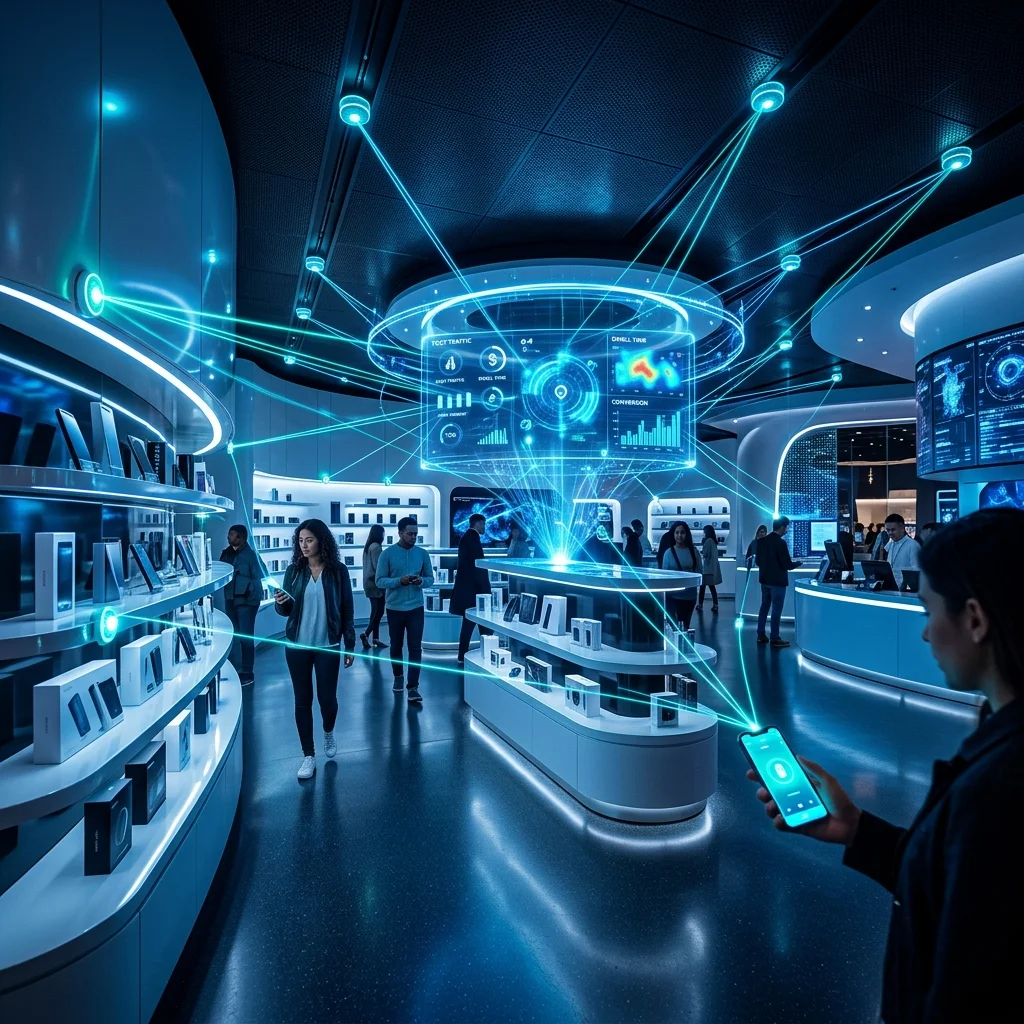
[IMAGE: A futuristic retail store interior with sleek shelves and digital displays. Small, glowing beacon nodes are embedded on shelves and ceiling, emitting subtle light beams connecting to customers’ smartphones and a central holographic dashboard showing real-time metrics like dwell time and foot traffic. The color palette is cool blue and neon cyan with a clean, high-tech aesthetic. No text or watermarks.]
The ultimate promise of smart beacons is not just indoor positioning or proximity marketing—it is contextual intelligence: the ability of a physical space to understand who is in it, what they need, and how to serve them in real time. As BLE and UWB technologies mature and costs continue to fall, the beacon will evolve from a simple transmitter to an invisible agent of operational intelligence. For businesses that invest today, the payoff will extend well beyond the numbers on a balance sheet, into a new paradigm of how physical and digital worlds converge.
(All rights reserved by Global Beacon Chronicle. Unauthorized reproduction is prohibited.)
Editorial Board / Editorial Board
Collective pseudonym for the Global Beacon Chronicle editors.