From Pilot to Production: How Plasma Reactor Tech is Reshaping the Rare Earth
Radify's transition of its plasma reactor technology from pilot to full-scale

From Pilot to Production: How Plasma Reactor Tech is Reshaping the Rare Earth Supply Chain
Article Summary: Radify's transition of its plasma reactor technology from pilot to full-scale production marks a pivotal shift in critical mineral sourcing. This article analyzes how this technology, designed to extract rare earth elements (REEs) from industrial waste, moves beyond a simple innovation to challenge the geopolitical and economic foundations of the global REE market. We explore the core economic logic of turning liabilities (waste) into strategic assets, assess whether this signals a genuine move towards supply chain sovereignty for Western nations, and examine the long-term implications for traditional mining and international trade dynamics. The analysis positions this development not just as a technical milestone, but as a potential catalyst for industrial and geopolitical realignment.
---
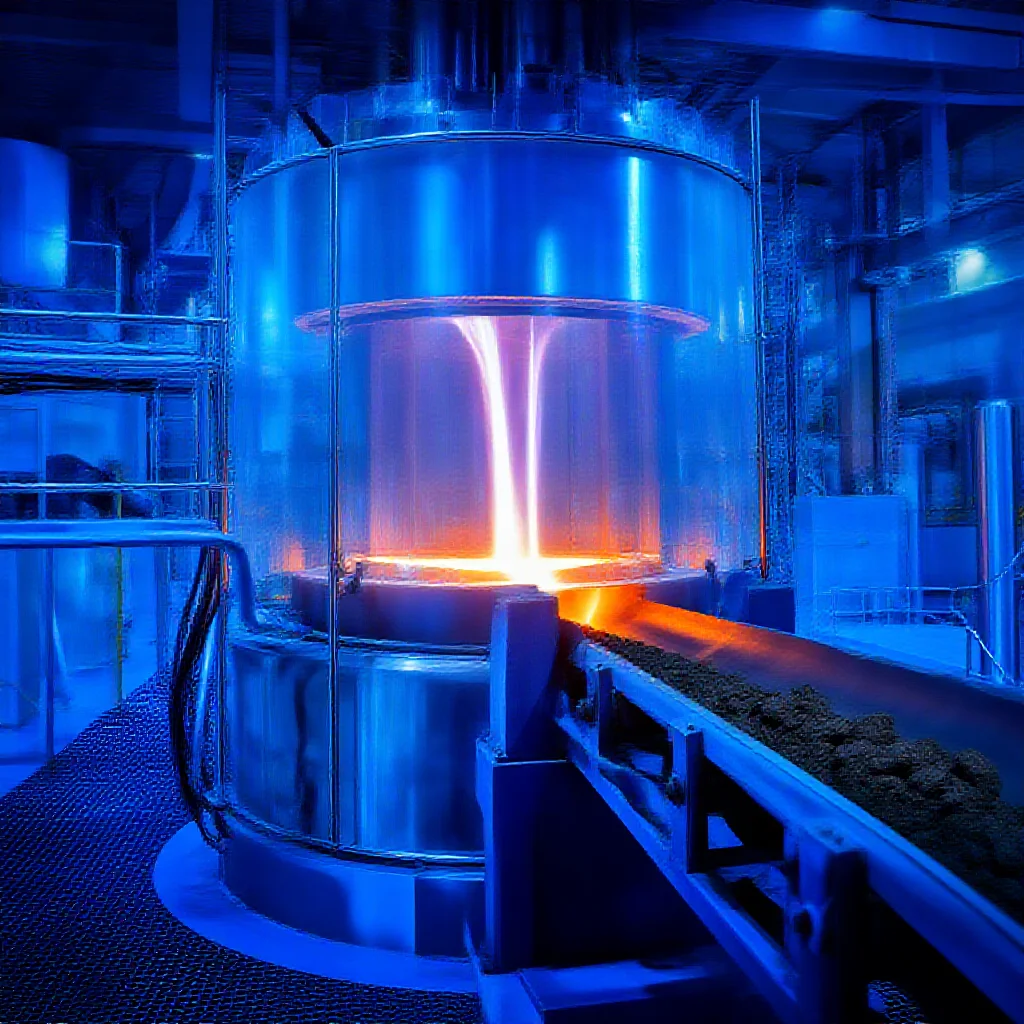
Radify has commissioned its first production-scale plasma reactor, a facility engineered to extract rare earth elements (REEs) from industrial waste streams. The company's stated operational target is to process 50,000 tons of waste material annually by 2027 (Source 1: [Primary Data]). This transition from pilot-scale validation to operational deployment represents a tangible step in altering the foundational economics of critical mineral supply.
Beyond the Headline: The Economic Logic of Waste-to-Weapon
The move from pilot to production is not merely a technical graduation; it is a significant capital commitment that signals investor confidence in the underlying unit economics. The core value proposition of this technology lies in its inversion of traditional resource economics: it transforms perpetual environmental liabilities—industrial waste requiring management and disposal—into a domestic, strategic asset.
The economic model shifts from the high-capital expenditure, geopolitically sensitive, and environmentally intensive process of primary mining to one centered on securing and processing waste feedstock. The announced target of processing 50,000 tons of waste annually by 2027 establishes a quantifiable metric for market impact. To contextualize this scale, it is necessary to compare the potential rare earth oxide output from this waste stream against the production volumes of established mining operations. While 50,000 tons of feedstock does not equate to 50,000 tons of rare earth oxides, the scale indicates an intent to move beyond niche application into meaningful market contribution.
Fast Analysis: Verifying the Production Readiness Claim
The term "production-scale" requires contextualization against industry benchmarks for rare earth processing. A full-scale separation plant, such as those operated by market leaders like Lynas or MP Materials, typically processes tens of thousands of tons of concentrated feedstock annually to produce thousands of tons of separated rare earth oxides.
Radify's 2027 target appears strategically timed and is consistent with the scaling challenges inherent in heavy industrial and chemical process technology. The timeline from first production reactor commissioning in the near term to the 50,000-ton capacity within approximately three years can be classified as aggressive yet plausible, assuming no significant technological or supply chain impediments. This pace mirrors the scaling trajectories seen in other capital-intensive resource sectors where pilot success leads to modular or phased commercial expansion.
The Deep Audit: Sovereignty, Security, and the Slow Unwinding of Dependence
The geopolitical implication of plasma recycling technology is its potential to alter the calculus of resource nationalism. Traditional supply chain security focuses on securing access to foreign ore deposits, a strategy fraught with political and trade vulnerabilities. This technology proposes a redefinition of resilience, shifting the strategic objective from "securing foreign mines" to "securing domestic waste streams." This decouples supply, at least partially, from geographical and geological constraints.
The long-term impact on the primary mining sector is analytical. The emergence of a significant, cost-competitive secondary source of REEs could establish a price ceiling for certain rare earths, potentially affecting the investment economics for new greenfield mining projects. It does not eliminate the need for primary mining, given growing total demand, but it introduces a new variable into market forecasts.
This technological pathway aligns with stated strategic goals in key economic regions. Reports from entities like the U.S. Department of Energy and the European Commission consistently emphasize circular economy principles and supply chain diversification as pillars of their critical material strategies. Radify's production-scale move represents a concrete step toward operationalizing those policy frameworks.
Neutral Market and Industry Predictions
The commissioning of this production-scale plasma reactor initiates a multi-year validation period for the economic and technical claims of waste-based REE extraction. Market impact will be a function of consistent operational performance, achieved output purity, and final production costs relative to incumbent sources.
Successful execution at the stated scale by 2027 would likely catalyze increased investment and competitive activity in the critical mineral recycling sector. It would provide a non-linear alternative for supply chain managers, potentially leading to more regionalized and resilient material flows for specific rare earth elements recoverable from targeted waste streams.
The technology's ultimate influence on global REE trade dynamics will be measured by its cumulative capacity growth over the next decade and its ability to reliably offset a measurable percentage of import demand in strategic markets. Its primary immediate effect is the introduction of a tangible, scalable variable into the long-term supply equation, offering a pathway to incrementally reduce absolute dependence on any single extraction geography.
(All rights reserved by Global Beacon Chronicle. Unauthorized reproduction is prohibited.)
Editorial Board / Editorial Board
Collective pseudonym for the Global Beacon Chronicle editors.