Revolutionizing Auto Repair: How MSXI’s Beacon Workshop Intelligence System
MSXI’s Beacon Workshop Intelligence System uses low-energy Bluetooth beacons

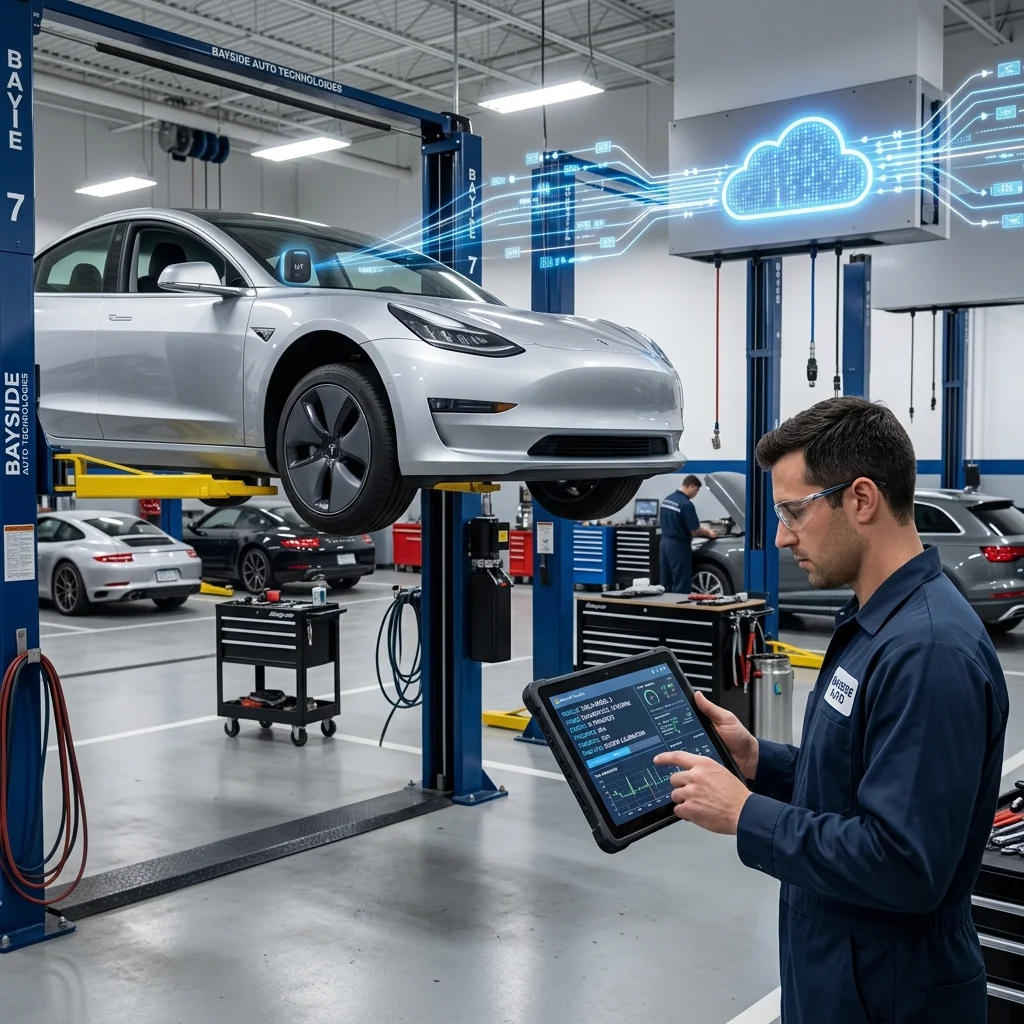
How MSXI's Beacon System Uses Bluetooth to Track Vehicle Repairs and Cut Delays
The auto repair industry has long operated under a frustrating asymmetry: customers drop off their vehicles and wait, often in the dark, for updates that rarely come until the work is done—or worse, when an unexpected delay arises. This transparency gap not only erodes trust but also creates inefficiencies that ripple through dealerships and original equipment manufacturers (OEMs). MSXI’s Beacon Workshop Intelligence System aims to close that gap using a networked approach of low-energy Bluetooth beacons and Wi-Fi gateways that feed real-time data into cloud-based analytics.
“Customers always ask, ‘How long will it take? Is it ready yet?’ and we haven’t had a good answer beyond a vague estimate,” says a service manager at a major dealership chain piloting the system. “Now they get an automated text the moment the car moves into inspection, when parts arrive, when the mechanic starts work—and when it’s done.” This level of visibility, enabled by Internet of Things (IoT) hardware, promises to reshape how repair shops communicate, how dealers manage workflow, and how OEMs sustain their fleets remotely.
[IMAGE: A frustrated customer at a dealership service counter, contrasted with a smartphone displaying a repair progress update.]
Hardware and Cloud Synergy: Inside the Beacon System
At the core of the Beacon system is a simple but robust hardware layer. Small, coin-sized Bluetooth low-energy beacons are placed inside vehicles—typically affixed to the windshield or under the dashboard—at check-in. These beacons broadcast a unique identifier via Bluetooth. Throughout the workshop, strategically installed Wi-Fi gateways with built-in Bluetooth scanners detect the beacons as vehicles move through different zones: parking lot, inspection bay, lift area, parts staging, and final quality check.
The gateways act as the system’s eyes, constantly scanning for beacon signals. When a vehicle enters a designated zone, the gateway logs a timestamped event and transmits that data via the existing Wi-Fi network to MSXI’s cloud-hosted software. The software processes the raw location data into a structured timeline of repair stages—from arrival to completion—with precise durations captured at each step.
This architecture avoids the complexity and cost of GPS or cellular tracking inside a workshop. Bluetooth beacons are inexpensive, passive devices that can run on a coin cell battery for over a year. The Wi-Fi gateways leverage the shop’s existing network infrastructure, reducing deployment friction. The entire system runs on the cloud, meaning updates and analytics are accessible from any internet-connected device without on-premise servers.
[IMAGE: Infographic showing a beacon inside a car, a gateway on the workshop ceiling, and arrows to a cloud icon labeled 'Workshop Intelligence System'.]
Three-Tier Value: Customers, Dealerships, OEMs
The Beacon system delivers differentiated value across three stakeholder groups, each with distinct pain points.
For Customers: Real-Time Text Updates and Instant Authorization
Once a vehicle is checked in and the beacon is attached, the system automatically sends the customer an SMS or text message confirming receipt and providing an estimated completion time based on historical production averages. As the vehicle progresses through each stage—inspection, diagnostics, repair, parts wait, final test—the customer receives an update. If additional work is identified, the system can trigger a digital notification asking for authorization, with options to approve, decline, or request a call. This eliminates the typical back-and-forth phone tag and reduces the time a vehicle sits idle waiting for customer approval.
For Dealerships: Live Vehicle Status and Production Benchmarking
Service advisors and managers see a dashboard showing every vehicle’s current status in real time. The system automatically calculates how long each vehicle has been in a given stage and flags any that exceed expected thresholds. Production averages across all vehicles help managers spot bottlenecks—for example, if technicians consistently spend 40% longer on oil changes than the industry benchmark. Department-level metrics allow comparison between shifts, individual technicians, and even individual bays.
“Before, we had to walk the floor and ask each tech where they were,” notes the service manager. “Now I see the whole floor on a single screen. If a car has been in the parts staging area for 45 minutes, I know to check with the parts counter before the tech even tells me.” The system also supports historical trend analysis, enabling dealers to plan staffing, capacity, and parts inventory based on real usage patterns rather than guesswork.
For OEMs: Fleet Sustainment and Remote Benchmarking
For automotive OEMs, particularly those with large commercial fleets or service networks, the Beacon system provides a window into dealership operations that was previously opaque. The cloud platform can aggregate data across multiple dealerships, comparing production times, common bottlenecks, and repair stage durations. OEMs receive alerts when a vehicle is off-road for longer than a predefined threshold, enabling proactive intervention—such as dispatching a mobile repair unit or arranging a loaner vehicle.
Remote sustainment capabilities allow OEM engineers to analyze whether a particular repair pattern (e.g., repeated transmission replacements) correlates with dealership-specific delays, tool availability, or technician training gaps. This data-driven approach shifts OEM sustainment from reactive warranty management to predictive problem-solving.
[IMAGE: Split graphic: left side shows a customer phone with a text message, center shows dealership dashboard with metrics, right shows OEM analytics screen.]
Deep Dive: Operational Insights and Bottleneck Analysis
The real power of the Beacon system lies not just in tracking, but in the analytics that emerge from aggregated, time-stamped data. The cloud software processes millions of beacon events to build a granular picture of workshop operations.
Identifying Bottlenecks
By capturing the exact time a vehicle enters and exits each stage, the system can calculate stage-specific wait times. For example, if inspection takes an average of 18 minutes but the standard is 12 minutes, the software flags inspection as a bottleneck. Digging deeper, the system can correlate that delay with specific technicians, shifts, or even the time of day—revealing that inspection stalls every morning between 9:00 and 9:30 when the service advisor is busy with intake calls. This level of specificity allows managers to address root causes rather than symptoms.
Production Benchmarking
With historical data accumulated over weeks or months, dealers can benchmark their own performance against aggregated industry averages. A dealership that consistently completes brake jobs 30% faster than the network benchmark can share best practices. Conversely, a shop that lags on transmission repairs can investigate whether it lacks proper equipment, training, or parts stocking. OEMs can use this benchmarking to set realistic warranty labor times and to identify dealerships that may need support.
Predictive Maintenance Potential
Beyond real-time tracking, the system’s data history opens the door to predictive maintenance. If a specific vehicle model consistently spends an extra hour in the “parts wait” stage for a particular repair, the dealer can pre-stock those parts before the next similar job arrives. Over time, the system can even predict which repairs are likely to require additional waiting based on part availability trends, weather patterns, or seasonal demand.
[IMAGE: A bar chart showing average time per repair stage (e.g., inspection, parts wait, labor) with a highlighted bottleneck.]
Emerging Trends and Industry Implications
The Beacon system sits at the intersection of several converging trends in the automotive aftermarket.
IoT-Driven Transparency as a Competitive Differentiator
As consumers become accustomed to real-time tracking in other industries—package delivery, food ordering, ride-hailing—they increasingly expect the same from auto repair. Dealerships that can offer live repair status updates via text are gaining a competitive edge over independent shops that still rely on phone calls. Early adopters report higher customer satisfaction scores and reduced inbound calls to the service desk.
Data-Driven Operations Beyond the Floor
The insights generated by the Beacon system are not limited to the repair bay. Dealers are beginning to integrate the data with their parts inventory systems, customer relationship management platforms, and workforce scheduling tools. For example, if the system predicts that the next three vehicles in line are for oil changes that require a specific filter, the parts clerk can pre-stage those filters before the vehicles arrive on the lift. This reduces idle time and improves parts turnover.
A Deep Entry Point for OEM Integration
Perhaps the most strategic implication is the Beacon system’s potential as an integration layer between OEMs and their dealer networks. By providing a standardized data feed on vehicle repair progress, OEMs can unify disparate dealership information systems into a single analytics platform. This enables fleet managers to optimize vehicle downtime across an entire region, warranty administrators to detect fraud patterns, and product engineers to gather real-world repair data.
“We see this as a foundational technology,” says a product manager at MSXI. “Once the infrastructure is in place—beacons, gateways, cloud software—it becomes a platform for additional services, from automated customer feedback collection to dynamic pricing of repairs based on real-time capacity.”
[IMAGE: A diagram showing data flow from workshop beacons → gateways → cloud → OEM systems, with arrows indicating feedback loops for inventory and scheduling.]
Conclusion: A Window into the Workshop
The MSXI Beacon Workshop Intelligence System represents a practical, scalable approach to solving one of the most persistent pain points in auto repair: the lack of transparency. By combining low-cost Bluetooth beacons with existing Wi-Fi infrastructure and cloud analytics, it gives customers the real-time updates they want, dealers the operational visibility they need, and OEMs the data they require for remote sustainment.
As the automotive aftermarket continues to digitize, systems like Beacon will likely become standard equipment—not just for large dealership chains, but for independent shops seeking to compete on service quality. The technology is not revolutionary in the sense of a breakthrough invention; rather, it is evolutionary, applying proven IoT principles to a sector that has long been analog. In doing so, it is quietly transforming the repair experience from a black box into a transparent, data-rich process that benefits everyone involved.
(All rights reserved by Global Beacon Chronicle. Unauthorized reproduction is prohibited.)
Editorial Board / Editorial Board
Collective pseudonym for the Global Beacon Chronicle editors.