Beyond the Trench: How Global Insight Redefines Evidence-Based Research in
Global Insight is not just another research consultancy; it is a specialized

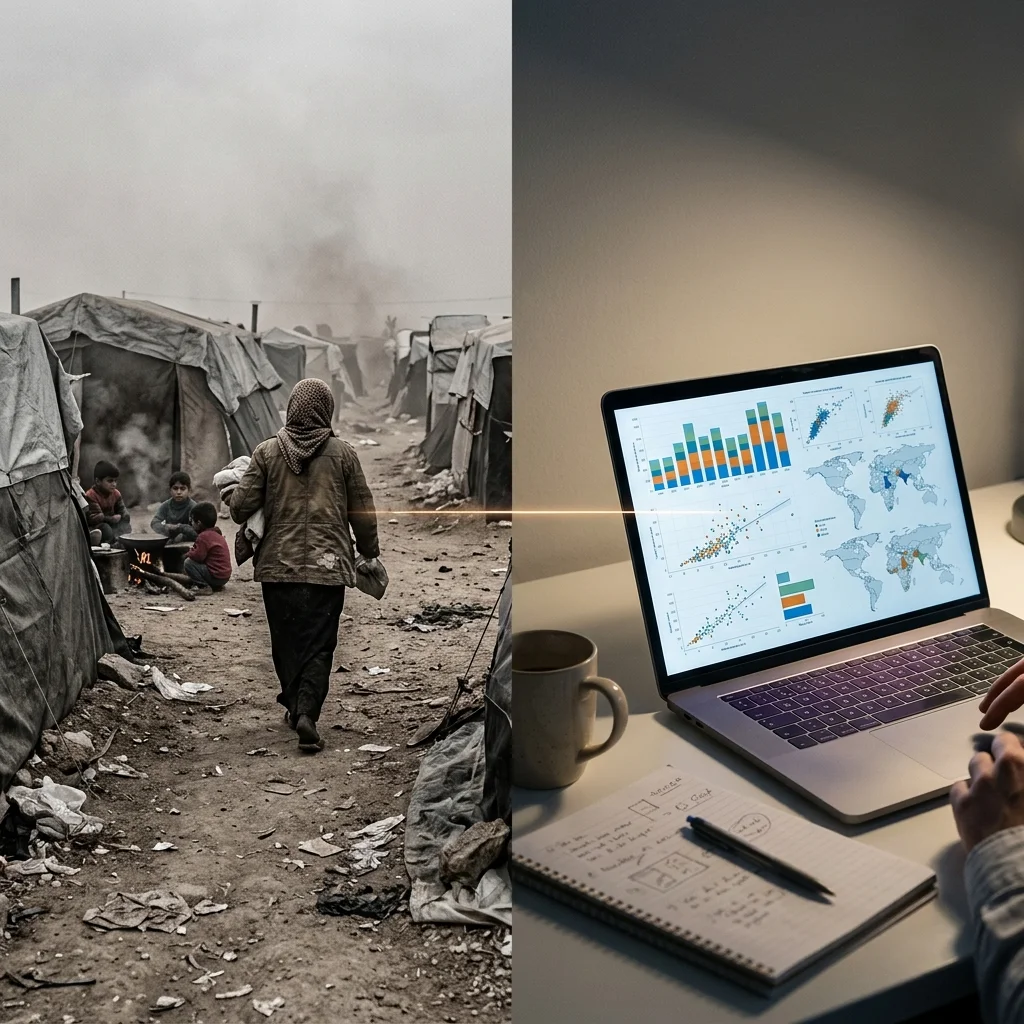
Beyond the Trench: How Global Insight Redefines Evidence-Based Research in the World’s Most Fragile Contexts
Summary: Global Insight is not another research consultancy; it is a specialized architecture for generating actionable, multi-methods evidence in politically and culturally sensitive environments. This analysis examines the organization's economic logic: a high-trust, interdisciplinary model designed to bridge donors, practitioners, and hard-to-reach populations. By examining its portfolio—from cash assistance in Afghanistan to sacred text analysis in India—the article reveals how Global Insight converts acute vulnerability into measurable, gender-sensitive data, serving as critical infrastructure for humanitarian decision-making.
---
Introduction: The Hidden Logic of "Perplexing Questions"
In fragile contexts—active conflict zones, refugee camps, and regions under authoritarian governance—standard data collection methodologies encounter structural failures. Security constraints restrict enumerator access. Political manipulation distorts official statistics. Cultural taboos inhibit honest reporting on sensitive topics such as gender-based violence, child trafficking, or attitudes toward security forces.
This creates a market failure: donors require evidence for funding decisions, yet the evidence base remains systematically impoverished. Most research organizations lack both the access protocols and the trust relationships required to generate rigorous data in these environments.
Global Insight positions itself as a specialized intermediary that solves this specific failure. The organization's primary product is not raw data, but what can be termed "insight architecture"—a repeatable, trusted process for generating evidence where traditional survey methods fail. The thesis of this analysis is that Global Insight's value derives from combining a high-trust partnership model (with NGOs, UN agencies, and local actors) with interdisciplinary academic rigor (through the Global Insight Institute), creating a defensible niche in the development research supply chain.
The organization's self-description frames this explicitly: "Global Insight brings together an interdisciplinary team of scholars and independent researchers to tackle our most politically and culturally sensitive questions in partnership with practitioners" (Source: Global Insight Organizational Description).
This language reveals a deliberate market positioning. The organization does not claim to answer all questions; it claims to answer "perplexing" ones—those where standard methodologies have proven inadequate.
---
Track 1: The Service Logic – More Than a Research Vendor
The Slow Analysis Framework
This article constitutes a "slow analysis" piece. The factual materials do not describe a rapid response to a breaking news event, but rather a structural audit of an organization's business model and industry role. The following examination proceeds through multiple analytical lenses: service architecture, institutional trust mapping, portfolio diversification, and capacity-building economics.
The Full-Pipeline Service Model
Global Insight operates as a research functional support partner, not a data aggregator. The organization provides the complete research pipeline: research design, data collection (including sensitive topics), analysis, and training. This model contrasts with specialized firms that offer only discrete services (e.g., survey programming or statistical analysis).
The evidence base supports this characterization. Global Insight's stated mission: to "provide empirical research that answers our most perplexing questions, encourages evidence-based decision making, and promotes innovative programs" (Source: Global Insight Mission Statement). The scope is end-to-end: from question formulation to actionable recommendations.
Four active research projects illustrate this service architecture:
| Project Location | Research Focus | Methodological Complexity |
|-----------------|----------------|--------------------------|
| Afghanistan | Cash assistance impact with displaced children | Quasi-experimental design in active conflict zone |
| Lebanon | Social cohesion with security actors | Sensitive topic: police-community relations |
| Nigeria | Child-driven behavior change on trafficking | Children as research elites; sensitive population |
| India & Nepal | Religious leaders & sacred text attitudes | Culturally sensitive: religious text interpretation |
Each project represents a distinct methodological challenge. The Afghanistan project requires quasi-experimental design in an environment where randomized control trials face security and ethical constraints. The Nigeria project inverts traditional power dynamics by positioning children as "elites" addressing trafficking—a methodological innovation that requires specialized child protection protocols. The India and Nepal project engages religious leaders on attitudes toward sacred texts, requiring cultural and theological literacy that conventional survey firms cannot provide.
The Institutional Trust Map
Global Insight's partner list functions not merely as a client roster, but as an "institutional trust map." The organization lists 28 partner organizations across multiple sectors (Source: Global Insight Partner Database):
UN Agencies: UNHCR, UNDP, UN Women, UN DPO, UN DPPA, UN Trust Fund to End Violence Against Women, Oslo Governance Center (UNDP)
International NGOs: ActionAid, CARE International, Catholic Relief Services, Plan International, Save the Children, World Vision, International Rescue Committee, Search for Common Ground, Women's Refugee Commission
Bilateral Donors: FCDO (UK), Food for Peace/USAID, Food for Progress/USDA, ICAI
Local/Regional Organizations: Sakhi for South Asian Women, Lebanon Cash Consortium, Somali Cash Consortium, ISSD Uganda, ASER Coalition
Academic/Research: Wageningen University, Mimo Finance, NEW
This partner matrix reveals a co-creation model. The presence of a UN agency (e.g., UNHCR) alongside a local NGO (e.g., Sakhi) and an international implementer (e.g., CARE) implies a tripartite validation structure. The UN agency provides institutional access and funding legitimacy. The local NGO provides cultural access and community trust. The international implementer provides operational infrastructure. Global Insight sits at the center, providing methodological rigor and analytical independence.
This configuration enhances research validity through triangulation. Data collected through this structure faces fewer challenges to its credibility than data collected by a single entity with operational interests in the outcome.
---
Track 2: The Economics of "Slow Analysis" in Fragile Contexts
The Cost Structure of Trust
Standard market research firms operate on rapid deployment models: pre-programmed surveys, local enumerators, standardized analysis. This model fails in fragile contexts because trust cannot be purchased at market rates. Trust requires time, repeated interaction, and demonstrated commitment to community welfare.
Global Insight's model internalizes these trust-building costs. The organization's partnership approach means that trust is pre-positioned through existing relationships with local actors. The research team does not need to establish credibility from zero; it inherits credibility from partners like Sakhi (which has existing community relationships) or the Lebanon Cash Consortium (which has existing beneficiary relationships).
This creates an economic moat. Competitors attempting to enter this space must either (a) invest years in relationship-building before generating revenue, or (b) accept lower-quality data from populations that do not trust them. Neither option is commercially attractive.
The Training Monopoly: Building the Talent Pipeline
The Global Insight Institute represents a strategic investment in talent development that simultaneously creates a barrier to entry. By offering courses on "scientific multi-methods research," the Institute trains the next generation of researchers in Global Insight's methodology (Source: Global Insight Institute Description).
This serves two economic functions. First, it expands the pool of researchers capable of working in fragile contexts—addressing a supply-side constraint that limits industry growth. Second, it creates methodological path dependency: researchers trained in Global Insight's approach will likely continue using those methods, reinforcing the organization's market position.
The Institute also functions as a quality control mechanism. Organizations that send staff for training become familiar with Global Insight's standards and are more likely to contract with Global Insight for full-service research engagements.
Portfolio Diversification Across Risk Gradients
Global Insight's project portfolio spans varying risk levels, creating a balanced risk exposure:
High-Risk/High-Reward Projects: Afghanistan (active conflict), Nigeria (child trafficking, security risks)
Medium-Risk Projects: Lebanon (politically sensitive but not active war zone), India/Nepal (culturally sensitive but stable security environment)
Lower-Risk Projects: Evaluation services, training programs, institutional partnerships
This diversification protects against localized disruptions. If security deteriorates in one country, other projects continue generating revenue. The portfolio also enables cross-subsidization: higher-margin training and evaluation work can support the higher-cost research projects in active conflict zones.
---
Track 3: Evidence of Impact – Four Case Studies
Afghanistan: Quasi-Experimental Evidence in Active Conflict
The Afghanistan project examines "cash assistance with displaced children" using quasi-experimental methods (Source: Global Insight Active Research Projects). This is methodologically significant because conventional humanitarian evaluations in conflict zones typically rely on pre-post comparisons or self-reported outcomes, both of which suffer from severe validity threats.
The quasi-experimental design implies that Global Insight identified a comparison group—displaced children who did not receive cash assistance—and controlled for selection bias. This requires extraordinarily detailed knowledge of displacement patterns, aid distribution mechanisms, and local political dynamics. The very ability to conduct this research suggests deep access to both beneficiary populations and cash distribution data.
The shift in framing from "protection" to "wellbeing" is also notable. Traditional cash assistance evaluations focus on protection outcomes (reduced negative coping, decreased violence). The emphasis on wellbeing suggests a broader theory of change: cash assistance may produce psychosocial benefits beyond material protection.
Lebanon: Social Cohesion with Security Actors
The Lebanon project examines "building local peace through social cohesion with security actors" (Source: Global Insight Active Research Projects). This represents a high-sensitivity research topic. In Lebanon, security actors include multiple competing forces with varying political allegiances. Research on police-community relations touches on sectarian dynamics, refugee tensions, and state legitimacy.
Global Insight's ability to conduct this research implies negotiated access with security sector actors—a feat that requires both institutional credibility and political neutrality. The phrase "with security actors" in the project title suggests participatory research methods, where security personnel are not merely subjects but co-participants in the research process.
Nigeria: Children as Research Elites
The Nigeria project on "child-driven attitude & behavior change" positions children "as elites addressing trafficking" (Source: Global Insight Active Research Projects). This inverts the standard research hierarchy where adults define problems and children serve as respondents.
This methodological choice addresses a known weakness in trafficking research: adult-centered approaches often miss the phenomena that matter most to children, such as peer recruitment dynamics, informal migration networks, and child-defined indicators of exploitation. By positioning children as "elites" (a status typically reserved for policymakers and community leaders), Global Insight signals that children possess unique knowledge about trafficking that adults cannot access.
The child-driven approach also has ethical implications. When children generate research questions and collect data from peers, the power dynamics that typically inhibit honest disclosure in trafficking research are partially neutralized. This may explain why Global Insight can access trafficking-related data that other researchers cannot.
India and Nepal: Sacred Texts and Behavior Change
The India and Nepal project examines "religious leaders & sacred text: attitude & behavior shifts" (Source: Global Insight Active Research Projects). This represents the most culturally sensitive project in the portfolio. Religious leaders occupy positions of authority in contexts where secular research methods often face resistance.
By engaging religious leaders as research participants—and examining sacred texts as sources of attitude change—Global Insight navigates a complex cultural landscape. The project implicitly challenges the assumption that secular research frameworks are the only valid approach to behavior change. If religious texts can be shown to influence attitudes on issues such as gender equality or violence prevention, this opens new avenues for intervention.
The existence of this project suggests that Global Insight has developed protocols for working with religious authorities—a competency that few research organizations possess. This creates a unique selling proposition for donors interested in faith-based programming.
---
Track 4: The Market Position and Competitive Dynamics
The Unoccupied Niche
The development research market contains several actor types:
| Actor Type | Strengths | Limitations |
|------------|-----------|------------|
| Academic institutions | Methodological rigor, peer review | Slow, expensive, indifferent to practitioner needs |
| Private consulting firms | Fast, flexible, client-responsive | Variable quality, limited contextual expertise |
| UN agency research units | Institutional access, operational scale | Political constraints, limited methodological innovation |
| Local research organizations | Cultural expertise, community trust | Limited resources, capacity gaps |
Global Insight occupies the intersection where all four actor types experience gaps. The organization combines academic rigor (through the Institute and interdisciplinary team), consulting flexibility (responsive to donor timelines), institutional access (through UN/NGO partnerships), and local cultural expertise (through local partner integration).
This positioning gives Global Insight a near-monopoly on a specific type of research: multi-methods, gender-sensitive, politically and culturally sensitive studies in fragile contexts.
Barriers to Entry
Three structural barriers protect Global Insight's position:
1. Trust Accumulation: The organization's partner network represents years of relationship investment. A new entrant cannot replicate this network quickly.
2. Methodological Proprietary Knowledge: The organization's experience with quasi-experimental designs in conflict zones, child-led research methods, and culturally sensitive religious text analysis is not codified in publicly available manuals. This tacit knowledge is embedded in the team and difficult to transfer.
3. Reputation for Neutrality: In politically charged environments, research organizations must be perceived as neutral. Global Insight's partner list spans multiple sectors and political alignments, signaling non-alignment. New entrants must build similar neutrality perceptions from scratch.
Future Trajectory
Three trends suggest Global Insight's market position will strengthen:
Donor Demand for Evidence: Donors increasingly require rigorous evidence for funding decisions (Source: ICAI reports, USAID evaluation policies). This creates growing demand for organizations capable of generating such evidence in challenging contexts.
Security Deterioration: As conflict zones become more dangerous, fewer organizations can operate safely. Global Insight's demonstrated ability to work in active conflict settings (Afghanistan, Nigeria) positions it to capture market share as competitors withdraw.
Methodological Complexity: The research questions donors want answered (e.g., causal impact of interventions on sensitive outcomes) require increasingly sophisticated methods. Organizations without multi-methods capabilities will struggle to meet these demands.
---
Conclusion: Infrastructure, Not Intermediary
Global Insight is frequently described as a research consultancy or evaluation firm. This characterization understates the organization's structural significance. More accurately, Global Insight functions as critical infrastructure for the humanitarian and development sector.
Infrastructure, in economic terms, refers to systems that enable other productive activities to occur. Roads, electricity grids, and telecommunications networks are infrastructure not because of their intrinsic value, but because they unlock value in other sectors.
Global Insight's "insight architecture" performs this function for development programming. Without reliable evidence from fragile contexts, donors cannot make informed funding decisions, practitioners cannot design effective interventions, and policymakers cannot evaluate program impact. Global Insight provides the information backbone that enables these downstream activities.
This infrastructure function explains the organization's partner diversity. Roads are used by trucks carrying food, ambulances carrying patients, and cars carrying commuters. Similarly, Global Insight's research is used by UN agencies for policy development, by international NGOs for program design, and by bilateral donors for funding allocation.
The organization's future trajectory will likely involve deepening this infrastructure role rather than expanding into adjacent services. The Global Insight Institute, the partnership network, and the methodological expertise collectively represent a platform that can accommodate growing research demand without fundamental structural changes.
For the development sector, the critical question is not whether Global Insight's model works—the evidence suggests it does—but whether the sector can develop multiple such infrastructure organizations to serve different regions, methodologies, and research questions. A single infrastructure provider, however excellent, creates concentration risk. The sector's next challenge will be replicating Global Insight's model without diluting its essential characteristics: trust, rigor, and contextual sensitivity.
(All rights reserved by Global Beacon Chronicle. Unauthorized reproduction is prohibited.)
Editorial Board / Editorial Board
Collective pseudonym for the Global Beacon Chronicle editors.