Beacon Market 2026–2031: Inside the $231 Billion Opportunity, Technology Shifts,
The global beacon market was valued at $1.36 billion in 2018 and is projected

Beacon Market 2026–2031: Inside the $231 Billion Opportunity, Technology Shifts, and Strategic Implications
Introduction: The Beacon Boom – Beyond the Billions
The global beacon market was valued at $1.36 billion in 2018 and is projected to surge to $31.61 billion by 2026 and $231.36 billion by 2031, representing a compound annual growth rate (CAGR) of 48.9%. These numbers, while staggering, only hint at a deeper transformation. Beacons — small, low-power wireless transmitters that broadcast signals to nearby smart devices — are no longer a niche technology confined to museum audio guides or retail coupon experiments. They are evolving into the backbone of proximity marketing, indoor navigation, and IoT asset tracking across airports, hospitals, factories, shopping malls, and smart buildings.
This article goes beyond the headline growth figures to audit the beacon ecosystem systematically. How does a 48.9% CAGR redistribute economic value among hardware makers, software platform owners, and connectivity providers? What does the fact that North America held 43.38% of the market in 2018 reveal about regional innovation clusters and policy environments? And as Bluetooth Low Energy (BLE) chips become commodity items, where will the next profit pools emerge?
[IMAGE: A timeline-graph showing market size bars from 2018 to 2031, with an arrow highlighting the exponential curve from $1.36B to $231B.]
The Hidden Economic Logic: Value Migration from Hardware to Platforms
The beacon market is commonly segmented into three layers: hardware (the physical beacon tags), platform/SDK (software stacks that process signals and deliver applications), and connectivity (BLE, Wi-Fi, hybrid, and other protocols). A 48.9% CAGR implies rapid adoption across all three, but not all layers capture margin equally.
Hardware Commoditization Is Underway
In 2018, a single BLE beacon tag cost between $5 and $25 depending on battery life, casing, and certification. By 2023, mass production of Bluetooth chips — driven by suppliers such as Nordic Semiconductor, Texas Instruments, and Dialog Semiconductor — pushed unit prices below $5 for standard models. The trend will continue. As beacon hardware becomes a low-margin commodity, the economic center of gravity shifts upward.
Platform SDKs and Data Analytics Capture the Premium
Apple’s iBeacon and Google’s Eddystone are not hardware products; they are open protocols that define how devices listen for and interpret beacon signals. Both companies monetize through ecosystem lock-in: iBeacon integrates natively into iOS (Core Location framework), while Eddystone supports Android’s Nearby API. The real value lies in the software middleware that sits above these protocols — platforms that offer real-time location analytics, geofencing, customer engagement workflows, and multi-venue management.
Evidence from industry revenue reports shows that platform/SDK licensing fees ($10–$100 per beacon per year) already account for a larger share of total market revenue than hardware sales in many verticals. As beacon deployments scale from hundreds to tens of thousands of units per venue, the incremental cost of software licensing is near zero, yielding high gross margins for platform providers.
Supply Chain Implications
For chip manufacturers, volume growth will compensate for margin compression — but only up to a point. Nordic Semiconductor, for example, reported record BLE chip shipments in 2022 but declining average selling prices. Meanwhile, cloud-platform providers such as AWS, Microsoft Azure, and independent location intelligence firms (e.g., Estimote, Kontakt.io) are positioning themselves to capture the recurring revenue stream. The strategic implication: companies that once competed on hardware specs are now racing to build sticky software ecosystems.
[IMAGE: A value chain diagram showing hardware (<$5/unit) to platform/SDK ($10-100/unit annual license) to data services, with arrows showing where margin concentrates.]
Connectivity Wars: BLE, Wi-Fi, Hybrid – and the Rise of High-Precision Indoor Positioning
The connectivity segment of the beacon market is categorized into BLE, Wi-Fi, hybrid, and others. Each technology offers different trade-offs in power consumption, range, accuracy, and infrastructure cost.
BLE Dominance and Its Limits
BLE has become the default choice for most beacon deployments due to its ultra-low power consumption (battery life of 1–5 years), low chip cost, and extensive smartphone support. However, BLE’s range is typically limited to 10–50 meters, and its accuracy in dense indoor environments can degrade due to signal interference from metal structures and crowd movement.
Wi-Fi as a Complementary Backbone
Wi-Fi offers larger range (up to 100 meters) and leverages existing enterprise wireless infrastructure. The trade-off is higher power draw and less precise positioning (typically 5–15 meters versus BLE’s 1–3 meters in optimized setups). For large-scale deployments — airports, convention centers, hospitals — a Wi-Fi backbone with BLE beacons for fine-grained location is becoming a common hybrid architecture.
Hybrid Solutions: The Narita Airport Case Study
In October 2018, Nippon Telegraph and Telephone Corporation (NTT Corp) and GiPStech installed high-precision indoor positioning beacons at Narita Airport, Tokyo. The system combined BLE beacons with Wi-Fi fingerprinting and proprietary algorithms from GiPStech to achieve sub-meter accuracy in one of the world’s busiest transit hubs. Passengers could navigate gate-to-gate with turn-by-turn directions on their smartphones, receive real-time flight updates when near specific zones, and locate retail outlets within seconds.
This deployment illustrates the future direction: pure BLE is sufficient for basic proximity (e.g., coupon delivery when near a store), but high-value use cases — indoor navigation for visually impaired passengers, asset tracking for airport baggage handling, and autonomous robot navigation — demand hybrid connectivity and advanced signal processing.
[IMAGE: A photo or illustration of Narita Airport terminal with annotated beacon locations on walls/ceilings, showing how BLE and Wi-Fi nodes overlap.]
Protocol Standards and Ecosystem Politics: iBeacon vs. Eddystone
The beacon technology landscape has been shaped by two dominant protocol specifications: Apple’s iBeacon (launched in 2013) and Google’s Eddystone (launched in 2015, later merged into Google’s Nearby Connections). The technical differences are minor — both use BLE advertising packets — but the strategic implications are profound.
iBeacon’s First-Mover Advantage
Apple’s iBeacon protocol was implemented natively in iOS 7, giving it immediate access to hundreds of millions of devices. Retailers, museums, and stadiums adopted iBeacon-compatible beacons rapidly because no app-side code was needed for basic ranging. This locked developers into Apple’s Core Location framework, which controls beacon monitoring, ranging, and region events. The result: any solution built on iBeacon is tightly coupled to iOS, and by extension, to Apple’s App Store policies and privacy rules.
Eddystone’s Open but Less Penetrant Approach
Google designed Eddystone to be platform-agnostic, supporting both Android and iOS through third-party libraries. It introduced a “Ephemeral ID” feature for privacy, allowing beacon broadcasts to change periodically so that only authorized services could decode them. However, Eddystone never achieved the same native integration depth on Android as iBeacon did on iOS. Google’s shift to Nearby Connections in 2018 effectively deprecated standalone Eddystone support, creating fragmentation.
Impact on Supply Chains and Standards
Hardware manufacturers must decide whether to produce beacons that broadcast only one protocol or both. Most modern beacon chips (e.g., Nordic nRF52840) support simultaneous advertisement of iBeacon and Eddystone frames, but the software stack that processes them still diverges. Procurement teams at enterprises deploying beacons must consider: if a venue expects to serve both iPhone and Android users equally, they need a middleware platform that normalizes the two protocols — adding cost and complexity.
A longer-term trend is the emergence of open standards like the Bluetooth SIG’s “Direction Finding” feature (specified in Bluetooth 5.1) and the upcoming “High Accuracy Distance Measurement” (HADM) spec. These could reduce dependency on proprietary protocols, but the installed base of iBeacon will remain dominant through 2031 simply because of installed iOS devices.
[IMAGE: A side-by-side infographic comparing iBeacon and Eddystone packet formats, ecosystem compatibility, and privacy features.]
Regional Dynamics: North America’s 43.38% Share and What It Reveals
In 2018, North America accounted for 43.38% of the global beacon market. This dominance is not accidental. Several structural factors explain why the region leads:
- Early adopter retail ecosystem: Major US retailers (Walmart, Macy’s, Target) piloted beacon-based proximity marketing as early as 2014–2015, generating a wealth of use-case data.
- Airport modernization: The US Federal Aviation Administration (FAA) and airport authorities invested in indoor positioning for passenger flow management, with notable projects at Dallas/Fort Worth, Atlanta Hartsfield-Jackson, and Las Vegas McCarran.
- Venture capital concentration: Beacon startups such as Estimote, BlueCats, and Swirl Networks were founded in North America and raised over $100 million combined before 2020.
- Policy environment: Privacy regulations in North America (especially Canada’s PIPEDA and US state-level laws) allowed opt-in beacon marketing, whereas the EU’s GDPR imposed stricter consent requirements that slowed adoption in Europe.
Implications for Other Regions
The early lead of North America means its beacon infrastructure is more fragmented — dozens of legacy protocols and vendor lock-ins. As the market expands to Asia-Pacific and Europe (each projected to grow at CAGRs exceeding 45%), these regions have the opportunity to leapfrog to newer standards (Bluetooth 5.1 direction finding, hybrid Wi-Fi+BLE) and cloud-native platform architectures. China, in particular, is deploying beacons at massive scale for smart city projects, with companies like Shenzhen-based Blueiot offering low-cost hardware.
[IMAGE: A world map heatmap showing beacon market share by region (North America, Europe, Asia-Pacific, Rest of World) with 2018 percentages and projected 2031 shares.]
Emerging Trends and Strategic Implications for 2026–2031
1. From Proximity Marketing to Operational Intelligence
The earliest beacon applications focused on pushing coupons and notifications. The next wave uses real-time location data to optimize workflows: tracking hospital equipment, monitoring production line bottlenecks, managing warehouse inventory. This operational intelligence market is less sensitive to privacy constraints because the data is machine-to-machine, not consumer-facing.
2. Bluetooth 5.x and the End of Battery Worries
With Bluetooth 5.0 and 5.1, beacons can achieve ranges of 200+ meters (line-of-sight) and support angle-of-arrival (AoA) positioning for sub-meter accuracy. Battery life for a typical beacon now reaches 5–7 years, reducing total cost of ownership dramatically. By 2030, energy-harvesting beacons (solar, thermal, vibration) may eliminate batteries entirely for some use cases.
3. Edge Computing and On-Device Processing
The SDK platforms are pushing processing from cloud servers to smartphones and edge gateways. Apple’s ARKit and Google’s ARCore already fuse beacon signals with camera data for indoor AR navigation. This on-device approach reduces latency, preserves privacy, and lowers cloud costs — making beacon deployments more scalable.
4. Standards Consolidation or Fragmentation?
The Bluetooth SIG’s Direction Finding working group aims to create a universal standard for indoor positioning. If adopted widely, it could diminish the role of proprietary protocols like iBeacon. However, Apple has historically resisted commoditizing its ecosystem advantages. The outcome of this tension will determine whether the beacon market consolidates around a single open standard or remains a patchwork of protocol suites.
5. Supply Chain Resilience for Beacon Hardware
The COVID-19 pandemic exposed the vulnerability of semiconductor supply chains. Beacon chip lead times extended to 30+ weeks in 2021–2022. As the market approaches $231 billion, hardware manufacturers will need to diversify sourcing and invest in regional fabrication capacity. China’s dominance in BLE chip assembly (over 60% of global volume) introduces geopolitical risk for North American and European deployments.
Conclusion: The $231 Billion Question – Who Owns the Location Layer?
The beacon market’s trajectory from $1.36 billion to $231.36 billion over 13 years is not just a growth story — it is a story of value migration. Hardware becomes cheap and interchangeable; protocols become gatekeepers; platforms become the profit centers. The companies that will thrive in 2031 are not those that sell the most beacons, but those that control the middleware that turns location signals into actionable insights.
For supply chain managers, the call to action is clear: choose hardware that supports multiple protocols, invest in a platform that abstracts the connectivity layer, and plan for hybrid BLE+Wi-Fi deployments to future-proof against evolving standards. For policymakers, the dominance of iBeacon raises questions about digital sovereignty and interoperability. The beacon boom is here, but its spoils will go to those who understand that the real battle is not about signals — it is about the software that interprets them.
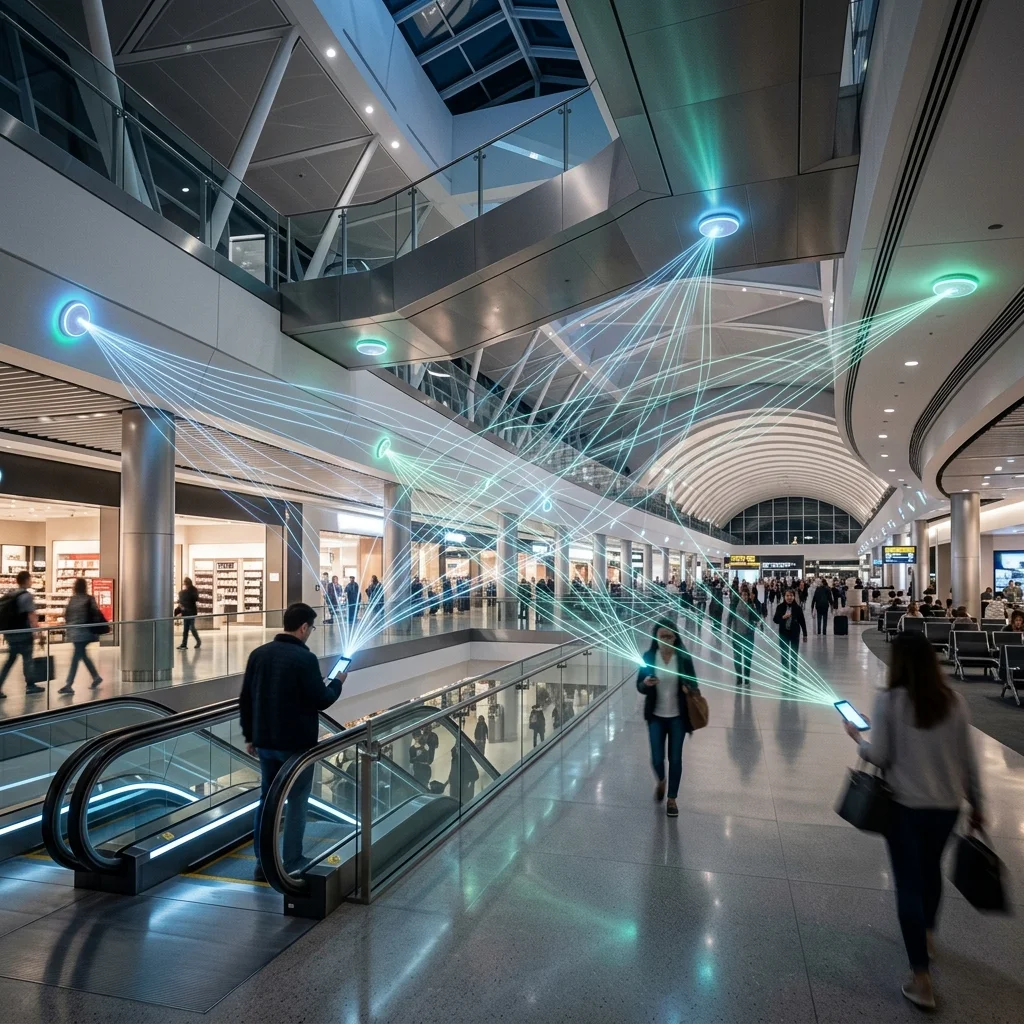
[IMAGE: A futuristic indoor space like a large airport terminal or retail mall, with subtle glowing blue or green beacon signals radiating from small devices on walls and ceilings, showing invisible location-based data streams connecting to smartphones. Soft illumination, no text or watermark, high-tech yet clean aesthetic.]
(All rights reserved by Global Beacon Chronicle. Unauthorized reproduction is prohibited.)
Editorial Board / Editorial Board
Collective pseudonym for the Global Beacon Chronicle editors.